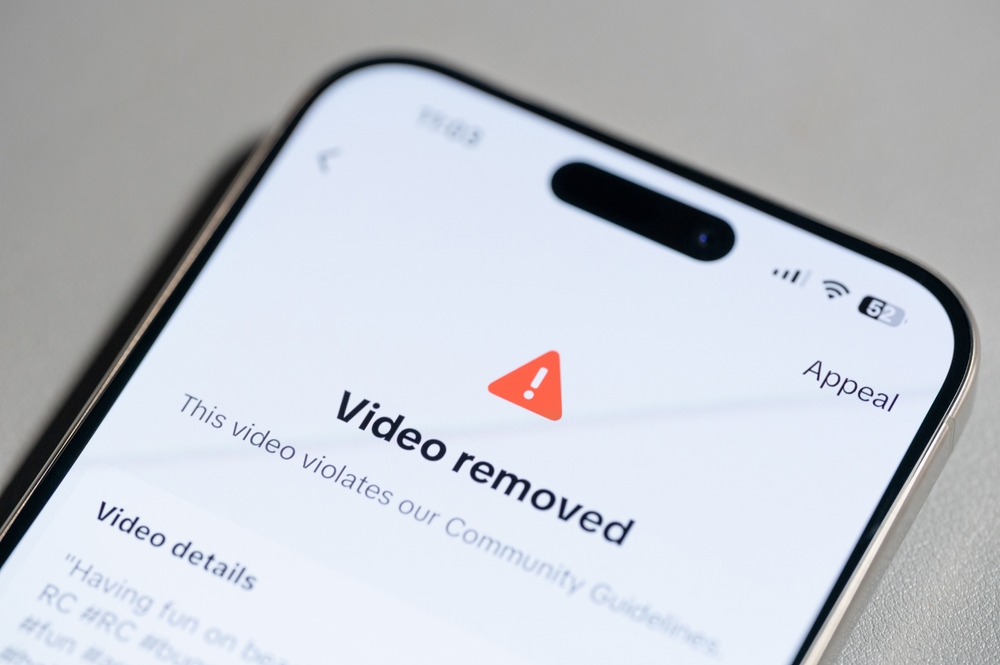
Racialized counterterrorism and counterextremism policies of the War on Terror have been integrated into platform content moderation systems, causing anti-hate speech and anti-discrimination frames to be applied in ways that disproportionately target the marginalized communities they claim to protect.
Without an accurate description of the politics that “hate” movements reflect, and without a corresponding integrated analysis of power, these frames simply give states more tools to weaponize against the marginalized and dissent.
War on Terror’s Legacy
Our research at the Muslim Counterpublics Lab in 2024 found that Muslim Americans rely on digital spaces to shape their identities, build communities, document state violence, and develop narratives in response to state oppression. They do much of this work online because they are often shut out of traditional media and because they fear being targeted in their offline lives.
Despite their reliance on digital spaces, we found that Muslim American tech users felt platforms disproportionately suppressed Muslim-centered content, including their advocacy for social and racial justice causes such as Palestine.
Our research confirmed findings from a 2023 Human Rights Watch report exposing a system of censorship on Meta’s platforms that suppressed content supporting Palestine, including through the removal of posts documenting Israeli airstrikes, footage of paramedics pulling bodies from rubble, and even messages of mourning and condolences.
The racialized application of platform content moderation schemes has been confirmed by the companies’ own internal documents. In 2024, Meta’s employees revealed disparities in the company’s moderation of Hebrew and Arabic content: automated flagging systems indiscriminately removed non-violating Arabic content, while there was almost no flagging of Hebrew content, despite the well-documented rise in anti-Palestinian and racist content in that language. Palestinian accounts are also disproportionately flagged and their content deleted for alleged “violence and incitement,” even when they are documenting human rights abuses.
These examples of over-policed online speech of Muslims, Palestinians, and Arabic speakers are the result of uncritically applying anti-hate and anti-discriminatory speech frameworks rooted in the counter-terrorism and counter-extremism policies of the War on Terror.
Double Standards
Companies are able to enforce such double standards in speech moderation under the guise of content-neutral language embedded in the layered categories of community standards on their sites. These categories include separate and distinct policies on, for example, hateful conduct, dangerous organizations and individuals (DOI), coordinating harm, violent and graphic content, and inauthentic accounts.
Meta’s hateful conduct policy bans direct attacks based on protected characteristics such as race, ethnicity, national origin, and religion. Meta has enforced this policy in a way that treats criticism of Israel as antisemitic attacks on Jews because it has chosen to treat state-supported political entities like “Zionist” as a proxy for protected religious/ethnic identity “Jewish.” When platforms adopt this policy, any post criticizing Zionist political ideology or Israel’s state actions is automatically flagged as hate speech against Jewish people, leading to content removal and account suspensions of Palestinian advocates.
Thus under Meta’s community standards, a post saying “Islam should be eradicated” could be classified as an attack on a religion’s concept (allowed under Meta’s tiered hate speech policy that distinguishes attacks on ideas from attacks on people), while “Zionism should be eradicated” would be removed as an attack on Jews (banned by Meta as an attack against a protected people).
Online Speech and Offline Violence
To underscore the racialized, disparate application of these frames, even as content moderation policies have unfairly targeted the speech of Muslims and other marginalized communities, credible threats from groups that enjoy institutional support and power have gone undetected, resulting in violent and devastating offline harms.
The Center for the Study of Organized Hate (CSOH) report, “Manufacturing the Muslim Threat,” catalogued more than 1,100 posts on the official social media accounts of elected government officials that called for the deportation and denaturalization of Muslims, described U.S. cities with significant Muslim populations as “conquered” or “invaded”, and invoked claims of a supposed Muslim takeover of the United Kingdom and Europe to stoke anti-Muslim hysteria in the United States.
In March, U.S. Rep. Randy Fine (R-FL) posted on X, “We need more Islamophobia, not less. Fear of Islam is natural.” The same month, Rep. Brandon Gill (R-TX) stated: “Importing Islam will annihilate America as we know it.” Sen. Tommy Tuberville (R-AL) regularly refers to “Radical Islam,” which he calls “INCOMPATIBLE with our Western values.”
These exact statements were then reflected in the manifesto published by the shooters who attacked Muslim worshippers at the San Diego mosque in May. The shooters wrote: “Islam is in every way incompatible and hostile to western countries,” “They’ll assert dominance and lay claim to the land by loudly and obnoxiously praying in our streets,” “demanding Sharia law, only voting for their own in positions of power, being violent as any s…skin and attacking others often in the name of Islam,” “What I do hate is the religion of Islam itself and what I hate more than that is seeing them here, invading my country,” “They must be isolated and exterminated.”
In their manifesto, the shooters also referenced the same racist conspiracy theory promoted by the White House, reposted and praised by Vice President JD Vance on X, that Somali immigrants in Minnesota were defrauding the government out of millions of dollars, citing the alleged fraud as evidence that immigrants “DO. NOT. F…ING. BELONG. HERE.”
Harmful narratives that proliferated on social media platforms were thus directly referenced by individuals to justify their violent attacks. Notably, neither the content cited as inspiration for the attack nor the attackers’ livestream was effectively policed by the platforms, despite ample warning signs about the attackers. One of the attackers operated a TikTok account on which they posted neo-Nazi accelerationist video edits along with videos of themselves dressed in the uniform of a well-known neo-Nazi group. The account was removed from the platform only after the attack had already taken place, despite the fact that the video should have qualified as a violation of the platform’s own community standards explicitly prohibiting white supremacist and neo-Nazi content. These warnings about the attackers’ activities were not isolated to just their online behavior — they were reinforced by alerts triggered by their offline behavior, too: the Chula Vista police department had obtained a gun violence restraining order against one of the attackers’ households prior to their attack.
Despite all of these flags regarding their disturbing pattern of both offline and online behavior, the attackers’ speech went largely unrestricted on platforms.
Companies claim the failure to moderate content promoting violence against Muslims and other marginalized communities simply reflects gaps in their technologies. Their press releases are rife with excuses about their inability to contain attackers’ manifestos and video links. We’re supposed to believe that the content moderation systems of these conglomerates are unable to stop the spread of explicit material that incites violence against vulnerable communities, yet they are easily able to remove accounts that criticize state-aligned entities for “hate speech.”
Based on the racialized ways in which we’ve seen content moderated, which include the failure to moderate content promoting violence against Muslims while over-policing Muslim speech and dissent, these failures only seem to appear when the victims are deemed expendable. Public figures calling for the mass killing of Muslims face no consequences, while pro-Palestine speech is met with hyper-efficient, targeted content suppression.
The question then becomes: Whose lives matter, and whose lives are deemed worthy of receiving protection from hate and discrimination?
Reclassifying Dissent as “Hateful”
Anti-hate and anti-discriminatory speech frameworks are disproportionately enforced against the very communities they claim to protect, in part because they are so easily distorted by state entities that co-opt victimhood in order to shield their oppression.
A recent example of a state co-opting anti-hate and anti-discrimination speech frames in service of power is Germany’s antisemitism commissioner, who described punk artist Bob Vylan’s 2025 performance at the Glastonbury Festival in England, where Vylan led a chant of “Death, death to the IDF,” as “hate speech and incitement”. But the question is never asked, “incitement against whom?” In this case, that “hate” and “incitement” he claims are directed at a nuclear-armed nation-state’s military, currently accused by virtually every human rights organization in the world of committing genocide. This is a perversion that weaponizes frameworks designed to protect marginalized communities in service of hegemonic power that is mass exterminating the vulnerable.
Using “hate” on its own is harmful because it obscures the political motives and systems of support these movements rely on to subjugate others. More details of the attack on the San Diego mosque reveal it was not just a hate crime, but part of a neo-Nazi, white nationalist political movement the attackers participated in and promoted, a fact that goes underreported. The attackers sought to kickstart a race war, they wrote, by building off previous white supremacist attacks, including Christchurch.
It’s not the proliferation of hate or inciting speech alone that causes harm to Muslims and other marginalized communities. It’s the obfuscation (through depoliticized terms like “hate”) that reduces supremacist movements to an emotion or personal bias that hides their political motives and the institutions they rely on. This obfuscation allows the powerful to position themselves as victims and use anti-discrimination frames to silence marginalized groups and further enables physical violence against their communities.
Organizations like Palestine Legal have documented thousands of cases where calling Israel an “apartheid state” is reclassified as “discriminatory” or “hate speech” and is met with targeted, institutionally supported complaints that frame anti-war activism and dissent as civil rights violations or hate crimes against another group.
This sleight of hand reclassification of speech effectively erases the lived experiences of people facing oppression and state-backed violence. A Palestinian describing their family’s history of displacement, or a Muslim activist analyzing Israel’s apartheid, occupation, and genocide through the lens of international law, are framed as “hateful” or “discriminatory.”
Framing what should be protected political expression denouncing state violence as “discriminatory” or even “extremist ideology” not only results in justifying further targeted policing and state violence against marginalized communities and dissent, but it also dismisses the political grievances of oppressed communities as “irrational.” At the same time, reducing a political agenda to an individual bias like “hate” erases its political foundations, making it easier for an authoritarian state to entrench itself as the arbiter of whose politics, and subsequently, whose violence, are legitimate.
Explicit Political Terminology Needed
Hate frames without an integrated power analysis make it difficult to challenge state-entrenched, far-right, exclusionary narratives. Those who have resisted the state’s attempts at domination, subjugation, and erasure have always been smeared as “hateful,” “extremist,” “radicals,” “violent,” and “terrorists.” We can’t rely on or use the same language. A more effective approach is to move away from vague terms like “hate” and instead use greater specificity when identifying incitement and political violence.
Politics reflects values, and terms should clarify the politics of the movements they identify: whether they are politics of exclusion and domination, or politics of resistance and liberation. Are we fighting authoritarianism, supremacism, and exploitation, or are we making it easier for the state and its aligned parties to continue to clobber the vulnerable? Without this distinction, these two very different types of politics are collapsed into one, making it easier for an authoritarian state proliferating far-right politics to criminalize dissent and opposition as irrationally violent ideologies whose suppression is justified.
Hate and anti-discriminatory speech regulations on their own have been ineffective in providing a salve for marginalized communities facing incitement and violence. “Hate” is a political project, and until we recognize it as such, we will be unable to keep communities safe from the violence it fuels. If we don’t embed a power analysis into our hate speech frameworks, the next decade of online regulation won’t curb incitement against marginalized communities — it will simply criminalize resistance to authoritarianism.
(Sanaa Ansari Khan is a licensed attorney based in Washington, D.C., where she has worked on civil rights and digital rights issues over the last two decades for organizations including CAIR, Muslim Advocates, and Lawyers’ Committee for Civil Rights Under Law.)