
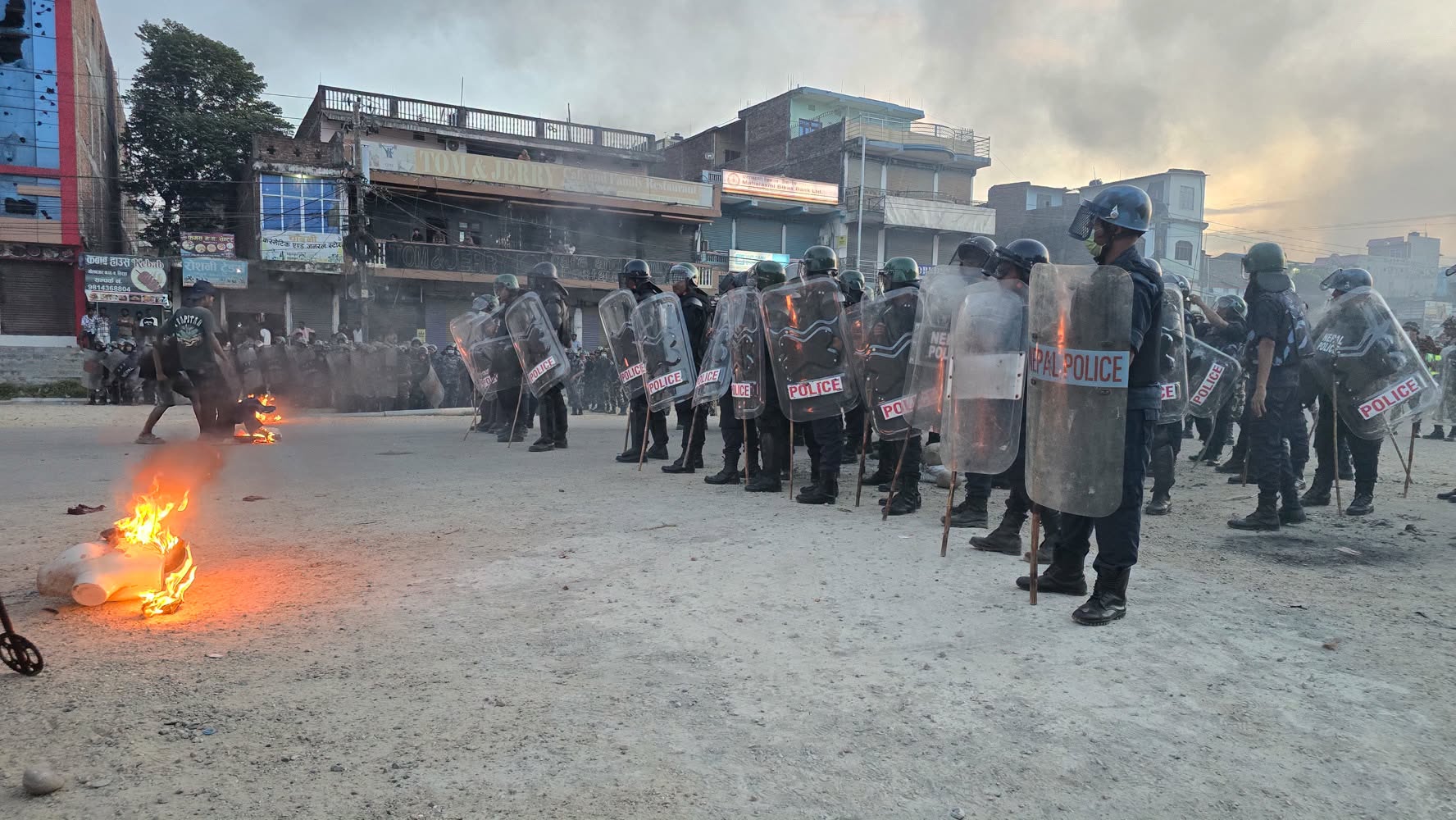
For generations, the Hindus and Muslims of Dewanganj Rural Municipality, a community in eastern Nepal’s Sunsari district, coexisted peacefully until clashes erupted in late July. For Hindus, the month of Shrawan marks the observance of the Bolbam pilgrimage, dedicated to Lord Shiva. On the eve of the pilgrimage on July 26, preparations were in full swing near the Shiva temple, energized by religious songs playing from the DJ sound system. Local Muslims confronted the Bolbam groups over loudspeaker noise, which later turned violent.
Security personnel arrived to defuse the situation but instead found themselves caught in clashes with the Hindu groups. The police opened fire, claiming the lives of three Hindus and injuring dozens. This became an eruption point, leading to pandemonium and widespread communal violence that engulfed Sunsari and the surrounding Morang, Siraha, Saptari, and Dhanusha districts of the broader Terai region.
Hindu Nationalist Mobilization
Seizing the opportunity, local Hindu nationalist organizations exploited the deaths of the three Hindus and facilitated the proliferation of tensions across Terai districts, fostering violence and unrest. The minor local dispute over a DJ loudspeaker escalated into a demand for a Hindu Rashtra—the idea of Nepal as a Hindu state rather than a secular one.
The Joint Hindu Morcha, comprising every major Terai-based Hindu nationalist organization, submitted 13-point demands (with six more allegedly added the next day) to the Home Minister, Sudan Gurung, before calling off the protest. The move indicated that these organizations were key players throughout the one-week-long unrest in Nepal’s Terai districts (Morang, Siraha, Saptari, and Dhanusha) that followed the original dispute in Sunsari’s Dewanganj area.
Video clips have surfaced showing an active involvement and organized presence of leaders representing Hindu nationalist groups, Hindu Samrat Sena and Narayani Sena. Hindu Samrat Sena is accused of mosque vandalism in Koshi Rural Municipality during the violence. In Nepalgung, a city in the western Terai region, Vishwa Hindu Parishad Nepal, a right-wing Hindu nationalist group and the Nepal offshoot of India-based Vishwa Hindu Parishad, organized a protest following the violence.
Transnational Hindutva Influence
The rise of the Terai variant of political Hindutva, or Hindu nationalism, not only coincides with the rise of the Bharatiya Janata Party (BJP) in India in 2014 but also follows the ideological and organizational template of its Indian counterparts. Direct offshoots of Rashtriya Swayamsevak Sangh (RSS), Vishwa Hindu Parishad, Shiva Sena, and Bajrang Dal in India, the Nepali counterparts—Hindu Swayamsevak Sangh (HSS), Hindu Samrat Sena Nepal (HSSN), Shiva Sena Nepal, Bajrang Dal Nepal, Vishwa Hindu Parishad Nepal (VHPN), and other fringe outfits—are championing the narrative to turn Nepal into a Hindu nation and mainstream anti-minority sentiments. Such sentiments are specifically targeted against religious minorities labeled as “outsiders”—Muslims and Christians—with a share of 5.09% and 1.76% of Nepal’s total population, respectively.
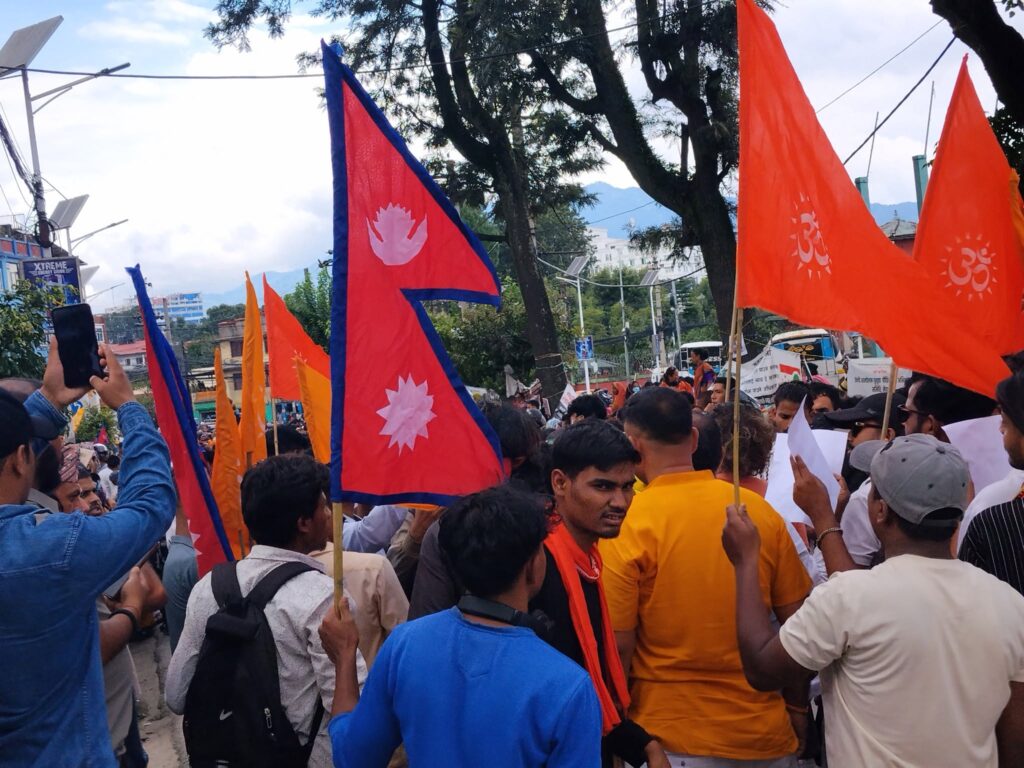
The HSS has been expanding its influence across Nepal’s Terai belt. Hindu Samrat Sena, in particular, has been accused of anti-minority activities in recent years, including an attack on a local Christian gathering in 2024. Vishwa Hindu Parishad Nepal openly promotes the reconversion of Christians to Hinduism through Ghar Wapsi. Its motto reads: “I’m Hindu; therefore, I won’t let religious conversion happen.”
Documented incidents point to a pronounced rise in Hindu-Muslim tensions over the past decade, amid growing religious polarization and the expanding influence of Hindu nationalist organizations. These organizations have increasingly adopted the same religious-nationalist lexicon, symbols, and rhetoric of othering and demonization associated with the Hindutva movement across the border in India.
These include the politicized use of “Jai Shri Ram,” a Hindu invocation that has become closely associated with Hindu nationalist mobilization in India, in place of the gentler and traditionally used “Jai Siya Ram”; displays of the angry Hanuman flag; and slogans such as “Musalman/Jihadi bhagau, desh bachau” (“chase Muslims/Jihadis away and save the country”) and “Muslims are Jihadis.” These developments reflect the growing ideological and organizational influence of India’s Hindutva movement in Nepal.
The local groups also appear to be adopting Hindutva’s politics of grievance and Hindu victimhood. In India, the Hindu nationalist mobilization has long drawn on historical trauma and communal conflict to construct a persistent sense of Hindu vulnerability. Nepal lacks a comparable history of large-scale Hindu-Muslim violence, but recurring local disputes risk being painted as evidence of a broader religious threat. Such a crisis narrative can deepen communal distrust, mobilize further violence, and make Hindu-Muslim tensions an increasingly persistent feature of Nepal’s social and political landscape.
Religious Minorities at Risk
The violence in Sunsari and across the Terai illustrates the growing risks facing Muslim minorities in Nepal. The deaths of three Hindus in clashes with security forces unleashed a broader wave of violence that was redirected toward Muslims as a community.
The pattern is reminiscent of the 2004 “Black Wednesday”, when the murder of 12 Nepali migrant workers by militants in Iraq triggered a series of retaliatory attacks against Muslims across Nepal, including an attack on Jama Mosque in the heart of Kathmandu. In both cases, Nepal’s Muslim minority became the target of collective retaliation for violence for which they bore no responsibility.
Local Muslims have reported attacks on mosques and madrasas, assaults and harassment, and instances of Muslims being forced to recite Hindu religious slogans and prayers. In another incident, a mob burned a Muslim skullcap mounted on a stick. The violence that began in Sunsari and spread to other districts marked a significant escalation in anti-Muslim violence in Nepal.
Such violence can function as a mechanism of intimidation, reinforcing minorities’ sense of vulnerability and their perceived “place” in society. It also feeds a political narrative that minorities were safer under Nepal’s Hindu monarchy and that religious tensions are a consequence of secularism. Addressing parliament, Rastriya Prajatantra Party lawmaker Khushbu Oli explicitly blamed secularism for growing religious intolerance, tensions, and sectarian disputes.
The violence in Sunsari is neither isolated nor geographically contained. Its rapid spread to other districts within 24 hours demonstrates how localized religious tensions can quickly escalate and travel across the country. At least 17 incidents of communal violence have affected Terai districts over the past eight years.
For Nepal’s Muslim minority, repeated targeting during these episodes has created a pattern of insecurity in which even localized religious disputes carry the risk of broader collective retaliation.
Breaking this pattern requires moving from reactive security measures to prevention. Many recent tensions have emerged around religious processions, festivals, and other predictable flashpoints, creating opportunities for early intervention and interfaith engagement, particularly among local youth, essential.
Prime Minister Balendra Shah now carries an important responsibility to ensure that his government’s commitment to secularism translates into meaningful protection and equal citizenship for religious minorities. This must be accompanied by accountability for those responsible for communal violence. How his government responds to this moment will help determine whether Nepal can contain growing religious polarization and the expanding influence of India-linked Hindu nationalist groups, or whether these forces further erode the security and rights of its religious minorities.
(Krishna Man Rai holds an Erasmus Mundus Master’s degree in Religious Diversity in a Globalized World (ReD Global), specializing in the study of religious nationalism and minorities. He previously taught religion and philosophy at National College, Kathmandu University.)