
Introduction
In recent years, South Asians in the United States have increasingly become targets of online hate, with their identities, languages, accents, appearance, cultural customs, and religious practices subjected to mockery and abuse. They are denigrated with xenophobic slurs, racist memes, and dehumanizing rhetoric that depicts them as vermin, parasites, and invaders who are taking over American jobs, communities, and institutions.
These narratives frequently draw on conspiracy theories of demographic and cultural replacement and, in their extreme forms, include calls to deport, denaturalize, or otherwise remove South Asians from the country. Far-right and anti-immigration influencers have amplified these narratives and circulated videos featuring or encouraging the public harassment and humiliation of South Asians.
This online hostility exists alongside incidents of anti-South Asian harassment and violence offline. South Asians have faced harassment, racial abuse on the streets, and physical violence. In February 2025, an Indian-origin nurse in Florida was severely beaten by a patient who made anti-Indian remarks.1 In July 2026, an Indian Muslim mall employee in Utah was repeatedly stabbed in an attack that federal prosecutors charged as a hate crime.2 On September 13, 2026, a Sikh truck driver was stabbed 17 times3 in an unprovoked attack at a truck stop in Wyoming, raising fears of other such attacks on South Asians.
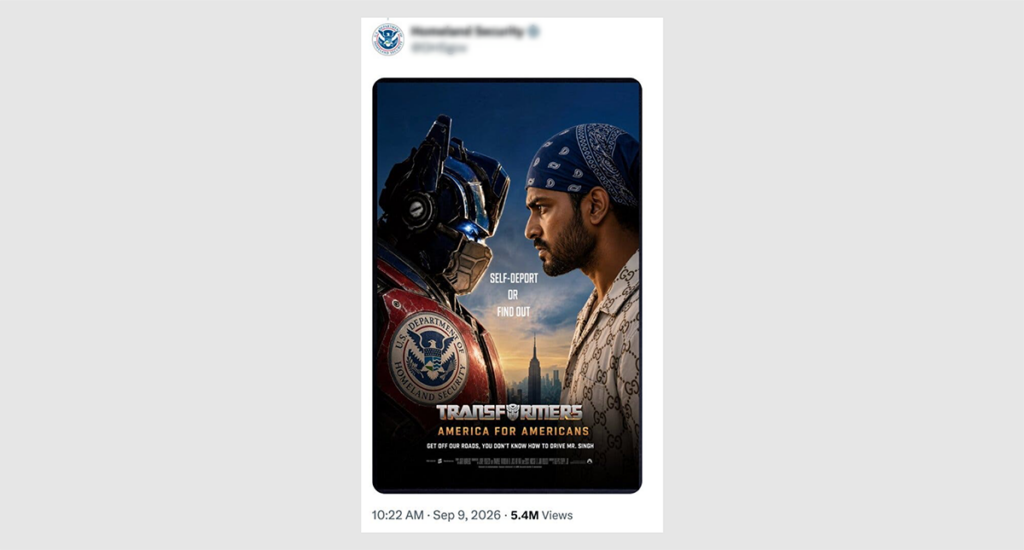
The attack followed in the wake of simmering anti-Sikh sentiment ever since two Sikh truck drivers were involved in fatal crashes4 in 2025 and an ensuing crackdown by the Trump administration on immigrant truck drivers. Earlier in September, the official Department of Homeland Security Instagram account had shared an image of a poster,5 captioned “Transformers: Age of Deportations.” The controversial poster, which received ample attention, featured an image of ‘Mr Singh,’ who was told to “get off our roads.” The poster was taken down on September 10, 2026.
This report analyzes the phenomenon and nature of anti-South Asian hate in the US on X (formerly Twitter), 4chan, 8chan, and Gab between January 1, 2025, and June 30, 2026.
Following Elon Musk’s acquisition of Twitter in 2022 and its rebranding as X, the platform has become a cesspool of hate.8 For example, as of January 2025, posts solely emphasizing anti-Indian hate and racism on X had drawn a staggering 138.54M views.9 The culture of hate on X exemplifies the hypocrisy of Musk’s alleged commitment to “free speech absolutism.”10 The principle is invoked, not least by Musk himself, to justify the proliferation of hateful narratives on X, while at the same time the platform has restricted or censored voices at the behest of foreign governments such as Turkey11 and India.12
4chan,13 8chan (now known as 8kun), and Gab14 are platforms historically associated with fringe right-wing online communities and limited content moderation. Anonymous trolling,15 racist and hateful content,16 and extremist rhetoric, including white supremacist content and advocacy of violence,17 have long proliferated across these spaces. They have also incubated memes and terminology that has later spread into broader internet culture. The common anti-Indian slur “pajeet,” for example, originated on 4chan in 2015, as did “saar,”18 a corruption of “sir” used to parody Indian pronunciation. Like X, these platforms have also served as spaces for misinformation, conspiracy theories, and dangerous speech.19
According to the 2020 US Census, there were about 6.1 million individuals20 of South Asian origin in the US. “Asian Indians,” as they are termed in the census, were the single largest “Asian alone” group21 in the US at 4.4 million people. By 2025, the Indian-identifying community itself numbered 5.2 million.22
We use the term “South Asian” to denote communities that share overlapping and intersecting identities. The term includes Indian-Americans and other South Asian-Americans, such as Pakistani-Americans and Bangladeshi-Americans, who are often perceived as Indian-Americans. It encompasses migrants of South Asian origin, including citizens, lawful permanent residents (green card holders), individuals on temporary visas, and undocumented immigrants. The term also refers to citizens and non-citizens who are targeted for visibly (or presumably) belonging to non-Christian faiths, whether they are Hindu, Muslim, or Sikh, which are commonly treated as synonymous with South Asian ethnicities or national origin.
Anti-South Asian hate cuts across national, religious, and ethnic lines, targeting diverse South Asian communities and often collapsing distinctions among them.
South Asian communities, which are richly diverse in terms of religion and national origin, are targeted on the basis of one or more aspects of their identity. Sikhs, who are easily identified as such because of markers of dress like turbans and their prominence in professions such as trucking, have been targeted on these grounds. Visibly Muslim South Asians have similarly faced hate motivated by both Islamophobia and resentment of South Asians. Hindus in cities such as Frisco, Texas have been singled out for attacks on the basis of their religion, with racist hostility provoked by the presence of temples, statues of deities, and religious or cultural festivals. In this manner, anti-South Asian hate, whether online or otherwise, is both broad-based and intersectional.
Online hate does not exist in isolation from offline forms of hostility. Online and offline hate can reinforce one another as narratives, stereotypes, and forms of demonization move between digital platforms, political discourse, media, and everyday life. Online hostility can accompany or contribute to in-person harassment, threats, discrimination, and violence, while political rhetoric and real-world events can generate new waves of abuse online. The distinction between online and offline hate is therefore increasingly porous, particularly as social media platforms have become central spaces for political communication and public discourse.
This report emphasizes the organized and systemic character of the online hate directed at South Asians, which goes well beyond spontaneous outbursts of hostility. Anti-South Asian hate deliberately and intentionally targets the community; it is manufactured, it is articulated to provoke resentment, anger, panic, and outrage, it is strategically circulated, and it is amplified online. The recurrence of narratives of South Asians as invaders, job thieves, and unwelcome outsiders across platforms, the ubiquity of slurs and stereotypes, the persistence of racist and xenophobic abuse, and the reinforcement of these narratives by influential accounts and figures all indicate a broader ecosystem in which anti-South Asian hate is produced, circulated, amplified, and normalized. Social media platforms have played a central and deeply troubling role in shaping this grim reality.
Key Drivers of Anti-South Asian Hate
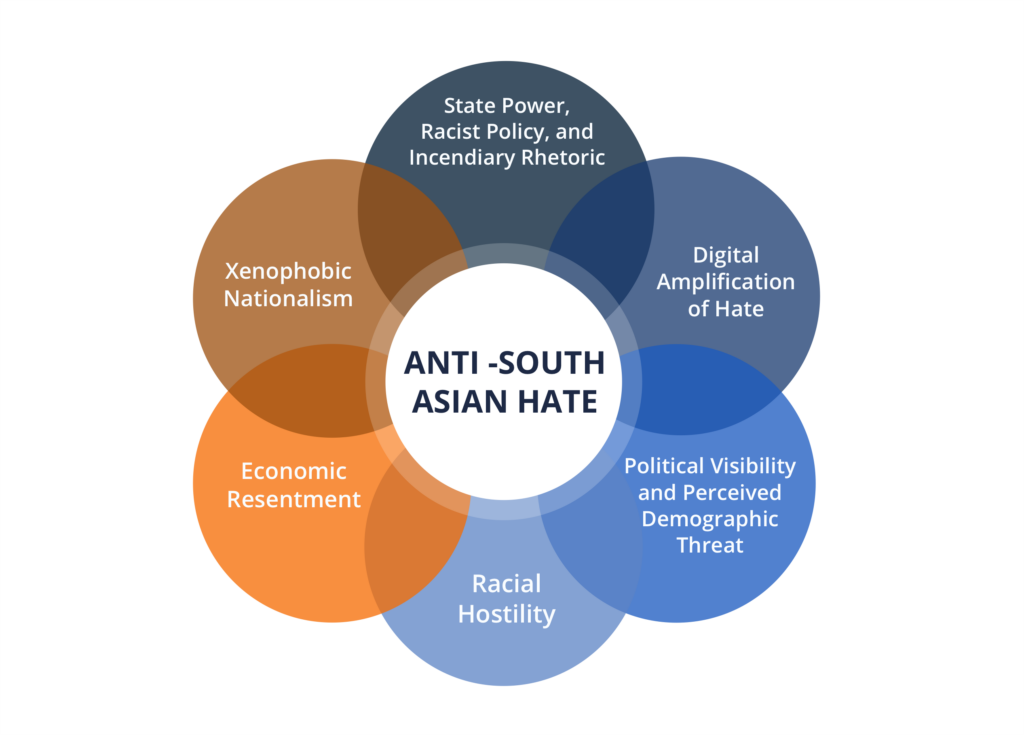
There are six major, interrelated factors that explain the explosion of anti-South Asian hate in the US:
FIGURE 1. SIX FACTORS FUELING ANTI-SOUTH ASIAN HATE
State Power, Racist Policy, and Incendiary Rhetoric
The South Asian community has faced a combination of the brute exercise of state power, racist policy, and incendiary rhetoric, with social media playing a crucial role in the process. South Asians have been affected both by policies aimed at immigrants broadly and by measures that disproportionately impact South Asian migrants.
The Trump administration has ended protections for 1.3 million immigrants23 from various countries, including Venezuela, Afghanistan, and Haiti, while offering the option of seeking asylum only to white South Africans.24 It has also implemented a total or partial ban25 on travel from 39 countries. Other measures include the weaponization of the Immigration and Customs Enforcement (ICE) and border patrol26 agencies, the mass arrest and detention of immigrants,27 with 400,000 arrested and 60,000 detained as of May 2026, the incarceration of detainees in camps with horrific conditions,28 and the mass deportation29 of immigrants and minorities, including American citizens.
On February 5, 2025, 104 Indians accused of entering the US without documentation were deported back to India,30 allegedly kept shackled in handcuffs for the duration of the 40-hour flight. Stop AAPI Hate has found that deportations of South Asian nationals under the current administration were roughly fourteen times the level recorded during the previous administration.31
At the same time, a number of administration policies, particularly those related to the H-1B visa program, have disproportionately impacted South Asians who account for the majority of H-1B visa holders and constitute the single largest group of overseas students in the US. Members of the Trump administration have long been opposed32 to the visa program, with some like Stephen Miller accusing India of “cheating on immigration policies.”33
In September 2025, Trump increased the fee for H-1B workers by an additional $100,000, followed by further restrictions on the program.34 These actions have sowed confusion and fear35 among South Asian migrants, placing them in a condition of abject vulnerability and precarity. Such actions serve a powerful symbolic function, in the bargain reinforcing the hostility of Trump’s base toward South Asians. They also convey a clear endorsement of the views of social media influencers who have generated large followings by targeting South Asians whether in relation to the H1-B visa program or merely for the fact of being South Asian.
In tandem with policy and the exercise of force, President Trump and his administration have employed inflammatory rhetoric36 and imagery against South Asians, including on social media. Posts by US government bodies have featured South Asians as criminals, for instance, in the “Transformers: Age of Deportations”37 poster image. Other posts have expressed support for racist sentiments expressed by political figures. On September 21, 2026, the US Department of Education shared a post on X38 with the caption “Make Football Great Again,” a clear endorsement of a racist post39 by Texas Republican Bo French in which he lamented the presence of South Asians at the University of Texas.
The actions and rhetoric of the state have contributed to a climate in which racist hostility against South Asians is sanctioned and approved as patriotic sentiment. Power, policy, and discourse thus lay the groundwork for anti-South Asian hate while sending a strong message that South Asians are outsiders to the US by definition and, as such, can never truly belong in the country.
Xenophobic Nationalism
Underlying this political environment is a broader resurgence of xenophobic nationalism, which combines majoritarianism with hostility toward minorities and finds expression in virulent, and often violent, rhetoric against perceived outsiders. On the rise globally over the last two decades, xenophobic nationalism has become a fertile source for political figures to generate political capital by designating immigrants and minorities as threats to the majority population.
The prime source and manifestation of xenophobic nationalism in the US is the Make America Great Again or the MAGA40 movement, mirroring Donald Trump’s 2016 presidential campaign slogan. In the US, xenophobic nationalism increasingly entails a rejection of all forms of immigration, other than for non-white immigrants to the country.
Nationalist and extremist rhetoric,41 white supremacist ideology,42 and racist conspiracies43 expressed by politicians, state agencies,44 and endorsed by right-wing media have bolstered xenophobic nationalism. President Trump himself has engaged in xenophobic rhetoric against South Asians,45 calling immigrants from India “gangsters with laptops.”46
One manifestation of this shift is the growing prominence of “remigration,”47 the forced deportation and repatriation of immigrants of color, which has been embraced by the current political administration and sections of the American population. In 2025, the US State Department’s Bureau of Population, Refugees, and Migration established a unit, the Office of Remigration,48 which is tasked with facilitating the removal of non-citizens from the US. The number of migrants sought to be deported varies49 among supporters of remigration, including MAGA and MAGA-aligned political leaders, and administration officials. Greg Bovino, the former U.S. Border Patrol Commander-at-Large, for instance, had ambitions of deporting 100 million people,50 roughly the non-white population of the US.
Racial Hostility
Anti-South Asian hate in the United States is not a new phenomenon. There is a long history of violence and discrimination51 against South Asians in the US, from the time they first arrived in the country52 in the 1700s. The current tide of anti-South Asian hate in the US is rooted in this longer history. Additionally, the latest wave of anti-South Asian racism also reflects newer developments.
A Carnegie Endowment survey found that one in four53 Indian Americans had faced racism and hate in 2025. The FBI’s record of hate crime data54 for 2025 shows a persistently high level of violence against Asian-origin communities in the US, including against South Asians. The “convergence of anti-immigrant, anti-South Asian, anti-Muslim, anti-Sikh, and anti-Indian rhetoric” is a new trend for 2025,55 putting South Asian communities at heightened risk. Congressman Raja Krishnamoothi, Co-Chair of the Congressional Asian Pacific American Caucus (CAPAC), recently noted56 that the US was witnessing a “disturbing rise in anti-Indian and South Asian hate.” The term ‘Paki,’ a derogatory word for Pakistanis, is the third most common57 anti-Asian slur on the internet, including in American online spaces.
Anti-South Asian racism draws on a mishmash of religious, cultural, and national stereotypes, frequently confusing Indians, Pakistanis, Bangladeshis, and other South Asian nationalities and conflating Hindus, Muslims, Sikhs, Christians, and people of other faiths. Racial hostility against South Asians also converges with white supremacy, Islamophobia, and fundamentalist Christian prejudice against non-Christians. Many MAGA supporters reject South Asians58 who identify with the movement and South Asians affiliated with the Trump administration.59 South Asian Christians are largely viewed through the prism of race as outsiders rather than as belonging to a common religious community.
Political Visibility and Perceived Demographic Threat
The newfound visibility60 of South Asians in American political life is another prime trigger of anti-South Asian hate. Prominent South Asian politicians across the political spectrum have been attacked on the basis of their racial, ethnic, and religious identities and national origins.
They include Kamala Harris, former vice president and Democratic presidential nominee; Usha Vance, the current Second Lady of the United States; Kash Patel, director of the FBI; Zohran Mamdani, the first Muslim mayor of New York City; Democratic Representatives Pramila Jayapal, Shri Thanedar, Raja Krishnamoorthi, and Ro Khanna; Vivek Ramaswamy, a former presidential candidate and current candidate for governor of Ohio; Sriram Krishnan, an entrepreneur who served as Senior White House Policy Adviser on Artificial Intelligence during the first 18 months of Trump’s second term; and Saddam Salim, a Virginia state senator.
The outpouring of anti-Indian hate on X61 in January 2025 was a response to an X post by Ramaswamy, in which he unfavorably contrasted mainstream American parenting culture with Indian-American parenting practices. It was also driven62 by a response to a post by Krishnan,63 in which he called for reforms to ease pathways for obtaining H-1B visas and green cards. Mamdani’s victory in the Democratic primary in June 2025 elicited an outpouring of Islamophobia as well as anti-South Asian hate targeting his Indian heritage, immigrant background, and racial identity. These attacks became more pronounced64 following his victory in the mayoral election in November 2025.
Anti-South Asian hate rooted in economic resentment and triggered by the political visibility of the community is intertwined with anxieties on the part of the majority about loss of status.65 It also feeds on the once-fringe conspiracy of the Great Replacement Theory66 (GRT) that has now gone mainstream. The GRT is based on the idea that there is a well-orchestrated plan to replace white populations in Western countries with non-white populations through mass migration, resulting in a demographic takeover as well as the erasure of white Western culture.
Since at least 2024, GRT narratives have explicitly targeted South Asians online.67 The GRT underpins the objective of “remigration,” that is, the mass deportation of non-white migrants out of Western countries. The GRT-driven backlash against minorities and immigrants has led to racist and terrorist violence68 in the US. The theory also informs state initiatives in the US, such as recruitment drives for ICE, which are often expressed in nakedly supremacist and radically violent rhetoric.69
Economic Resentment
The economic prosperity and professional visibility of sections of the South Asian community, symbolized by CEOs of Fortune 500 companies, highly paid workers in the technology industry and other professional sectors, and the high median income of various South Asian-origin groups, is one of the key drivers of anti-South Asian hate. Indian Americans70 had the highest median annual income for all ethnic groups in the US in 2023, at $151,200, compared to the national average71 of $80,610. The Pakistani American72 annual median income of $108,100 and the Sri Lankan American73 annual median income of $103,000 were also markedly higher than the national median income. These aggregate figures, however, obscure considerable socioeconomic diversity within South Asian communities and do not mean that South Asians uniformly experience economic prosperity.
Economic discontent has increasingly been channeled into manufactured anxiety about immigrants and minorities in the United States. Economic inequality in the US rose during the COVID-19 pandemic74 and has continued to increase75 along with social inequities, such as access to healthcare. In an environment in which racism has become normalized, South Asian Americans have become a convenient scapegoat for populist anger rooted in economic discontent. Indian Americans, for instance, once widely portrayed through the “model minority”76 stereotype, are increasingly derided as opportunists and cheats.77
The notion of the H-1B visa program as a means for South Asians to enter the US fraudulently constitutes another source of hate. Granted to skilled foreign workers,78 the H-1B visa program has morphed into a political hot-button issue over the last decade but has emerged as an even more prominent flashpoint since President Trump returned to office in 2025.
Restrictions on the program were initially imposed in 201779 during Trump’s first presidency and have become far more stringent80 during his second. Indians account for more than 70 percent81 of H-1B visa holders. President Trump,82 members of the administration,83 politicians,84 influencers, and others have attacked both the visa program and South Asian visa holders. South Asian migrants who work in blue-collar professions, such as Sikh truck drivers, have also faced racist attacks as well as accusations of immigration fraud and job theft.
Digital Amplification of Hate
The enormous scale of online hate is a function of the widespread reach of social media platforms and algorithmic systems that amplify and reward hateful content. It also reflects the growing alignment of powerful technology executives85 and owners like Elon Musk and Mark Zuckerberg with the MAGA movement and the rollback of hate speech policies,86 fact-checking programs, and other trust and safety measures by platforms.
The transformation of X after its acquisition by Musk is especially noteworthy because it has led to the normalization of a violent87 and racist discourse88 that was previously largely restricted to fringe online spaces. Like other minorities, South Asians in the US have been impacted by these developments through a marked increase in hate and incitement directed at them. Online platforms are also a key instrument for the propagation of GRT, which further fans the flames of anti-South Asian hate.
Far-right and extremist influencers in the US, like Nick Fuentes,89 Laura Loomer,90 Jake Lang, and Sara Gonzalez,91 and their followers have regularly targeted South Asians.
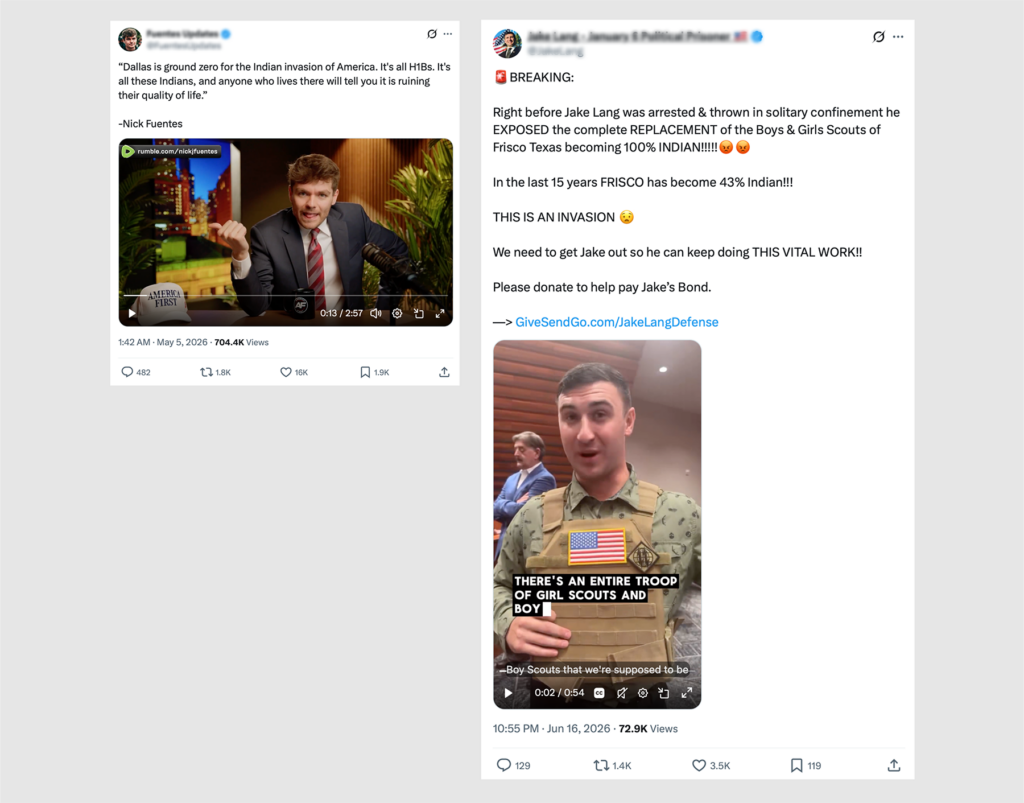
Loomer described South Asians as “third world invaders from India.”92 In late 2025, appearing on the Piers Morgan Uncensored show, Fuentes called Usha Vance a “jeet,”93 refusing to apologize and doubling down on anti-Indian slurs when Vice President J.D. Vance responded sharply to his comments. Fuentes’ followers, known as Groypers,94 are also a common source of anti-South Asian hate.
On January 21, 2026, right-wing influencer Sara Gonzalez, who has over half a million followers on X, posted a video95 on the platform with the caption: “I Exposed A MAJOR H-1B Visa Scam in Texas.” The video features Gonzalez harassing a person of South Asian identity whom she claims is exploiting the H-1B visa program.
Anti-South Asian content of an extreme nature abounds online. For instance, references to a racist 2024 documentary film titled India: The Worst Country on Earth, describing it as a “masterpiece,” can be easily found on accounts96 on X. A video on YouTube by GBNews titled “Exposed: The secret Indian networks replacing American workers,”97 which was posted in May 2026, has already drawn 379k views. The documentary format is increasingly being used by both influencers98 and organizations,99 including Turning Point USA, to manufacture hysteria around the narrative that South Asians are replacing “real” Americans.
The use of generative AI tools to create hateful and racist images and videos100 and amplify dangerous stereotypes, targeting South Asians101 as well as other groups, represents a troubling new development in the production and spread of online hate. Giving visual form to longstanding racist and xenophobic stereotypes102 about South Asians, AI-generated posts depict the community as filthy and unclean, sexually predatory, culturally backward, or a demographic threat.
Methodology
This study examined the scale, patterns, and dominant narratives of online hate targeting South Asians across X, 4chan, 8chan, and Gab from January 1, 2025, to June 30, 2026. Our analysis combined keyword-based data collection, automated classification, qualitative review, and purposive sampling to identify recurring forms of anti-South Asian hate and examine how they evolved during the study period.
We defined online hate based on the description of hate speech set out in the UN Strategy and Plan of Action on Hate Speech: “any kind of communication in speech, writing or behavior, that attacks or uses pejorative or discriminatory language with reference to a person or a group on the basis of who they are, in other words, based on their religion, ethnicity, nationality, race, colour, descent, gender or other identity factor.”103
For the analysis, we first identified patterns in hateful anti-South Asian content based on an initial phase of research and findings from prior reports produced by CSOH. We conceptualized these patterns as working narratives reflective of trends of anti-South Asian hate in the present.
For X, we used a social listening tool to collect and analyze posts containing anti-South Asian hate. We developed clusters of keywords and phrases for each working narrative and used them to query the platform for the period from January 1, 2025, to June 30, 2026. The keyword clusters were designed to capture content relevant to each narrative while minimizing false positives, including criticism of South Asians that did not qualify as hate under our definition.
We then analyzed and graphed the results to identify broad trends in the volume of anti-South Asian hate and significant peaks during the study period. We then qualitatively reviewed posts associated with these trends and peaks to better understand the narratives and developments reflected in the data.
Our review of the search results also identified additional themes not fully captured in the initial working narratives. We conducted targeted searches for posts related to these themes using purposive sampling. For the category involving the doxxing and targeted exposure of South Asians in connection with H-1B visa-related narratives, we primarily conducted targeted searches on X while also manually identifying relevant posts within the results generated by the broader keyword-cluster searches.
For 4chan, 8chan, and Gab, we collected content targeting South Asians from January 1 through December 31, 2025. For each platform, we searched for a set of known anti-South Asian slurs, dehumanizing phrases, violent language, and terms associated with immigration-related grievances, including “H-1B” and allegations of “visa fraud.”
Matching posts were automatically categorized using a classification system that assessed whether the content unequivocally qualified as hateful, identified the specific hateful terms or phrases, and classified the form of hate represented, including slurs, threats of violence, dehumanization, and immigration-related abuse.
Data collection methods varied according to the technical access available for each platform. For 4chan’s /pol/ board, we scanned the 4plebs archive. For 8chan and Gab, we relied on their available search functions and collected posts from accounts or sources previously identified as producing hateful content.
Search access for Gab and 8chan was rate-limited or blocked, so we essentially captured a portion of hateful anti-South Asian content on the platforms. As a result of the restrictions, the majority of the results yielded from the three platforms are from 4chan, which accounts for more than 90% of all mentions. In addition, 4chan was inaccessible from April 15 to April 24, 2025, resulting in a gap in data during this period. Despite these limitations, the collected material provides substantial evidence of recurring narratives and forms of anti-South Asian hate circulating within these online spaces.
Our methodology allowed us to obtain a robust overview of anti-South Asian hate across all the platforms studied, with a clear sense of the dominant themes and topics. We mapped peaks in the volume of hateful posts in relation to factors such as policy decisions by the White House, bills targeting the H-1B visa program, incendiary speeches by politicians targeting South Asians, and incidents involving South Asians that triggered hate. Drawing on the explanatory frame for context, we iteratively refined the working narratives into clear, sharply defined narratives of anti-South Asian hate.
Key Findings
- Anti-South Asian hate has risen sharply across X and fringe platforms. Over half a million hateful posts appeared on X between January 2025 and June 2026. Monthly volume grew 75% over the study period and 240% since January 2024, with five of the six highest-volume months occurring between November 2025 and June 2026, indicating that anti-South Asian hate continues to intensify.
- Anti-South Asian hate remained deeply entrenched on fringe platforms. The report identified 397,522 hateful mentions across 4chan, 8chan, and Gab in 2025, with monthly volume remaining at a persistently high baseline for much of the year.
- Racist policies and incendiary rhetoric, xenophobic nationalism, racial hostility, growing South Asian political visibility, economic resentment, and digital amplification collectively drove the surge in anti-South Asian hate.
- Posts portraying South Asians as invaders, job thieves, and a demographic threat made up 45% of anti-South Asian hate on X, with H-1B visas and immigration serving as major drivers. These narratives also included Great Replacement and “remigration” rhetoric, while on fringe platforms they also overlapped with antisemitic conspiracy theories.
- Slurs and dehumanization pervade every platform. The slur “pajeet” and its variants appeared in 30% of all posts on X and 45% of mentions on fringe platforms. Hygiene-based dehumanization grew fastest of all narratives on X, rising 171%.
- Posts attacked Hindu, Sikh, and Muslim religious practices, called for temples to be destroyed, and turned UK grooming-gang cases into a smear against all Pakistanis and South Asians.
- A network of X accounts doxxes South Asians, accusing them of taking American jobs or committing visa fraud, while some right-wing influencers harass South Asians at their homes and workplaces, film the encounters, and post the videos on X.
- South Asian public figures across party lines, including Republicans, faced racist and xenophobic attacks that framed their political participation as a “takeover.”
- Documentary-style videos are manufacturing “invasion” claims. Social media influencers and right-wing groups produce videos that present South Asian neighborhoods, businesses, and temples as proof of a takeover, particularly in Texas
- Generative AI is industrializing visual hate. AI-generated images and videos turn slurs and stereotypes into racist caricatures that portray South Asians as vermin, scammers, and sexual predators, producing dehumanizing content faster and at greater scale than ever before.
Scale and Trends of Anti-South Asian Hate
This section examines the overall volume and trends of anti-South Asian hate across the platforms studied, including major peaks and shifts during the study period.
Anti-South Asian Hate on X (formerly Twitter)
Between January 1, 2025, and June 30, 2026, we identified approximately 542,360 posts on X expressing anti-South Asian hate across a range of narratives. Monthly volume increased by 75% from January 2025 to June 2026, with June 2026 recording 1.75 times as many posts as January 2025. Five of the six highest-volume months occurred between November 2025 and June 2026, reflecting a sustained rise in anti-South Asian hate.
FIGURE 2. MONTHLY VOLUME OF ANTI-SOUTH ASIAN HATE ON X (JAN 2025–JUN 2026)
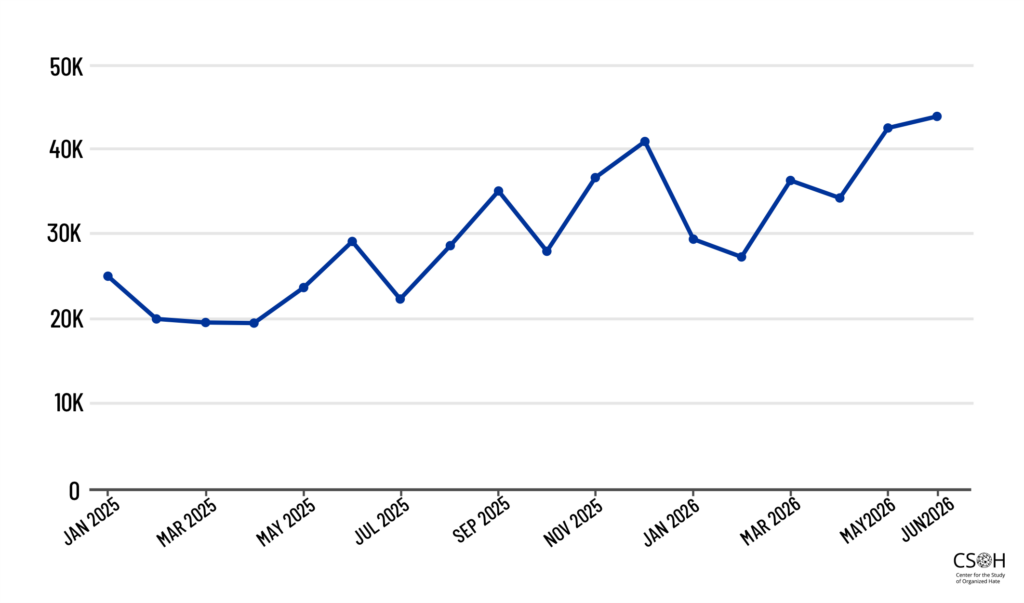
To provide a longer-term baseline, we also examined comparable data from 2024. We identified 205,585 anti-South Asian posts in 2024, compared with 328,747 in 2025, a 60% year-over-year increase. Looking at the longer monthly trajectory, volume rose from 12,904 posts in January 2024 to 43,843 in June 2026, an increase of 240%.
FIGURE 3. MONTHLY VOLUME OF ANTI-SOUTH ASIAN HATE ON X (JAN 2024–JUN 2026)
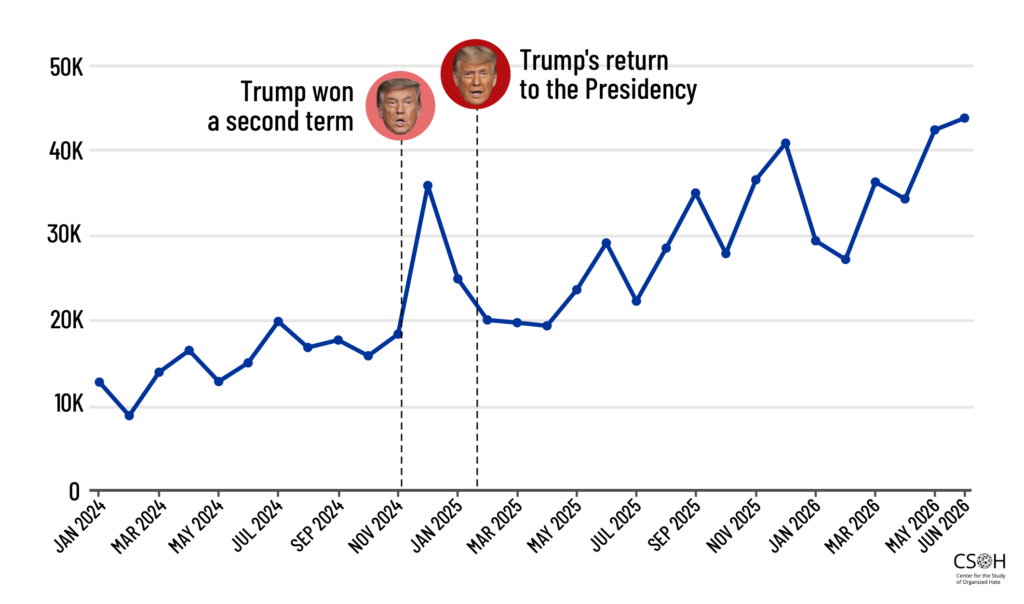
It is important to note that anti-South Asian hate was already elevated on the platform in January 2025 because of the backlash against Vivek Ramaswamy and Sriram Krishnan104 for their posts related to American culture and the H-1B visa issue and against Musk’s defense of the program105 in December 2024. The backlash centered on the topics of immigration, foreign workers, and Indian Americans and extended from December 2024 into January 2025.
Another significant development was Trump’s inauguration as president on January 20, 2025. Since assuming power as president, Trump and his administration have embarked on a highly aggressive anti-immigration agenda. The agenda includes implementing changes in immigration law,106 targeting student and immigration worker visa programs, and the arrest, incarceration, and deportation of undocumented workers through the US Immigration and Customs Enforcement (ICE) agency.107
Much of this was consistent with Trump’s campaign rhetoric and in the run-up to the 2024 presidential election, while his targeting of the H-1B visa program represented a drastic shift to a hardline stance on the matter. The second major development was President Trump’s act on his first day of signing Executive Order 14160108 to end birthright citizenship as articulated in the US Constitution, under which anyone born in the US is automatically granted citizenship.
May 2025 saw the next spike, a significant jump from April. Anti-South Asian messages, often related to the H-1B visa, had also shown a general increase across numerous social media platforms109 since January 2025. Against a general backdrop of elevated anti-Asian hate crimes110 in 2025, including those directed at South Asians, a number of interrelated factors catalyzed the spike.
On April 11, 2025, the Department of Homeland Security implemented a registration and fingerprinting mandate aimed at unregistered noncitizens. Equally impactful was Trump’s claim in May 2025111 on Truth Social that he had ended hostilities between India and Pakistan and had been instrumental in brokering a ceasefire between the sides, an assertion that was immediately met with denial by Indian authorities. The controversy that followed spilled into online discourse in the US, where anger and hostility were directed not only at India but also at Indian Americans, who were subjected to racist and xenophobic abuse based on their national origin and ethnicity.
Secretary of State Marco Rubio’s statement on May 20, 2025, that “thousands” of visas had been revoked112 by the administration also drew a significant rise in hate directed at South Asians.
Anti-South Asian hate activity remained elevated from July through September 2025, with several notable peaks corresponding with political developments, incidents involving South Asians, and policy decisions by the Trump administration.
Zohran Mamdani’s victory in the New York democratic mayoral primary on June 24, 2025, triggered a rise in online Islamophobia113 and anti-South Asian sentiment114 that had been persistent throughout his campaign. In July 2025, President Trump delivered a speech at the “Winning the AI Race Summit” in Washington, D.C., emphasizing the principle of “America First” and criticizing tech companies for outsourcing jobs to India.115 The AI Summit led to a sharp spike in anti-South Asian rhetoric online,116 including on X.
It is important to note that H-1B-related anti-South Asian hate remained persistently high throughout the period studied. In August 2025,117 Georgia Representative Marjorie Taylor Greene posted on X: “End Indian H-1B visas replacing American jobs.” Her remarks explicitly linked Indian visa holders to the displacement of American workers.
Later that month, another immigration-related controversy became a focal point for anti-South Asian and anti-Sikh hostility. On August 12, 2025, Sikh truck driver Harjinder Singh made an illegal U-turn on Florida’s Turnpike, resulting in a collision that killed three people.118 The Trump administration said Singh was in the country illegally, while the circumstances surrounding his immigration and work authorization became the subject of a broader political dispute. The incident subsequently generated a surge in anti-Sikh rhetoric and harassment extending beyond Singh to the wider Sikh trucking community.
September 2025 saw several official initiatives, ostensibly geared toward protecting American workers by targeting the H-1B visa program: the introduction of the “American Tech Workforce Act of 2025”119 in Congress; an order by President Trump to increase the fee for H-1B workers by an additional $100,000;120 the introduction of the H–1B and L–1 Visa Reform Act of 2025 in Congress;121 and the introduction of the Visa Cap Enforcement Act,122 which proposes ending visa cap exemptions for the nonprofit sector and universities. These initiatives disproportionately impact Indian workers, who constitute the majority of H-1B visa holders, and Indian students, who are the single largest group of overseas students in the US. In 2024, for instance, 71 percent of H-1B visa workers were Indian nationals, and Indian students numbered 363,000,123 the largest of all international student groups in the 2024-25 academic year. All of these factors contributed to the bump in anti-South Asian hate.
Finally, the contentious matter of tariffs on goods from India, at once an assertion of American economic nationalism and a punitive act against India, contributed to the surge in anti-South Asian hate124 on X in July and August 2025, spilling over into September.
November and December 2025 mark two more high peaks in hateful anti-South Asian content on X. The major political event in November 2025 was Zohran Mamdani’s election as New York mayor,125 with his defeat of former New York state governor Andrew Cuomo. Mamdani’s victory, widely viewed as a political earthquake, triggered a wave of anti-South Asian and Islamophobic rhetoric across the political spectrum, though primarily from the Right.
The month also saw several additional developments aimed at restricting the H-1B visa program. On November 20, 2025, Republican Congressman Chip Roy introduced the PAUSE Act126 in Congress, which proposes freezing almost all visa categories and halting the green card process for nonimmigrants. Five days later, Democratic Congressman Raja Krishnamoorthi introduced the High-skilled Immigration Reform for Employment Act.127 The act, which called for doubling the number of H-1B visas, drew a powerful racist backlash.128
H-1B immigration remained a prominent issue through November 2025. Later that month, Florida gubernatorial candidate James Fishback appeared on CNN to defend his plan for eliminating the H-1B visa program129 on the grounds that it had only helped Indians and not Americans. Around Thanksgiving, a 2024 clip of Nick Fuentes resurfaced130 in which the influencer is seen mocking J.D. Vance and his Indian-origin wife, Usha Vance, while making racist comments about Indians. These events further heightened tensions around South Asian immigrants and the H-1B issue, inflaming hate against the community on X.
Peaks in March 2026, May 2026, and June 2026 reflect ongoing developments on the political front targeting South Asians and the H-1B visa program, with June 2026 marking the highest peak in the data. Policy decisions related to the visa issue led to a general surge in anti-South Asian racism131 in the early months of the year.
On March 2, 2026, the Florida Board of Governors voted to pause new H-1B visa hires132 at state universities until early 2027. The third week of April 2026 saw another shot at the H-1B visa program, in the shape of the End H-1B Visa Abuse Act of 2026,133 which proposes stopping the program for three years and significantly reforming it. Around the same time, on his platform Truth Social, President Trump boosted comments by podcaster Michael Savage134 in which the host called India a “hellhole.”
The month of May saw more along these lines, ensuring that anti-South Asian sentiment stayed in the spotlight. The controversy over so-called “grooming gangs” in the United Kingdom also spilled into anti-South Asian discourse in the United States. A report released by British politician Rupert Lowe135 in June 2026 focusing on the involvement of men of Pakistani heritage in group-based child sexual exploitation was widely amplified by right-wing and MAGA-aligned accounts in the US, including by Elon Musk,136 who had played a central role in bringing renewed global spotlight to the issue since January 2025. Endorsing the findings of the report, Musk posted, “The politicians who turned a blind eye to the Rape of Britain must go to prison.”137 The controversy increasingly became a vehicle for broader anti-Pakistani rhetoric, with crimes committed in Britain generalized to Pakistanis as a group and used to target Pakistani-Americans as well.
Anti-South Asian Hate on 4chan, 8chan, and Gab
Across 4chan, 8chan, and Gab, we identified 397,522 mentions containing anti-South Asian hate or related hostile and violent narratives. The data show an online environment in which racism targeting South Asians was both persistent and deeply entrenched throughout the year. The combined dataset is overwhelmingly driven by 4chan, which accounts for more than 90% of all mentions. Limitations in Gab and 8chan collections mean that their data establish the presence and character of hate, rather than allowing reliable comparisons of prevalence across the three platforms.
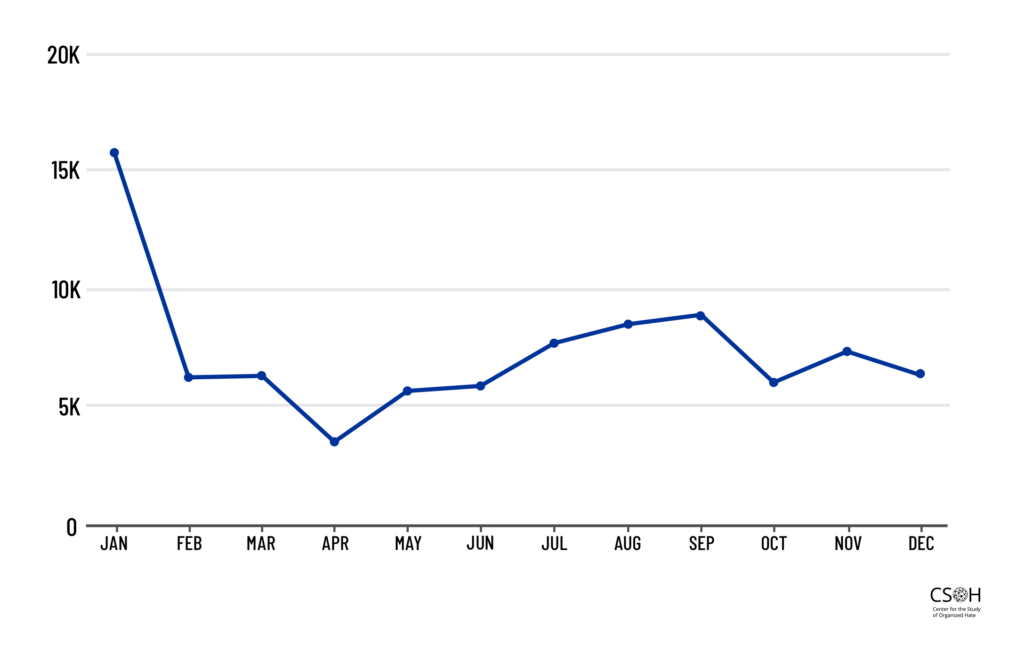
FIGURE 4. MONTHLY VOLUME OF ANTI-SOUTH ASIAN HATE ON 4CHAN, 8CHAN, AND GAB (2025)
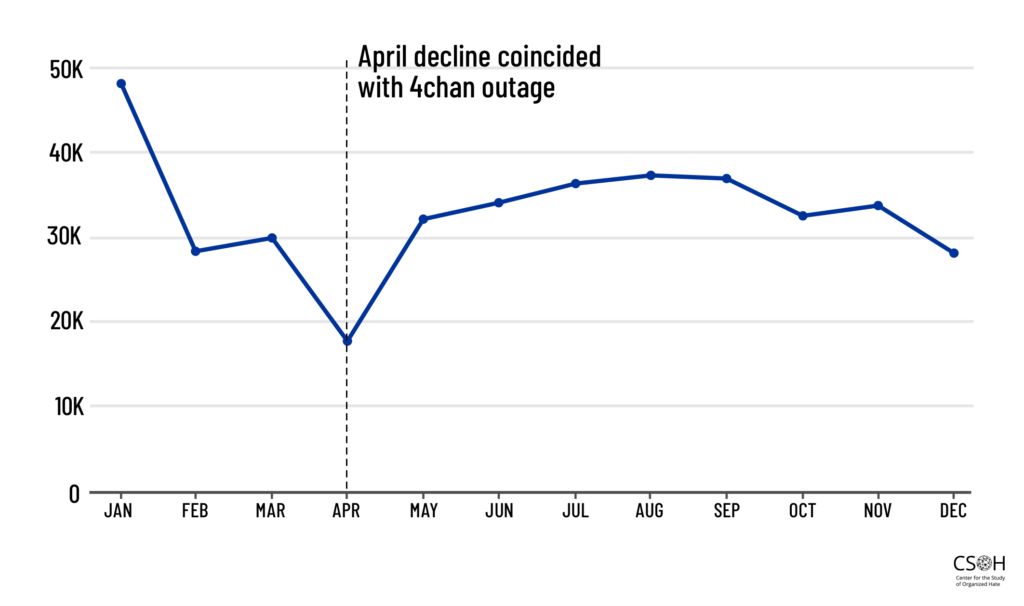
After reaching a high of around 48,496 mentions at the beginning of January 2025, anti-South Asian hate and incitement declined throughout the month before stabilizing around the 30,000-mention mark through February and March. Following another decline in April to 17,986 mentions, activity climbed back to around 32,294 in May and remained broadly within the 30,000–38,000 range through the end of the year. From around May 2025 onward, the data therefore show a persistently elevated baseline of anti-South Asian hate across these platforms, with the volume of hateful mentions lower than at the beginning of January but well above the level recorded at the start of April.
The content of anti-South Asian hate reflects the character of the platforms, with their right-wing ideological slant, culture of in-jokes, memes, and celebration of negative sentiments. Thus, while not entirely unconnected to external events, in comparison to X, anti-South Asian hate on 4chan, 8chan, and Gab is driven by the nature and culture of the platforms.
On the three platforms, anti-South Asian racial slurs like “pajeet” and its variations appear in 45% of mentions, while 22% invoke immigration, invasion, and great replacement narratives, including claims about South Asians “stealing” American jobs, suppressing wages, committing visa fraud, or being imported as cheap labor. 17% invoke stereotypes related to filth and hygiene or use other forms of dehumanizing language, while narratives portraying South Asians as religiously or morally degenerate account for 5% of mentions. These overlapping narratives reveal an interconnected ecosystem in which racial slurs, dehumanization, economic resentment, anti-immigrant sentiment, and replacement conspiracy theories reinforce one another.
Dominant Narratives and Forms of Anti-South Asian Hate
Our analysis revealed a detailed picture of the overall landscape of anti-South Asian hate in the corpus of posts that we identified through searches on the platforms. We identified seven clear dominant narratives of anti-South Asian hate across all platforms.
The seven narratives are distinct but intersect in that posts often contain elements of more than one narrative. For instance, a post may contain a racial slur against South Asians while also painting South Asians as a demographic threat to the majority population. Or a post may describe South Asians as unhygienic while also denigrating them as religiously depraved. Posts may use AI to present a visual narrative of South Asians as vermin invading the US or to present South Asian physical features in highly exaggerated and racist form. Given X’s distinctiveness from the other three platforms, we analyzed the results and have described the findings for X separately from those for the other three platforms. Results and findings for 4chan, 8chan, and Gab were analyzed collectively and presented as such.
Racial Slurs and Cultural Denigration
A key narrative of anti-South Asian hate in the data relates to slurs about South Asian culture and identity. The slurs include abusive terms that are used specifically for South Asians, like “pajeet,”138 “paki” and their plural or feminine139 forms, and “sand n****r.”140 They also include insults related to food, like the term “curry muncher” and references to the unpleasant smell of Indian food. Some slurs are combinations of both types of insults captured in terms like “curry n****r.”141
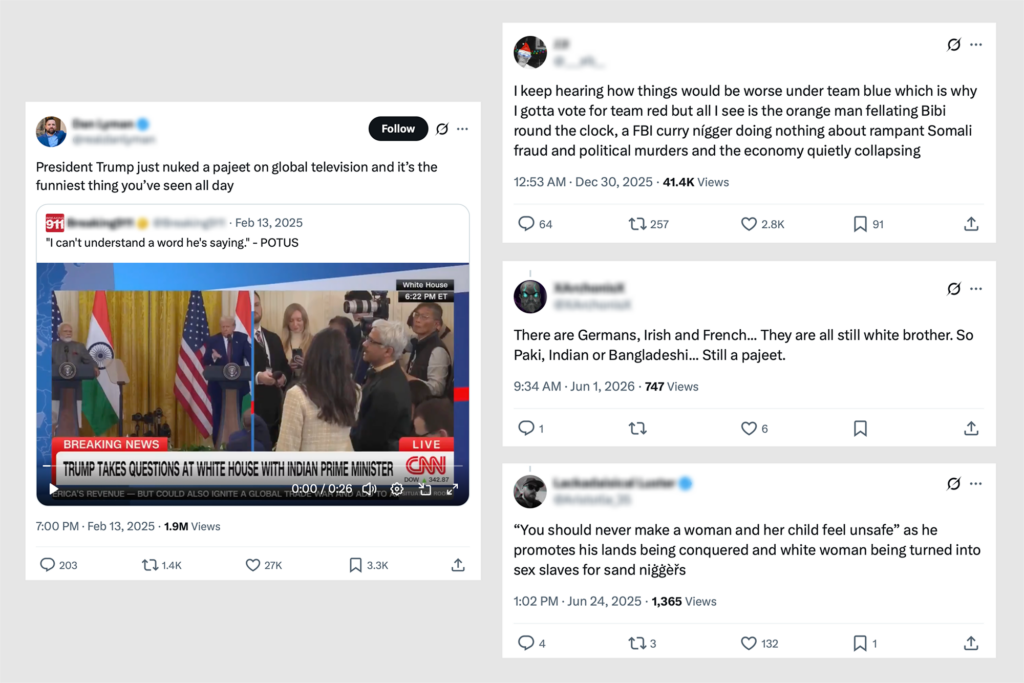
Between January 1, 2025, and June 30, 2026, we identified 168,393 posts on X that contained slurs targeting South Asian culture and identity, representing approximately 31% of the total anti-South Asian posts identified during the study period.
FIGURE 5. MONTHLY VOLUME OF RACIAL SLURS ON X (JAN 2025–JUN 2026)
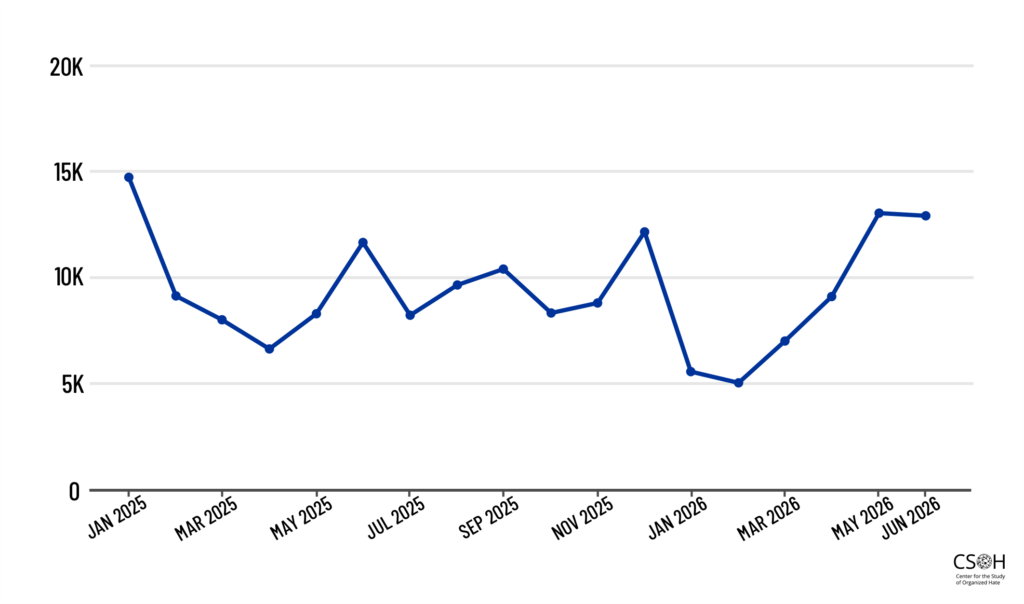
The term “pajeet” and its variants were overwhelmingly dominant within this narrative, accounting for around 162,916 mentions, or 30% of all anti-South Asian posts identified on X.
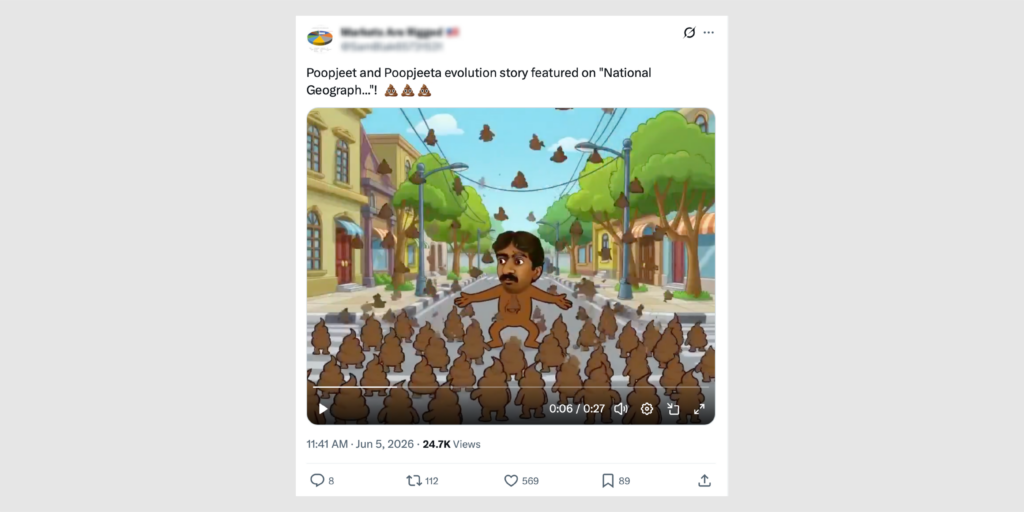
Coinages such as “poopjeet,” which meld the term “pajeet” with the trope of South Asians as physically unclean, are also found in the data. Since 2025, these terms have gained more visibility across social media platforms.
Racial slurs are the most pervasive form of anti-South Asian hate identified across 4chan, 8chan, and Gab. The slur “pajeet” and its variants appear in 177,593 (45%) of the total data. We found that the slur was frequently modified with prefixes and suffixes or combined with stereotypes about hygiene, immigration, employment, and race.
FIGURE 6. MONTHLY VOLUME OF RACIAL SLURS ON 4CHAN, 8CHAN, AND GAB (2025)
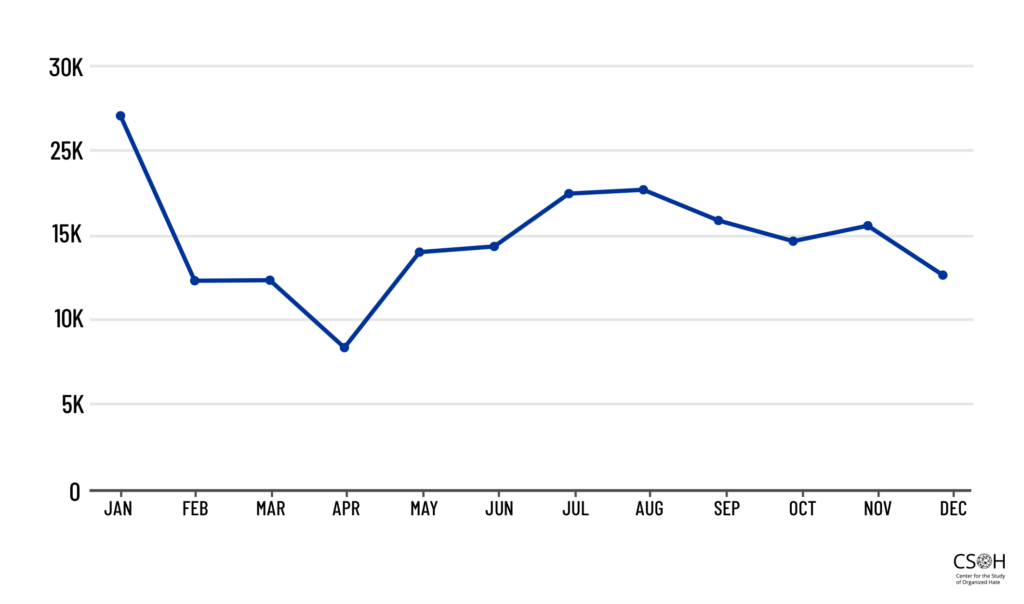
Variants include “poojeet,” “shitjeet,” and “migajeet,” as well as the verb “jeeted,” demonstrating how the term has evolved from a single slur into an expanding vocabulary of anti-South Asian abuse. Feminized forms, including “pajeeta” and “poojeeta,” further extend this vocabulary of racialized abuse to South Asian women.
South Asians as Invaders and a Demographic Threat
One of the most prominent narratives in the data portrays South Asians as “invaders” who are taking over the US or pose a demographic threat to the country. This narrative accounted for 245,099 posts on X between January 2025 and June 2026, equivalent to approximately 45% of the total anti-South Asian posts identified during the study period. Over the same period, its monthly volume increased by approximately 101%, rising from 10,003 mentions in January 2025 to 20,061 in June 2026.
FIGURE 7. MONTHLY VOLUME OF POSTS PORTRAYING SOUTH ASIANS AS DEMOGRAPHIC THREAT ON X (JAN 2025–JUN 2026)
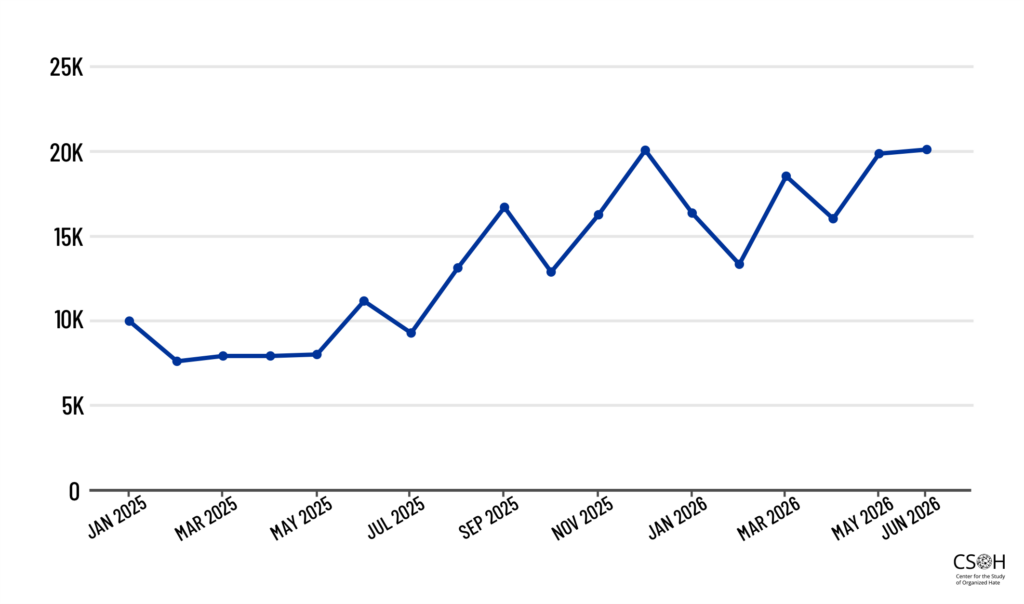
The invasion narrative is constructed through a number of claims, including: South Asians stealing well-paying American jobs in prestigious occupations and effecting an economic assault on American workers, especially through the H-1B visa program,142 but also through other means such as remittances;143 South Asians, whether Indians, Pakistanis, Bangladeshis, or others, imposing their “alien”144 ways of life on American society; South Asians as scammers and fraudsters; and South Asians deliberately taking over American cities and other spaces like universities through demographic flooding.
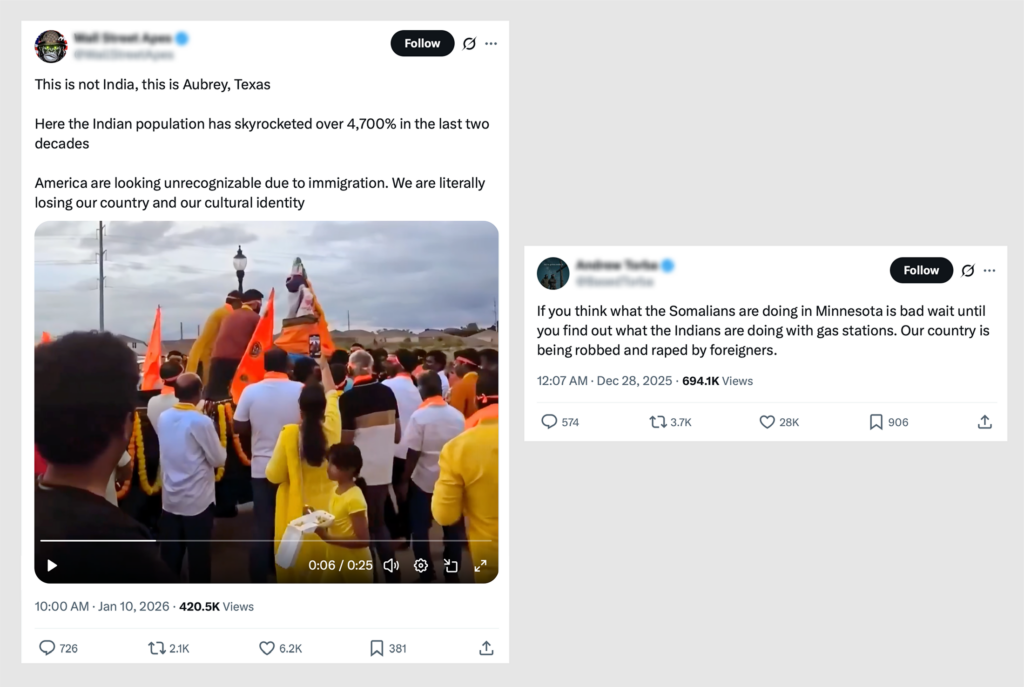
The “job stealer” narrative extends beyond the technology sector into professions such as healthcare. In one post, the matching of eight Pakistani medical graduates to a residency program in New Jersey was presented as evidence that “foreigners are taking over our healthcare system.”
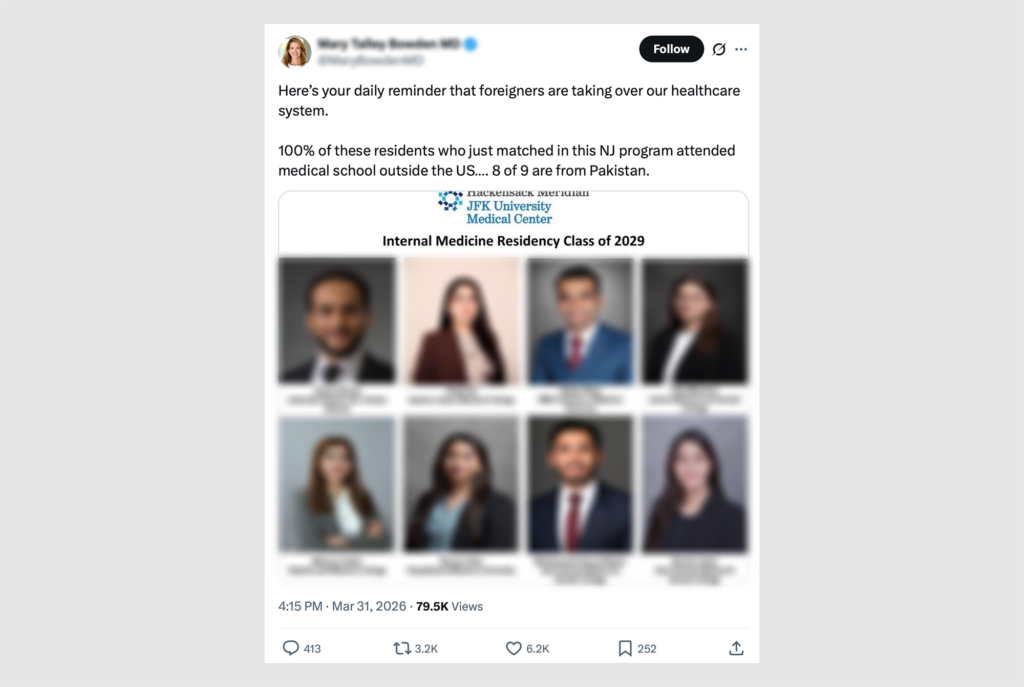
Many posts often combine one or more of these accusations. The narrative of South Asian invasion and demographic threat also includes calls to ban immigration from South Asia,145 denaturalize South Asian Americans, and deport, “remigrate,” or otherwise physically remove South Asians from the US.
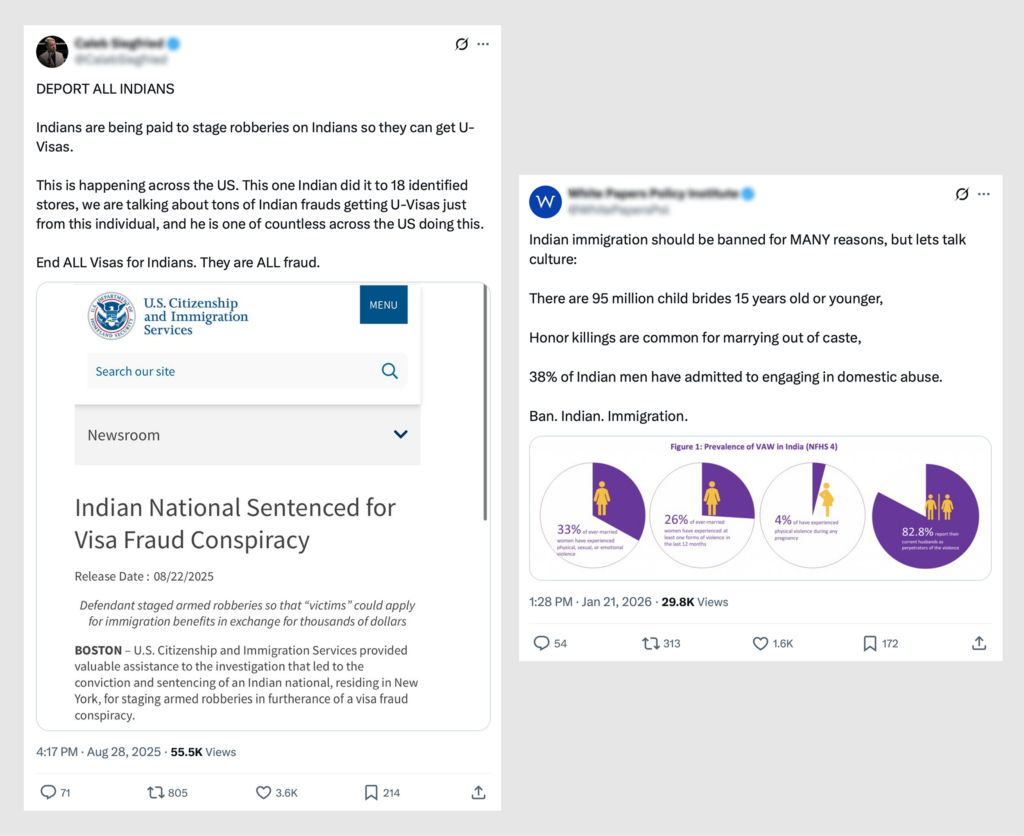
Texas as a Center of the “Invasion” Narrative
Documentary-style videos alleging an Indian “invasion” have emerged as another means of manufacturing purported evidence for the narrative that South Asians are taking over American community life and spaces. Frontlines TPUSA, an outlet of Turning Point USA, published a documentary titled “The Indian and Muslim Takeover of Texas”146 on X on April 2, 2026, which received more than 900k views as of September 2026.
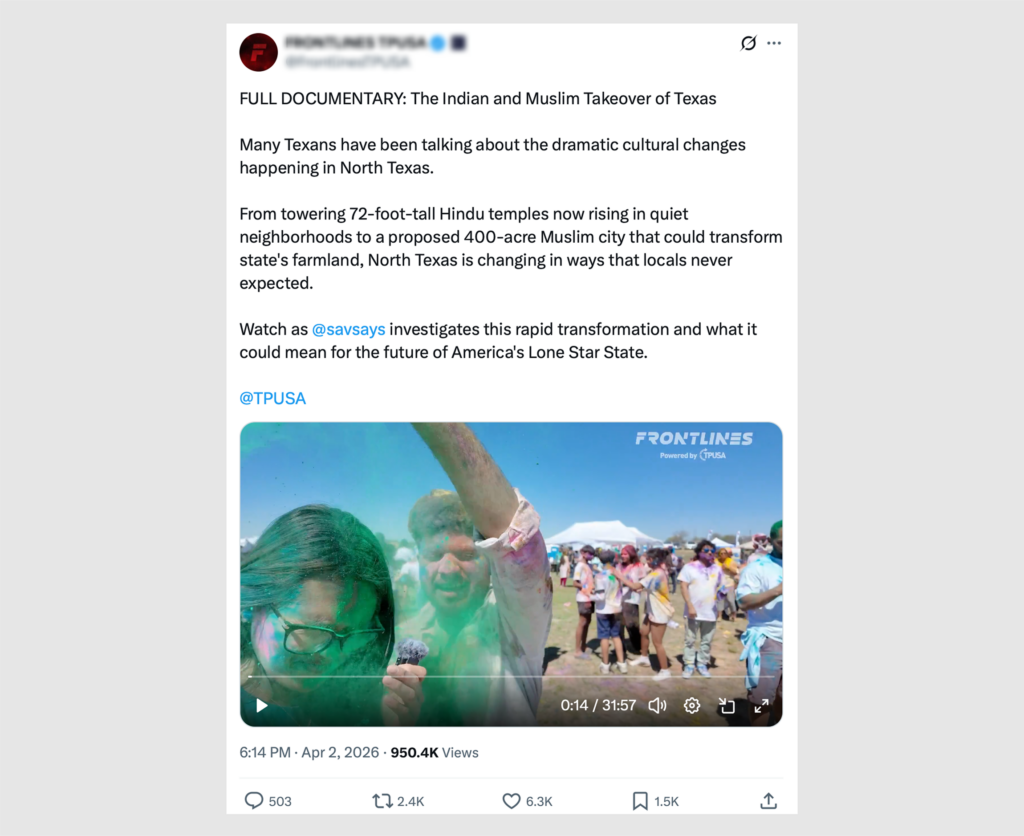
Similar documentaries are also produced by influencers such as Tyler Oliveira, who has 9.66 million subscribers on YouTube and 426k followers on X. On April 5, 2026, Oliveira posted a nearly hour-long documentary titled “I Exposed Texas’ Indian Invasion”147 on YouTube. As of September 2026, it had received 3.2 million views on YouTube and 4.2 million views on X.
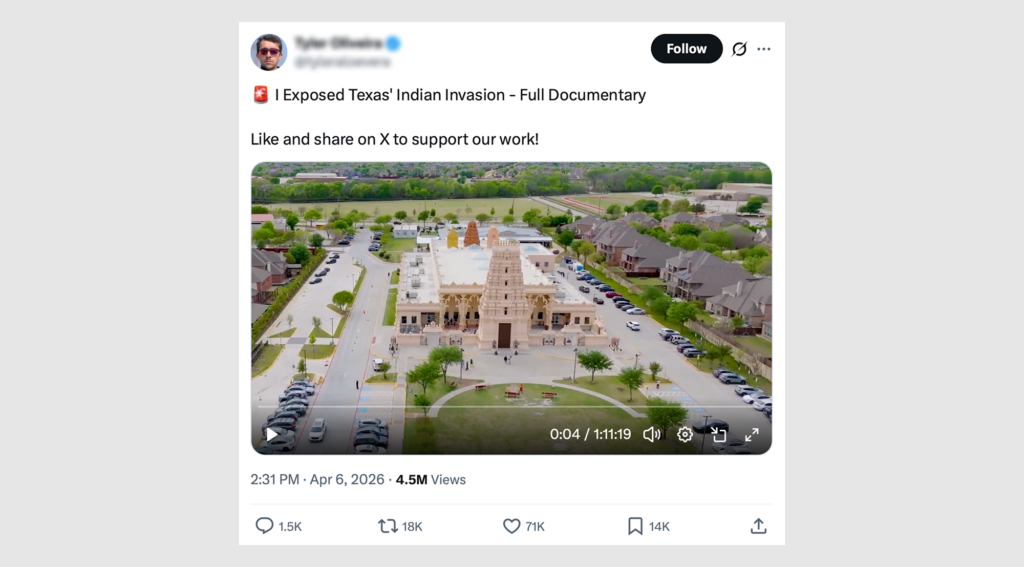
These documentaries typically focus on neighborhoods with significant South Asian populations or prominently feature South Asian homes, businesses, places of worship, and public spaces, presenting their presence as evidence of an “invasion.” Selective footage, interviews, and B-roll are used to create the impression that South Asians are displacing other communities or becoming dominant in certain areas.
The Dallas-Fort Worth area has been at the center of such narratives in MAGA-aligned and adjacent right-wing online spaces, particularly with regard to claims of both “Islamification” and an Indian “invasion.” Frisco, a suburb of Dallas, has repeatedly been targeted by influencers who produce vlogs and documentary-style videos that portray its growing South Asian population as evidence of a demographic takeover.
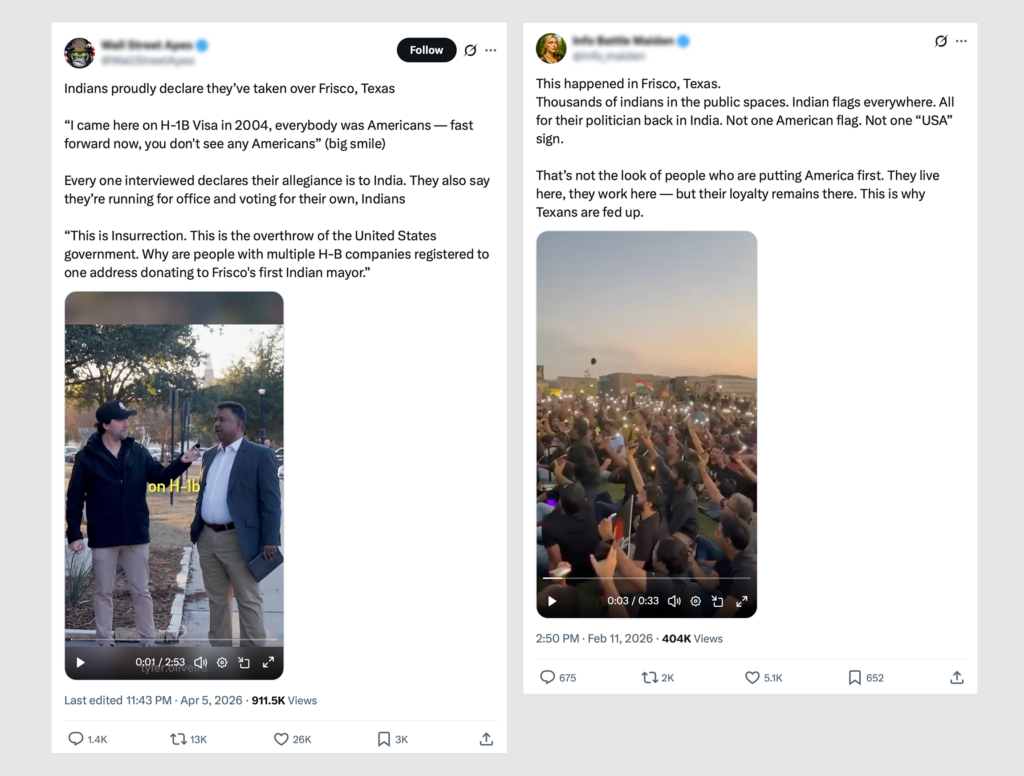
However, the city’s demographic composition presents a much more complex picture: in a population of close to 245,000, white residents remain the largest racial group at 45.5%, followed by Asian residents at 33.6%.148
While a large number of hateful posts in this category, particularly those concerning the H-1B visa program, specifically target Indians, other South Asians, including Pakistanis,149 are subjected to similar attacks. The narrative of a South Asian invasion also overlaps with the prominent MAGA-aligned narrative of an Islamic “invasion” of America,150 collapsing ethnic, national, and religious identities into a broader narrative of demographic and cultural replacement.
4chan, 8chan, and Gab
Similarly, across 4chan, 8chan, and Gab, South Asians are referred to as an invading population that poses a severe threat to American jobs, communities, and national identity. This narrative accounted for 88,707 mentions, representing 22% of the total data. Employment and immigration serve as the frame for the discourse of South Asians as invaders. South Asian workers are portrayed as taking American jobs, suppressing wages, committing visa fraud, or being imported as cheap labor.
FIGURE 8. MONTHLY VOLUME OF MENTIONS PORTRAYING SOUTH ASIANS AS A DEMOGRAPHIC THREAT ON 4CHAN, 8CHAN, AND GAB (2025)
Mentions also mimic stereotypical South Asian accents, adopt fabricated Indian personas, and perform exaggerated racial caricatures to portray South Asians as unethical people who engage in scams, run bot forms, and even colonize discussion boards. Posts frequently employ the ironic, memetic, and deliberately offensive culture of the platforms.
These claims frequently escalate into Great Replacement-style narratives, presenting South Asian migration as deliberate demographic displacement of Americans. Such replacement narratives are also yoked with antisemitic conspiracy theories which contend that Jews are responsible for importing, financing, and orchestrating Indian migration into Western countries. This claim presents South Asian immigration as part of a broader global conspiracy to engineer demographic replacement in the US. Posts advancing this narrative also call for the deportation or removal of South Asians from the country.
Filth, Hygiene, and Racial Degradation
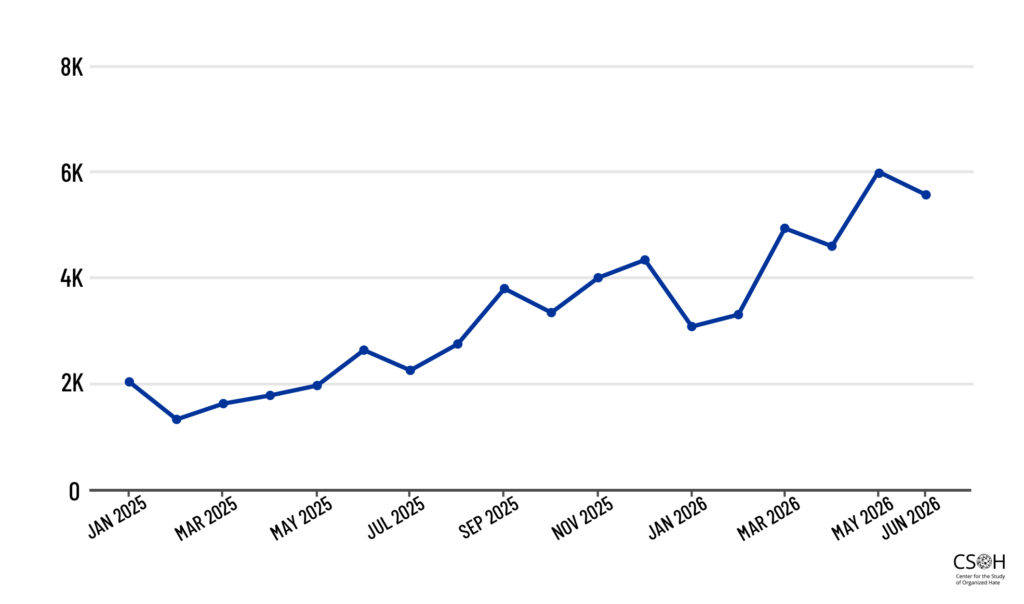
The narrative portraying South Asians as physically dirty and racially degrading them through stereotypes about hygiene accounted for 59,441 posts on X between January 2025 and June 2026, representing 11% of all anti-South Asian posts identified during the study period. Monthly volume increased 2.7-fold (171%) over the study period, rising from 2,052 posts in January 2025 to 5,557 in June 2026.
FIGURE 9. MONTHLY VOLUME OF POSTS ON FILTH, HYGIENE, AND RACIAL DEGRADATION ON X (JAN 2025–JUN 2026)
This narrative relies heavily on degrading and dehumanizing imagery, depicting South Asians as inherently unhygienic through phrases such as “stinky Indians” and “filthy Indians.” Posts fixate on their perceived smell, alleged lack of civic sense, and supposed inability to adhere to Western or Christian norms of cleanliness and etiquette, often attributing these stereotypes to an intrinsically uncivilized and uncouth nature. The narrative also includes abusive terms such as “street pooper” and characterizes South Asians as routinely defecating in public. Indians and Hindus are also mocked as drinkers of cow urine.
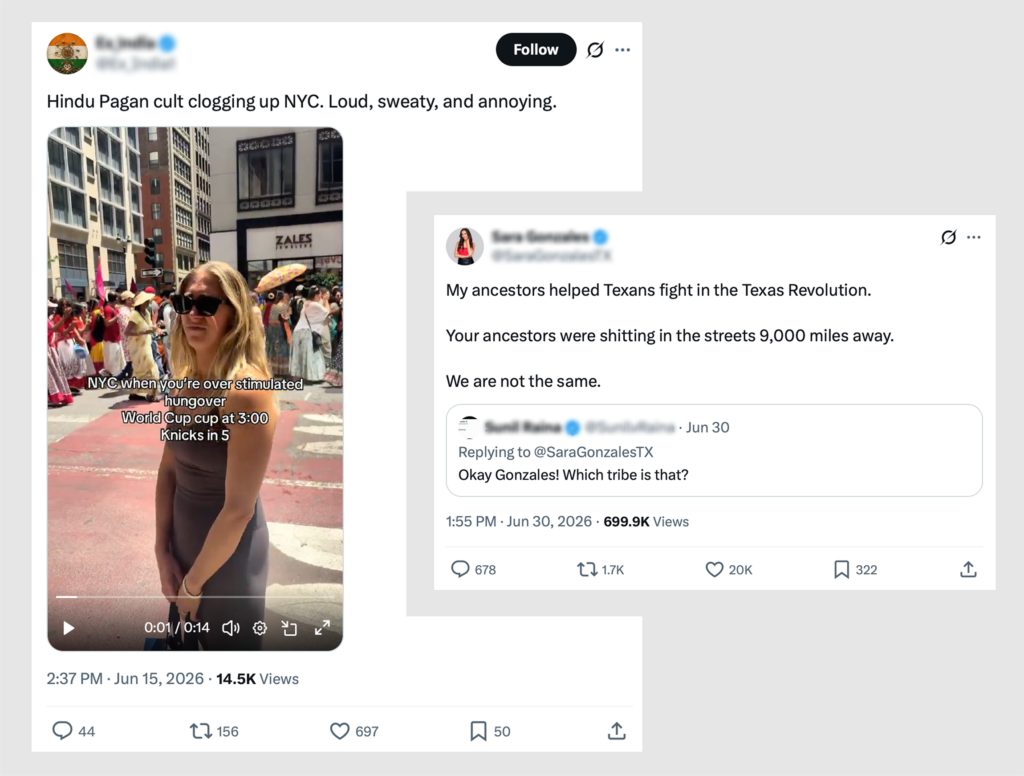
These stereotypes are projected onto South Asian countries and societies. Posts depict South Asian cities, rivers, and beaches as filthy and polluted,151 while claiming that Indian and Pakistani immigrants are transforming American cities into copies of South Asian cities.
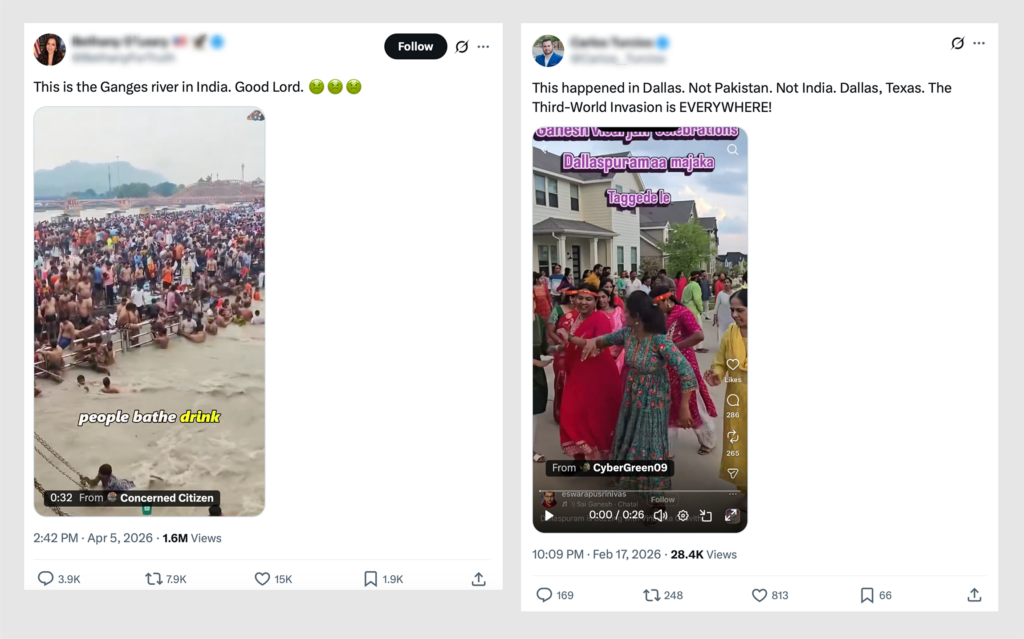
Images and videos of South Asian cities or migrant communities are frequently circulated as purported visual evidence for these claims, with isolated images and videos used to make sweeping racist generalizations about entire South Asian populations.
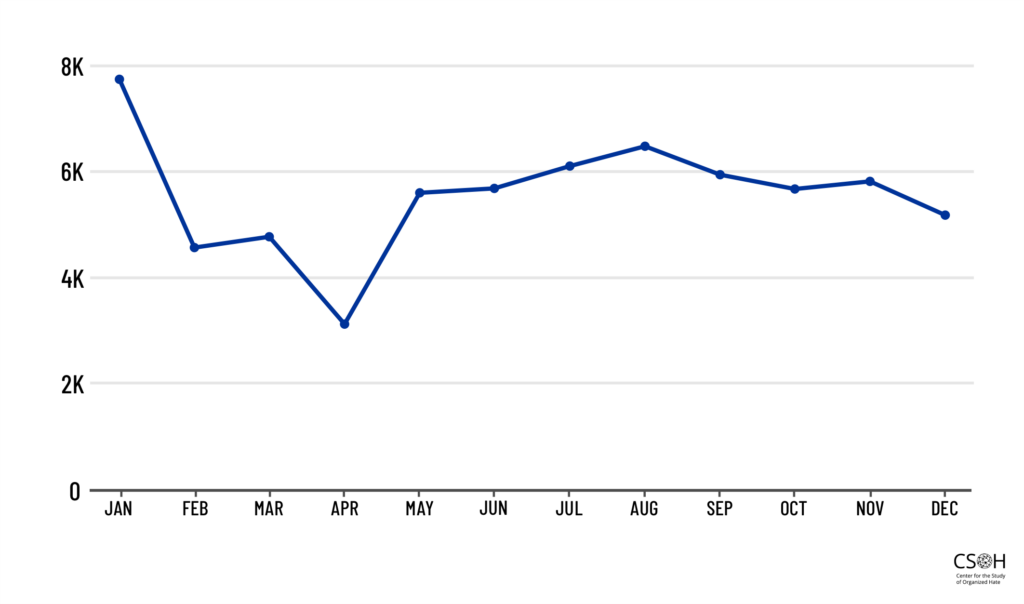
On 4chan, 8chan, and Gab, the narrative portraying South Asians as physically dirty accounted for 66,733 mentions, representing 17% of the total data. The rhetoric is strongly dehumanizing, with mentions depicting South Asians as vermin, carriers of disease, and sources of contamination constituting the largest category within the narrative.
FIGURE 10. MONTHLY VOLUME OF DEHUMANIZING MENTIONS TARGETING SOUTH ASIANS ON 4CHAN, 8CHAN, AND GAB (2025)
Scatological slurs such as “street shitter,” alongside descriptions of South Asians as dirty, smelly, and associated with feces and cow dung, form the next largest category.
The narrative also includes degrading and racist coinages such as “brownoid” and “fecaloid,” reflecting the linguistic norms and memetic culture of these fringe platforms while reducing South Asians to racialized and corporeal stereotypes.
South Asians as Religiously and Morally Degenerate
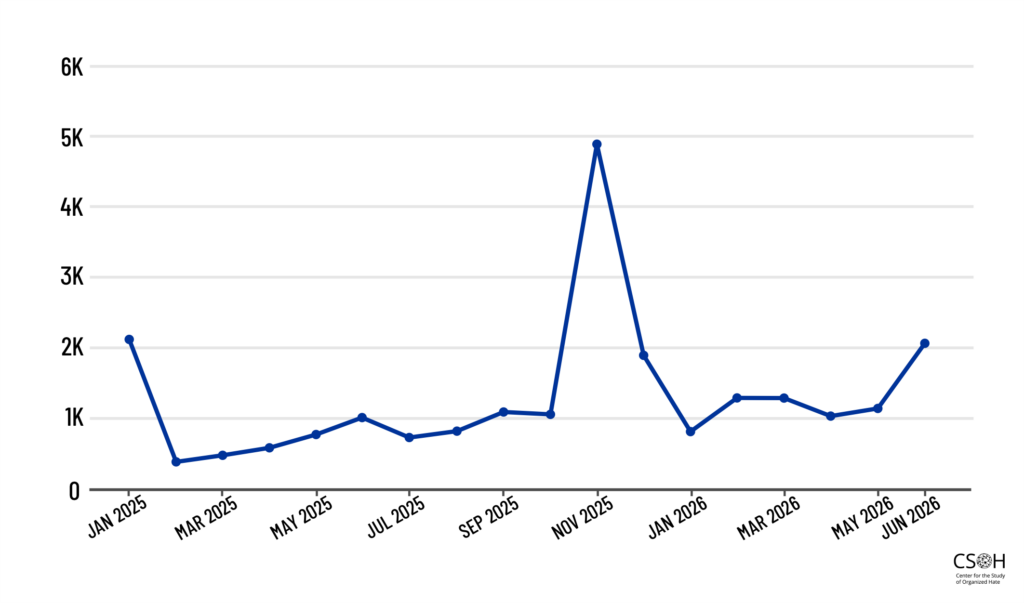
The narrative of religious and moral degeneracy of South Asians accounted for 23,354 posts, or 4% of all anti-South Asian posts identified during the study period. The volume fluctuated sharply, with a significant spike in November 2025. The spike coincided with the spillover of the UK grooming-gangs discourse into the US, as narratives surrounding the controversy were increasingly directed at Pakistani Americans.
FIGURE 11. MONTHLY VOLUME OF POSTS PORTRAYING SOUTH ASIANS AS RELIGIOUSLY AND MORALLY DEGENERATE ON X (JAN 2025–JUN 2026)
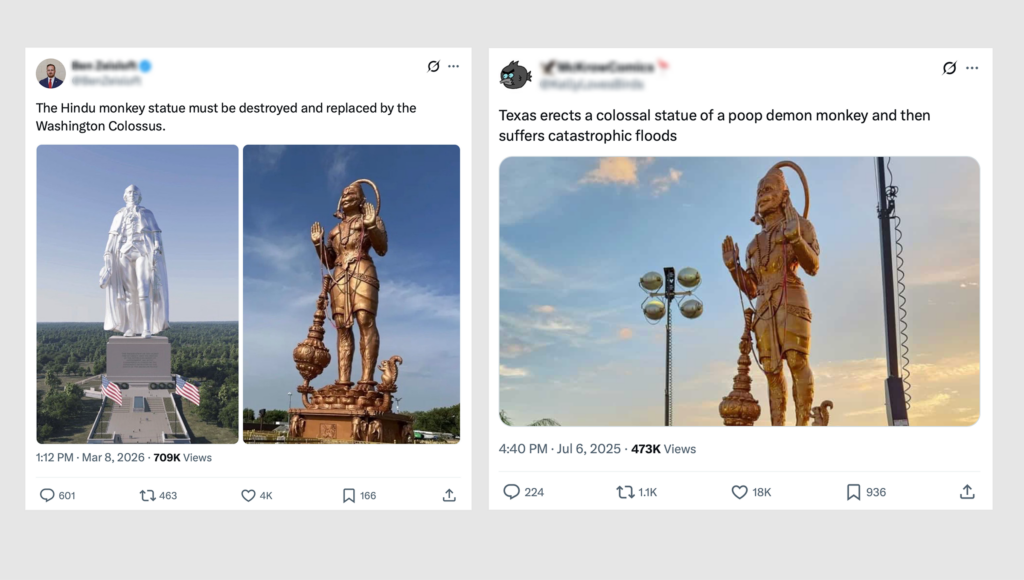
One strand of this narrative targets South Asian religious identities and practices, portraying them as demonic, pagan, and fundamentally incompatible with Christianity. South Asians are literally demonized, routinely referred to as “demon worshippers”152 and South Asian deities depicted in abusive and racist terms. Lord Hanuman, for example, is described as a “poop demon monkey.”153 Some posts go further, calling for South Asian places of worship, including the Hanuman Temple in Frisco, Texas, to be destroyed or removed and replaced with supposedly “American” monuments.
A second strand in the narrative portrays sexual deviance and a supposed propensity to sexually harass154 or rape women as intrinsic characteristics of South Asian men and communities. South Asians are also characterized as “inbred,” with inbreeding presented as a widespread South Asian cultural practice. This narrative extends to the discourse around “grooming gangs,”155 in which documented cases of group-based child sexual exploitation involving some perpetrators of Pakistani heritage are generalized into claims about Pakistanis and South Asians as a whole.
Much of the grooming-gang discourse is imported from the United Kingdom, where a number of high-profile cases have involved men of Pakistani heritage.156 Drawing on the UK-based discourse, right-wing organizations in the US are similarly raising a moral panic about the possibility of the same phenomenon occurring here157 as a result of Pakistani immigration. On X, these cases are frequently racialized and generalized into narratives portraying child sexual exploitation as an inherently Pakistani, Muslim, or South Asian phenomenon.
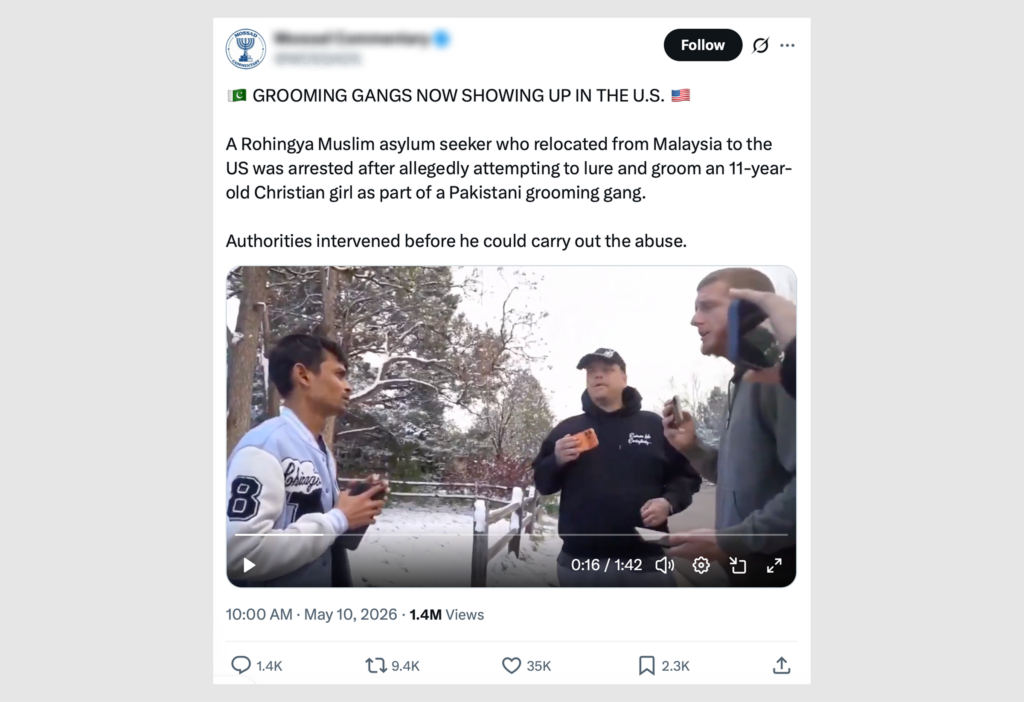
Elon Musk has played a prominent role158 in amplifying the UK grooming-gangs controversy to a global audience, helping bring these narratives into wider political and online discourse.
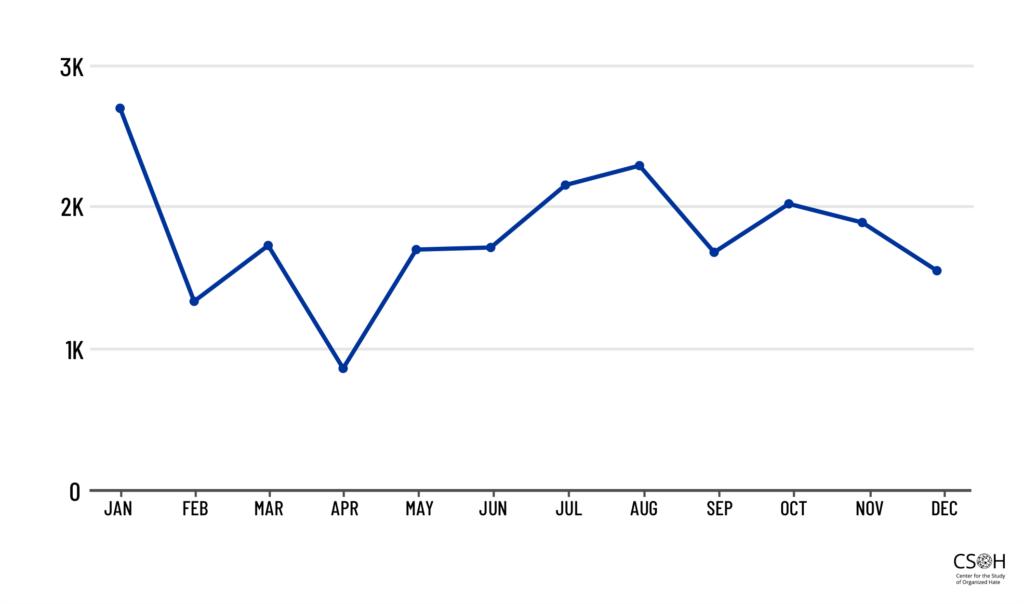
On 4chan, 8chan, and Gab, the narrative portraying South Asians as religiously and morally degenerate accounts for 21,644 mentions, representing 5% of the total data.
FIGURE 12. MONTHLY VOLUME OF MENTIONS PORTRAYING SOUTH ASIANS AS MORALLY DEGENERATE ON 4CHAN, 8CHAN, AND GAB (2025)
The narrative here falls into two broad categories. One category consists of racist and degrading generalizations about grooming gangs, rape culture among South Asians, and the treatment of women in South Asian culture as possessions and objects for breeding. A second category weaponizes stereotypes about casteism among South Asian cultures as proof of their undemocratic and innately hierarchical culture, by implication at odds with the egalitarian culture of the West.
Doxxing and Targeted Harassment of South Asians
The data also reveal a pattern of doxxing and harassment targeting South Asians who are perceived to be H-1B visa holders, as well as businesses and employers accused of employing H-1B workers.
A number of X accounts appear to be dedicated primarily to identifying and targeting immigrants, particularly South Asians who they believe to be working in the US on H-1B and other visas.
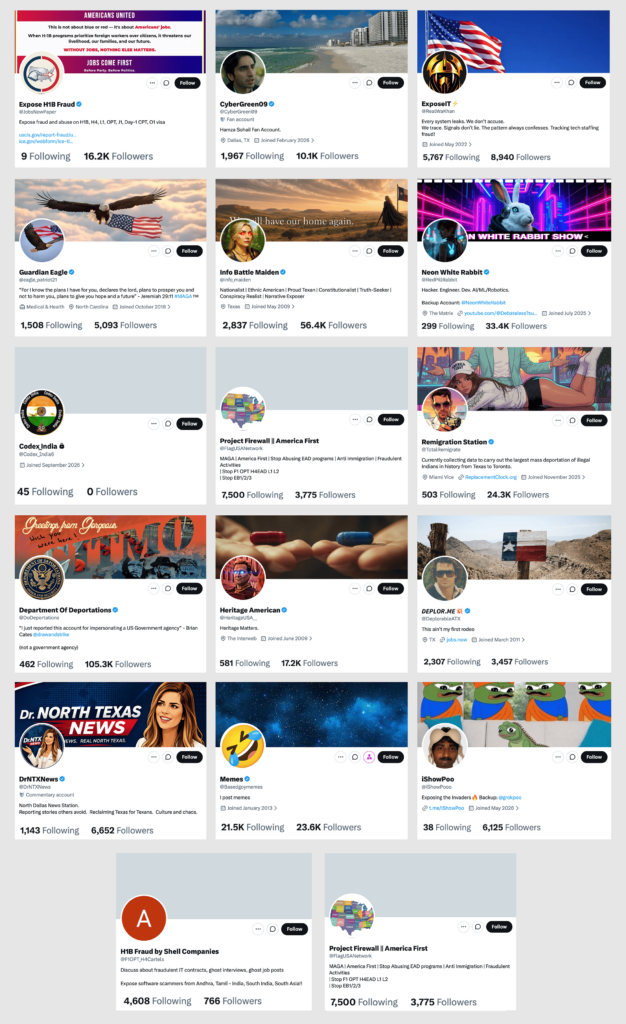
Some of these accounts search LinkedIn and other social media platforms for photographs and personal and professional information about South Asians, which they then republish on X to expose their targets to larger audiences.
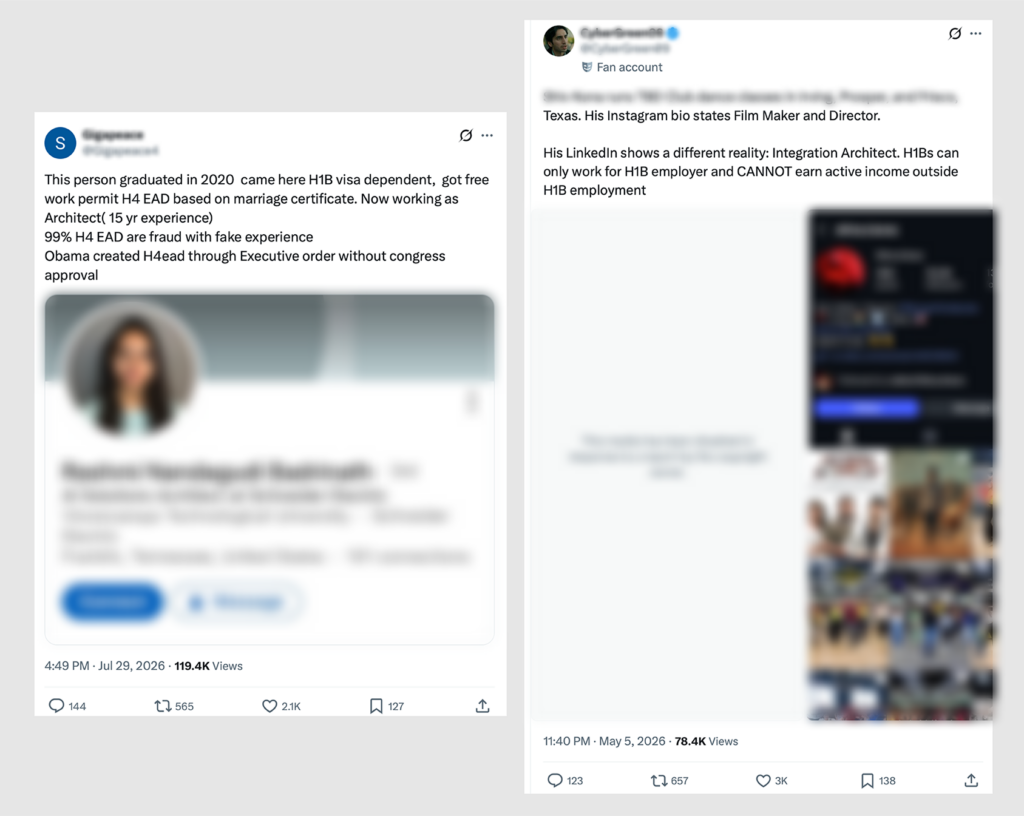
Posts frequently include photographs, names, employers, job titles, educational and professional histories, and purported visa or immigration status, often alongside unsubstantiated allegations of visa abuse, immigration fraud, or displacement of American workers. In some cases, individuals are assumed to be H-1B workers based on their South Asian identity, regardless of their actual citizenship or immigration status.
These accounts also encourage users to report targeted individuals to immigration or other government authorities, while directing attention toward their employers and workplaces. Such campaigns target ordinary workers as well as prominent South Asian professionals and executives. The aggregation and redistribution of information from LinkedIn and other platforms can expose South Asian individuals who have previously had a minimal or no public profile to harassment by much larger online audiences.
Another form of harassment moves from online targeting into physical spaces. Digital influencers confront South Asians at their workplaces, businesses, or homes under the pretext of “investigating159” their visa, immigration status, or their alleged role in immigration fraud.
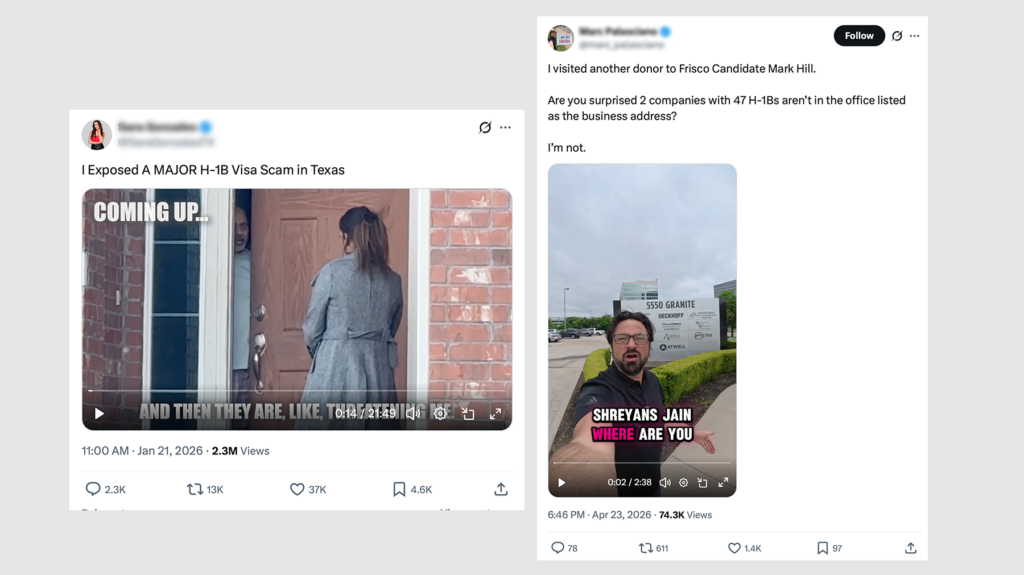
These encounters are filmed, edited, and subsequently uploaded to social media, where individuals are publicly identified and portrayed as suspected abusers of immigration policies or visa regulations, sometimes without evidence of their actual immigration status. In this manner, anti-H-1B rhetoric has become a vehicle for targeted harassment of South Asians.
Hate Targeting Politically Prominent South Asians
The growing visibility of South Asians in American political life has become another focal point for anti-South Asian hate online. The narrative targeting politically prominent South Asians combines economic resentment, hostility toward immigration, fears of demographic domination and political replacement, and resentment of the growing political and socioeconomic prominence of South Asian Americans.
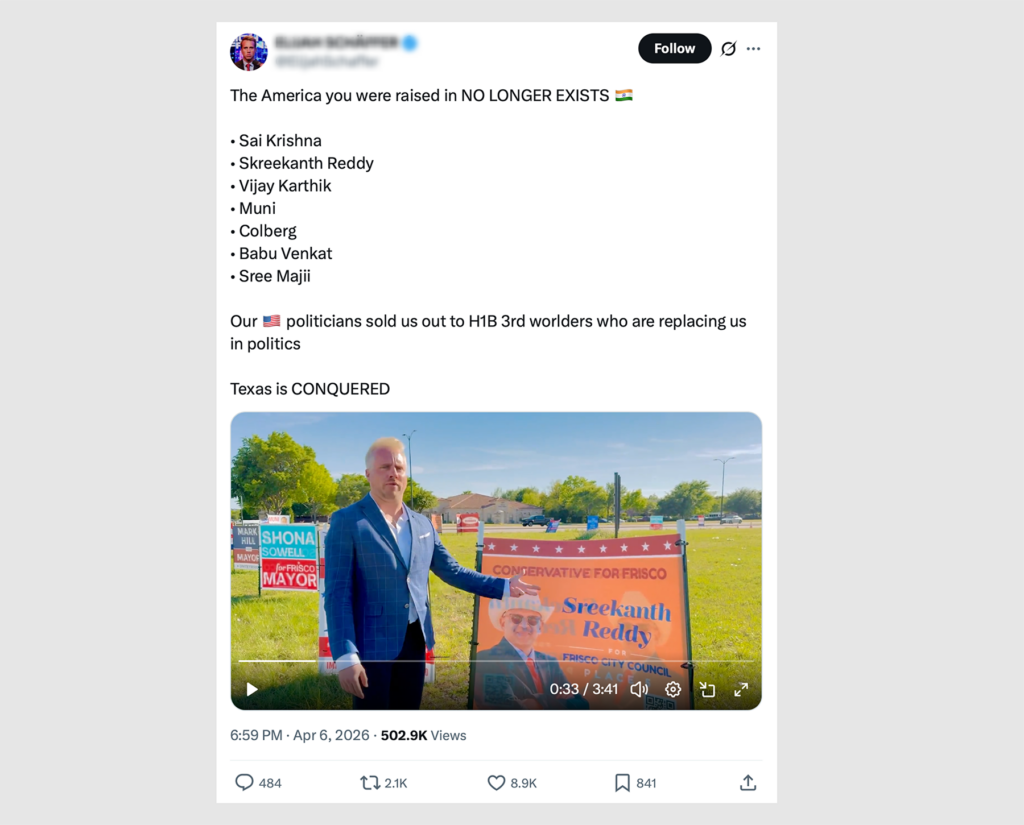
Political participation itself is sometimes portrayed as evidence of an organized takeover. South Asians holding public office, receiving political appointments, making campaign contributions, or developing relationships with elected officials are singled out as evidence of supposed South Asian “infiltration” and growing political control.
South Asian political figures across national, religious, and partisan backgrounds have faced racist, xenophobic, or religiously targeted attacks on social media. They include former Vice President and 2024 Democratic presidential nominee Kamala Harris;160 Second Lady Usha Vance;161 FBI Director Kash Patel;162 Zohran Mamdani,163 the mayor of New York City; Virginia Lieutenant Governor Ghazala Hashmi; Representatives Pramila Jayapal,164 Ro Khanna,165 Raja Krishnamoorthi,166 Shri Thanedar,167 Ami Bera, and Suhas Subramanyam; former presidential candidate and current candidate for governor of Ohio Vivek Ramaswamy;168 Sriram Krishnan,169 who served as a White House policy adviser on artificial intelligence; and Virginia state Senator Saddam Salim.170 The targeting of prominent South Asians cuts across partisan, national-origin, and religious lines, although the forms of hostility vary according to the identity of the targeted individual.
South Asians serving in the Trump administration and those aligned with the president have not been insulated from such attacks. At a Senate hearing, Kash Patel171 described racist abuse and violent threats directed at him. Harmeet Dhillon,172 Assistant Attorney General for Civil Rights at the Department of Justice, was subjected to racist attacks amid anger over immigrant Sikh truck drivers following a fatal traffic accident involving a Sikh driver. Indian American conservatives, including Ramaswamy,173 have similarly faced attacks questioning their Americanness on the basis of their race, ancestry, or religion. These examples demonstrate how anti-South Asian rhetoric can transcend partisan affiliation, targeting even figures closely associated with political movements from which some of the attacks originate.
Virginia state Senator Saddam Azlan Salim, a Bangladeshi American and Muslim, faced anti-South Asian and anti-Muslim attacks over several pieces of legislation that he introduced in 2026, including bills addressing Islamophobia,174 restricting assault-style firearms,175 and limiting state and local law-enforcement cooperation with federal immigration authorities.176 The backlash included claims that Salim was attempting to impose “Sharia law,” attacks focusing on his immigrant and Muslim background, and calls for him to be denaturalized and deported.177
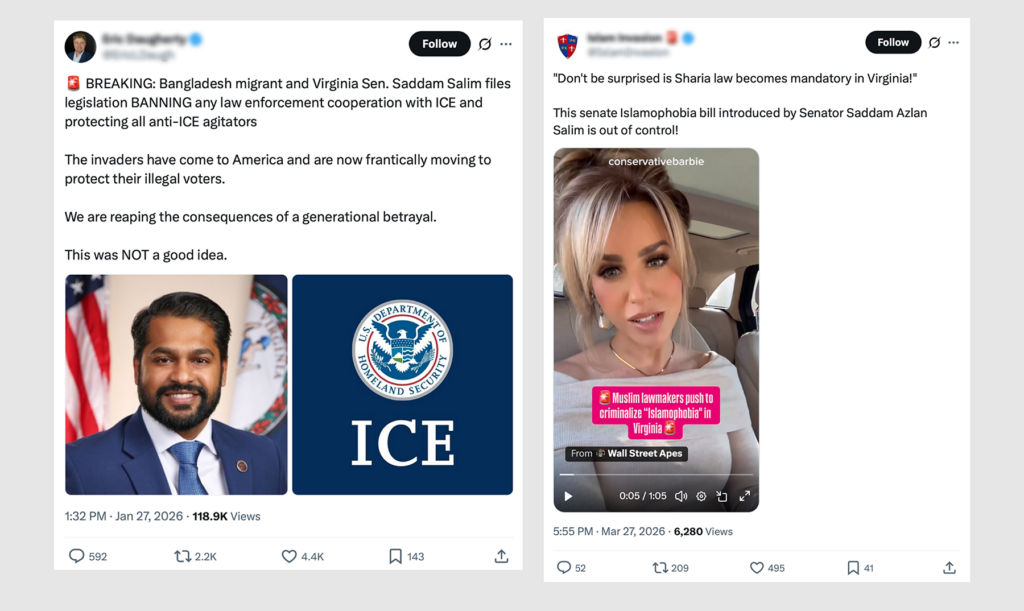
In these attacks, opposition to Salim’s policies was accompanied by rhetoric questioning his Americanness and his legitimacy as an elected official, on grounds of his national origin and religion.
The targeting of prominent South Asians extends beyond those who hold public office to South Asians who participate in political life through campaign contributions, political relationships, and appointments to public bodies. For instance, Pakistani American businessman S. Javaid Anwar has been singled out over his political donations and relationship with Texas Governor Greg Abbott.
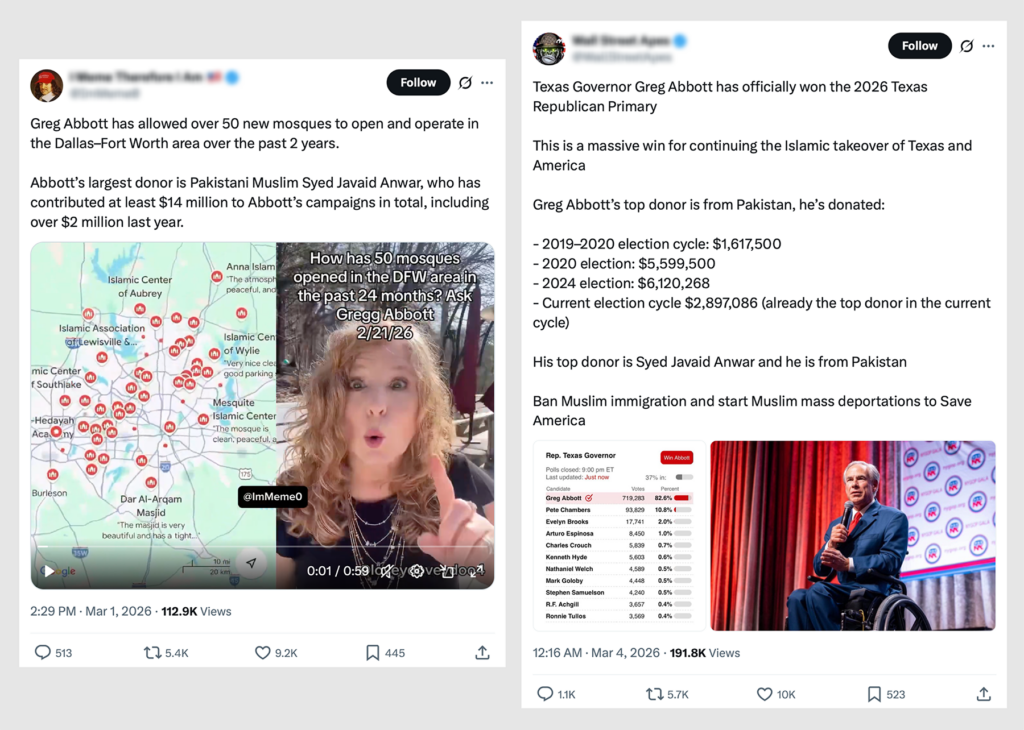
Anwar, a major Abbott donor who has served on the Texas Higher Education Coordinating Board, has been targeted in social media posts that portray his political contributions and access to the governor as evidence of the supposed “Islamification” of Texas. Ironically, Abbott himself has played a significant role in mainstreaming anti-Muslim bigotry in the state through his rhetoric and policies.178
The targeting illustrates how even lawful forms of political participation by South Asians, including campaign contributions and service on public bodies, can be reframed as evidence of ethnic or religious political influence and takeover.
AI-Generated Anti-South Asian Hate
The use of generative AI tools has become increasingly prominent in the production of anti-South Asian content, particularly targeting Indians. South Asians are shown as demonic and barbaric, caricatured for their appearance and accents, mocked for their delusions of greatness, poor hygiene, and habit of public defecation, depicted as scammers and sexual degenerates, portrayed as vermin invading America, and even shown literally as feces.
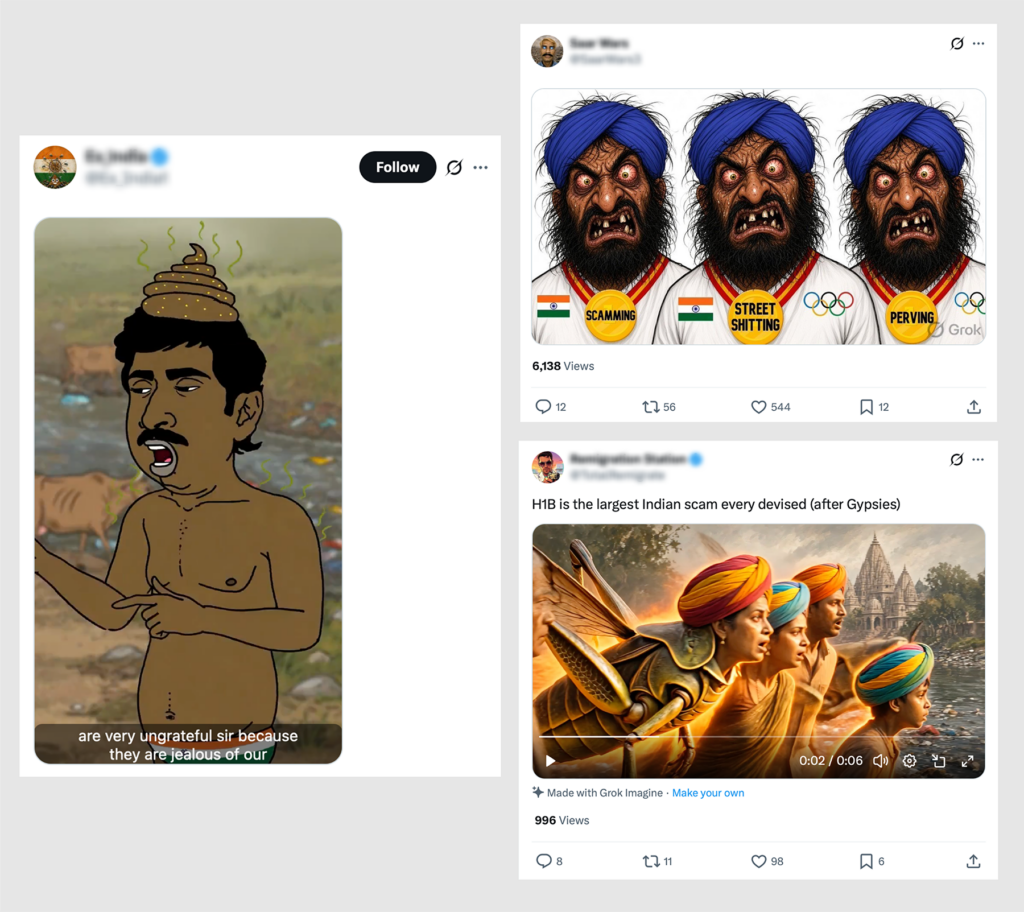
Generative AI has emerged as a new frontier in the production, amplification, and circulation of online hate. Generative AI is also used to visually represent racial slurs and dehumanizing language, transforming textual forms of abuse into exaggerated racist caricatures. AI-generated hate also commonly draws on the visual and textual vocabulary of memes and internet culture. In all these ways, generative AI tools provide new means of producing and circulating visual representations of existing harmful anti-South Asian narratives at scale.
Conclusion
The findings of this report document an explosive rise in anti-South Asian hate online. On X, monthly volume increased by 75% between January 2025 and June 2026. Looking at the longer trajectory, monthly volume rose by 240% between January 2024 and June 2026. Five of the six highest-volume months occurred between November 2025 and June 2026, reflecting the acceleration of anti-South Asian hate during the latter part of the study period. The data from 4chan, 8chan, and Gab similarly reveal persistent and deeply entrenched hostility toward South Asians.
This rise has unfolded amid significant changes in the US political and digital environment. With the ascendancy of MAGA in the public sphere and Trump’s return to the presidency in 2025, the social and political context in the US has radically changed, particularly regarding norms of socially acceptable speech, especially with regard to minorities. In the name of free speech and a rejection of political correctness, “wokeness,” and DEI, blatant prejudice, abuse, and threats have been normalized online. Political figures, right-wing influencers, and MAGA-aligned online communities have used social media extensively to attack political opponents and minority groups. At the same time, rhetoric and narratives long associated with fringe spaces such as 4chan, 8chan, and Gab increasingly circulate across larger platforms and wider public discourse. Changes within the technology industry have also reshaped this environment. Meta, for example, ended its third-party fact-checking program in the US and loosened restrictions on some forms of political discourse, while Elon Musk has openly supported far-right political movements and figures.
Social media platforms are central to this ecosystem. They reflect hostility that exists in the offline world, but can also reinforce, magnify, and normalize it by enabling hateful narratives to be repeatedly reproduced and distributed to much larger audiences. They also provide spaces in which racist and xenophobic discourse, threats, cultural slurs, memes, and conspiracy theories are generated, adapted, and circulated. In this sense, social media is not simply a mirror of anti-minority hate, but an infrastructure through which it can be produced and amplified.
In this environment, South Asians in the US find themselves particularly vulnerable. As a numerically small but increasingly visible community that is an easy scapegoat because of issues like the H-1B visa program, its perceived economic prominence, and its racial and cultural differences from the majority, the South Asian community is an easy target for politicians, extremist influencers, and the MAGA base. Prominent far-right influencers have made targeting South Asians from their online bully pulpits a core part of their ideological projects. As a result of their large follower counts and ready audiences, these influencers shape the political climate, contribute to cultural shifts, and set the agenda for broader public conversations. Their causes are taken up by politicians, who find the talking points raised by influencers ripe for exploitation for political gain. In this manner, the machine of anti-South Asian hate keeps churning and generating more hate.
Online hate does not exist separately from the societies in which it circulates. Repeated dehumanization, racial stereotyping, conspiracy theories, and calls for exclusion or removal can contribute to an environment in which hostility toward a community becomes increasingly normalized and can create conditions associated with stochastic violence.
While the targeting and demonization of minority groups is not new in the US, the scale and speed with which hate can now be generated, amplified, and circulated through social media increase the risks faced by targeted communities. More fundamentally, narratives that question whether people belong in the United States because of their race, religion, ancestry, or national origin have broader implications for civil and human rights, social cohesion, the rule of law, and democratic participation.
The explosive rise in anti-South Asian hate documented in this report should therefore be understood not only as a threat to South Asian communities, but as part of a wider challenge posed by the normalization and amplification of identity-based hate in American public life. The surge of anti-South Asian hate across these platforms should serve as an urgent warning about the role social media can play in amplifying and normalizing such hostility, and the broader risks this poses to American society.
Endnotes
1. Anushree Jonko, “‘Indians Are Bad’: US Man Attacks Indian-Origin Nurse, Charged with Hate Crime,” NDTV, March 4, 2025, https://www.ndtv.com/world-news/indians-are-bad-us-man-attacks-indian-origin-nurse-charged-with-hate-crime-7846717.
2. Quinn Welsch, “Utah Man Charged with Hate Crime after Attack on Muslim Mall Employee,” Courthouse News Service, July 17, 2026, https://www.courthousenews.com/utah-man-charged-with-hate-crime-after-attack-on-muslim-mall-employee/.
3. Eduardo Cuevas and Jeff Winter, “Sikh Truck Driver Stabbed 17 Times in Unprovoked Wyoming Attack Raises Fears of Assaults against South Asians, Officials Say,” CNN, September 18, 2026, https://www.cnn.com/2026/09/18/us/wyoming-sikh-truck-driver-stabbing.
4. Kurtis Lee, “Long-Haul Trucking Was a Refuge for Sikh Immigrants. Until Now.,” New York Times, December 21, 2025, https://www.nytimes.com/2025/12/21/business/sikhs-truckers-trump-crackdown.html.
5. U.S. Department of Homeland Security, “Transformers: Age of Deportations,” Instagram post, September 9, 2026 (since deleted), https://www.instagram.com/p/DdI1Tt-jNZ3/.
6. Anti-Indian Racism on X: Causes, Trends, and Narratives (Center for the Study of Organized Hate, 2025), https://www.csohate.org/2025/09/16/anti-indian-racism-on-x-july-september-2025/.
7. “The State of Anti-South Asian Hate,” Stop AAPI Hate, September 3, 2026, https://stopaapihate.org/2026/09/03/the-state-of-anti-south-asian-hate/.
8. Brianna Morris-Grant, “Elon Musk promised to stamp out hate speech and bots on X. New research shows neither happened,” ABC News (Australia), February 13, 2025, https://www.abc.net.au/news/2025-02-13/hate-speech-bots-twitter-report/104923196.
9. Anti-Indian Hate on X: How the Platform Amplifies Racism and Xenophobia (Center for the Study of Organized Hate, 2025), https://www.csohate.org/2025/01/09/x-anti-indian-racism/.
10. Eleanor Brooks and Jonathan Day, “What Is Free Speech Absolutism? Who Is a Free Speech Absolutist? Examples, Pros and Cons,” Liberties, May 17, 2022, accessed September 22, 2026, https://www.liberties.eu/en/stories/free-speech-absolutist/44213.
11. Eliza Gkritsi, “Musk’s X Suspends Opposition Accounts in Turkey amid Civil Unrest,” Politico, March 22, 2025, https://www.politico.eu/article/musks-x-suspends-opposition-accounts-turkey-protest-civil-unrest-erdogan-imamoglu-istanbul-mayor/.
12. Subimal Bhattacharjee “A Hard Test for X’s Transparency Pledge in India,” Indian Express, September 2026, https://indianexpress.com/article/opinion/columns/a-hard-test-for-xs-transparency-pledge-in-india-10857373/.
13. “4chan,” Encyclopedia Britannica, https://www.britannica.com/topic/4chan.
14. Savvas Zannettou et al., “What Is Gab? A Bastion of Free Speech or an Alt-Right Echo Chamber?,” arXiv, 2018, https://arxiv.org/abs/1802.05287.
15. Joel Stein, “How Trolls Are Ruining the Internet,” Time, August 18, 2016, https://time.com/4457110/internet-trolls/.
16. Kerry Flynn, “From 4chan to Gab: Where hate speech is thriving online” Mashable, August 17, 2017, https://mashable.com/article/alt-right-free-speech-online-network-gab.
17. Diana Rieger et al., “A Case Study of Alt-Right Communities on 8chan, 4chan, and Reddit” Social Media + Society (2021), https://journals.sagepub.com/doi/10.1177/20563051211052906.
18. “Saar,” Know Your Meme, https://knowyourmeme.com/sensitive/memes/saar.
19. Dangerous Speech Project, https://www.dangerousspeech.org/.
20. “Introduction,” South Asian American Digital Archive (SAADA), https://www.saada.org/resources/learners/introduction.
21. Brittany Rico, Joyce Key Hahn, and Cody Spence, “Chinese, Except Taiwanese, Was the Largest Asian Alone or in Any Combination Group; Nepalese Population Grew Fastest,” U.S. Census Bureau, September 21, 2023, https://www.census.gov/library/stories/2023/09/2020-census-dhc-a-asian-population.html.
22. “Indians in the U.S. Fact Sheet,” Pew Research Center, May 1, 2025, https://www.pewresearch.org/race-and-ethnicity/fact-sheet/asian-americans-indians-in-the-u-s/.
23. Lindsay Whitehurst, “Supreme Court Allows Trump Administration to End Legal Protections for Haitians and Syrians,” PBS NewsHour, June 25, 2026, https://www.pbs.org/newshour/politics/supreme-court-allows-trump-administration-to-end-legal-protections-for-haitians-and-syrians.
24. “Trump Administration Raises US Refugee Cap, but Only for White South Africans,” Associated Press, May 26, 2026, https://apnews.com/article/trump-refugees-white-south-africa-border-cap-bfe3974adf6c655eca7a5c30c1f9197f.
25. “A Guide to the Countries on Trump’s Travel Ban List,” Council on Foreign Relations, September 1, 2026, https://www.cfr.org/articles/guide-countries-trumps-travel-ban-list.
26. “ICE and Border Patrol Abuses,” American Civil Liberties Union, https://www.aclu.org/issues/immigrants-rights/ice-and-border-patrol-abuses.
27. Tara Watson et al., “The Administration Has Detained 400,000 Immigrants: What Do We Know about Their Children?,” Brookings Institution, May 18, 2026, https://www.brookings.edu/articles/the-administration-has-detained-400000-immigrants-what-do-we-know-about-their-children/.
28. Haddy Gassama, “ICE Is Rapidly Expanding Detention Camps into Warehouses Despite Record Deaths,” American Civil Liberties Union, April 28, 2026, https://www.aclu.org/news/immigrants-rights/deaths-in-detention-ice-is-rapidly-expanding-detention-camps-into-warehouses-despite-record-deaths
29. Mass Deportation: Analyzing the Trump Administration’s Attacks on Immigrants, Democracy, and America (American Immigration Council, July 2025), https://www.americanimmigrationcouncil.org/report/mass-deportation-trump-democracy/.
30. Cherylann Mollan, “India ‘engaging with US’ after shackled deportees spark anger,” BBC News, February 6, 2025, https://www.bbc.com/news/articles/cm27k2m91p7o.
31. “The State of Anti-South Asian Hate.” https://stopaapihate.org/2026/09/03/the-state-of-anti-south-asian-hate/.
32. Stuart Anderson, “The Story of How Trump Officials Tried to End H-1B Visas,” Forbes, February 1, 2021, https://www.forbes.com/sites/stuartanderson/2021/02/01/the-story-of-how-trump-officials-tried-to-end-h-1b-visas/.
33. Naresh Kaushik, “The American Far Right’s Indian Obsession Is Getting Uglier,” Opinion, NDTV, September 4, 2026, https://www.ndtv.com/opinion/the-american-far-rights-indian-obsession-is-getting-uglier-12001588.
34. Barbara Ortutay, “Trump Signs Proclamation That Adds $100K Annual Fee to H-1B Visas for High-Skilled Workers,” PBS NewsHour, September 2025, https://www.pbs.org/newshour/politics/trump-signs-proclamation-that-adds-100k-annual-fee-to-h-1b-visas-for-high-skilled-workers.
35. Freddie Clayton and Matteo Moschella, “Trump signs order that adds $100K annual fee to H-1B visas for high-skilled workers,” NBC News, Sep 20, 2025, https://www.nbcnews.com/world/asia/trump-h1b-visa-fee-travel-tech-workers-india-china-immigration-rcna232695.
36. Congressional Asian Pacific American Caucus, “CAPAC Members Condemn Trump’s Racist Post against Indian and Chinese Immigrants,” press release, April 24, 2026, https://capac.house.gov/press-release/capac-members-condemn-trumps-racist-post-against-indian-and-chinese-immigrants.
37. U.S. Department of Homeland Security, “Transformers: Age of Deportations.” https://www.instagram.com/p/DdI1Tt-jNZ3/.
38. Nileena Sunil, “Make College Football Great Again: Education Dept. Racist Post Linked to Bo French Controversy Draws Backlash,” American Bazaar, September 21, 2026, https://americanbazaaronline.com/2026/09/21/make-college-football-great-again-education-dept-racist-post-linked-to-bo-french-controversy-draws-backlash-488571/.
39. Carlos Nogueras Ramos, “Bo French doubles down on racist post made after UT win against Ohio State,” Texas Tribune, September 14, 2026, https://www.texastribune.org/2026/09/14/bo-french-post-ut-ohio-football-game/.
40. “MAGA Movement,” Encyclopaedia Britannica, https://www.britannica.com/topic/MAGA-movement.
41. “Trump administration using rhetoric linked to extremists” PBS, video, January 12, 2025, https://www.pbs.org/video/extreme-messages-1768253453/.
42. Jason Abbruzzese, “Some Trump administration social media posts mirror extremist rhetoric,” NBC News, January 16, 2026, https://www.nbcnews.com/tech/internet/trump-administration-social-media-posts-extremist-rhetoric-rcna254372
43. Huo Jingnan and Jasmine Garsd, “JD Vance spreads debunked claims about Haitian immigrants eating pets,” NPR, September 10, 2024, https://www.npr.org/2024/09/10/nx-s1-5107320/jd-vance-springfield-ohio-haitians-pets.
44. Matt Sledge and Sam Biddle, “ICE Recruitment Tweets Are So Racist That Cops Feared They Could Incite Neo-Nazi Violence”, The Intercept, May 21, 2026, https://archive.ph/QCwsX.
45. The Asian American Foundation, “TAAF Condemns President Trump for Amplifying Racist Rhetoric Targeting Chinese and Indian Immigrants,” https://www.taaf.org/news/taaf-condemns-president-trump-for-amplifying-racist-rhetoric-targeting-chinese-and-indian-immigrants.
46. Congressional Asian Pacific American Caucus, “CAPAC Members Condemn Trump’s Racist Post.” https://capac.house.gov/press-release/capac-members-condemn-trumps-racist-post-against-indian-and-chinese-immigrants.
47. Eviane Leidig, “Remigration,” Center for the Study of Organized Hate, January 20, 2026, https://www.csohate.org/2026/01/20/remigration/.
48. David Gilbert, “The State Department Really Doesn’t Want to Talk about the Office of Remigration,” Wired, May 27, 2026, https://www.wired.com/story/the-state-department-really-doesnt-want-to-talk-about-the-office-of-remigration/.
49. Samuel Benson, “Trump’s MAGA allies have a new plan for mass deportations. It could splinter the coalition,” Politico, April 1, 2026, https://www.politico.com/news/2026/04/01/trump-maga-immigration-raids-worksites-00853334.
50. Katie J.M. Baker and Hamed Aleaziz, “Gregory Bovino’s Final Days: Harsh Words and Few Regrets,” New York Times, March 24, 2026, https://www.nytimes.com/2026/03/24/us/gregory-bovino-border-patrol.html.
51. “Introduction,” https://www.saada.org/resources/learners/introduction.
52. Supriya Misra et al., “Health Implications of Racialized State Violence against …,” Journal of Racial and Ethnic Health Disparities, December 21, 2021, https://publichealth.sfsu.edu/sites/default/files/documents/Misra%20et%20al%202022%20health%20implications%20of%20racialized%20state%20violence%20against%20south%20asians%20in%20the%20united%20states.pdf.
53. Milan Vaishnav et al., “Indian Americans in a Time of Turbulence: 2026 Survey Results,” Carnegie Endowment for International Peace, February 2026, https://carnegieendowment.org/research/2026/02/indian-americans-in-a-time-of-turbulence-2026-survey-results.
54. Asian Americans Advancing Justice–AAJC, “FBI Hate Crime Data Reveals Persistent Threats to Asian Americans,” https://www.advancingjustice-aajc.org/press-release/fbi-hate-crime-data-reveals-persistent-threats-asian-americans-amid-escalating-anti.
55. Asian Americans Advancing Justice–AAJC, “FBI Hate Crime Data Reveals Persistent Threats,” https://www.advancingjustice-aajc.org/press-release/fbi-hate-crime-data-reveals-persistent-threats-asian-americans-amid-escalating-anti.
56. Congressional Asian Pacific American Caucus, “Our Nation Is Seeing a Disturbing Rise in Anti-Indian and South Asian Hate,” Facebook video, August 22, 2026, https://www.facebook.com/CAPAC/videos/our-nation-is-seeing-a-disturbing-rise-in-anti-indian-and-south-asian-hate-congr/1716919499582862/.
57. Stop AAPI Hate, “Keeping Count: Let’s Talk about Anti-Asian Slurs,” September 11, 2025, https://stopaapihate.org/2025/09/11/keeping-count-lets-talk-about-anti-asian-slurs/.
58. Ashwin Rodrigues, “MAGA Indians Went All In on Trump,” Wired, April 16, 2026, https://www.wired.com/story/maga-indians-went-all-in-on-trump/.
59. Pranav Jani, “There’s a message in how MAGA keeps biting Usha Vance, Patel, Ramaswamy,” Opinion, Columbus Dispatch, November 3, 2025, https://www.dispatch.com/story/opinion/columns/guest/2025/11/03/jd-vance-usha-vance-erika-kirk-vivek-ramaswamy-kash-patel-ohio/87057635007/?gnt-cfr=1&gca-cat=p&gca-uir=false&gca-epti=z1113xxp002050n11—-c11—-e1113xxv002730&gca-ft=163&gca-ds=sophi.
60. Sakshi Venkatraman, “As Harris, Ramaswamy, Usha Vance rose on national stage, Indian Americans faced harassment,” NBC News, Nov. 15, 2024, https://www.nbcnews.com/news/asian-america/harris-ramaswamy-usha-vance-south-asian-american-hate-rcna174935.
61. “Anti-Indian Hate on X,” Center for the Study of Organized Hate, https://www.csohate.org/2025/01/09/x-anti-indian-racism/
62. CNN IBN, “Trump AI Advisor Pick Sriram Krishnan Faces Backlash,” YouTube video, December 27, 2024, https://www.youtube.com/watch?v=awHsErqVt8Y&t=17s.
63. “Trump’s Choice of Indian-Origin Sriram Krishnan as AI Advisor Sparks Outrage over H-1B Focus …,” Times of India, December 2024, https://timesofindia.indiatimes.com/world/us/trumps-choice-of-indian-origin-sriram-krishnan-as-ai-advisor-sparks-outrage-over-h1b-focus-not-america-first/articleshow/116592808.cms.
64. Niala Mohammad and Raqib Naik, “Islamophobia and the New York City Mayoral Election,” Center for the Study of Organized Hate, November 3, 2025, https://www.csohate.org/2025/11/03/islamophobia-and-new-york-city-mayoral-election/.
65. Diana C. Mutz, “Status Threat, Not Economic Hardship, Explains the 2016 Presidential Vote,” Proceedings of the National Academy of Sciences 115, no. 19 (2018): E4330–39, https://www.pnas.org/doi/10.1073/pnas.1718155115.
66. “What Is Great Replacement Theory and How Does It Fuel Racist Violence?,” PBS NewsHour, May 16, 2022, https://www.pbs.org/newshour/politics/what-is-great-replacement-theory-and-how-does-it-fuel-racist-violence.
67. Global Project Against Hate and Extremism, “Online Racism Targeting South Asians Skyrockets,” May 8, 2024, https://globalextremism.org/post/online-racism-targeting-south-asians-skyrockets/.
68. “The Racist ‘Great Replacement’ Conspiracy Theory Explained.,” SPLC, May 17, 2022, https://www.splcenter.org/resources/hatewatch/racist-great-replacement-conspiracy-theory-explained/
69. Matt Sledge and Sam Biddle, “ICE Recruitment Tweets Are So Racist That Cops Feared They Could Incite Neo-Nazi Violence,” The Intercept, May 21, 2026, https://theintercept.com/2026/05/21/ice-dhs-social-media-white-supremacist-violence/.
70. “Indians in the U.S. Fact Sheet,” Pew Research, https://www.pewresearch.org/race-and-ethnicity/fact-sheet/asian-americans-indians-in-the-u-s/.
71. Gloria Guzman and Melissa Kollar, Income in the United States: 2023, Current Population Reports P60-282 (U.S. Census Bureau, 2024), https://www.census.gov/library/publications/2024/demo/p60-282.html.
72. “Pakistanis in the U.S. Fact Sheet,” Pew Research Center, May 1, 2025, https://www.pewresearch.org/race-and-ethnicity/fact-sheet/asian-americans-pakistanis-in-the-u-s/.
73. “Sri Lankans in the U.S. Fact Sheet,” Pew Research Center, May 1, 2025, https://www.pewresearch.org/race-and-ethnicity/fact-sheet/asian-americans-sri-lankans-in-the-u-s/.
74. Ann Saphir, “US Income Inequality Rose for 3 Years through 2022, Fed Data Shows,” Reuters, October 18, 2023, https://www.reuters.com/world/us/us-income-inequality-rose-3-years-through-2022-fed-data-shows-2023-10-18/.
75. Ellie Hu, “How COVID-19 Has Magnified Pre-existing Inequalities in the US,” Boston University, March 10, 2022, https://www.bu.edu/eci/2022/03/10/how-covid-19-has-magnified-pre-existing-inequalities-in-the-us/.
76. Jason Richwine, “Indian Americans: The New Model Minority,” American Enterprise Institute, February 24, 2009, https://www.aei.org/commentary/indian-americans-the-new-model-minority/.
77. Lydia Polgreen, “It’s One of America’s Most Successful Experiments, and It’s Coming to an End,” Opinion, New York Times, December 29, 2025, https://www.nytimes.com/2025/12/29/opinion/indian-americans-trump.html?eafs_enabled=false.
78. Gabrielle Clark, “What’s an H-1B Visa? A Brief History of the Controversial Program for Skilled Foreign Workers,” The Conversation, January 2025, https://theconversation.com/whats-an-h-1b-visa-a-brief-history-of-the-controversial-program-for-skilled-foreign-workers-247072.
79. “In 2017, US Government Introduced 60-Day Grace Period for H-1B Visa Workers; 9 Years Later DHS …],” Times of India, August 29, 2026, https://timesofindia.indiatimes.com/technology/tech-news/in-2017-us-government-introduced-60-day-grace-period-for-h-1b-visa-workers-9-years-later-dhs-wants-to-end-it-heres-the-status-update/articleshow/133608139.cms.
80. “In 2017, US Government Introduced 60-Day Grace Period,” Times of India, August 29, 2026, https://timesofindia.indiatimes.com/technology/tech-news/in-2017-us-government-introduced-60-day-grace-period-for-h-1b-visa-workers-9-years-later-dhs-wants-to-end-it-heres-the-status-update/articleshow/133608139.cms.
81. U.S. Citizenship and Immigration Services, Characteristics of H-1B Specialty Occupation Workers: Fiscal Year 2025, (April 2026), https://www.uscis.gov/sites/default/files/document/data/fy25_h1b_characteristics_congress_signed_04242026.pdf.
82. “H-1B Shock: Donald Trump Administration Tightens Screws, Moves to Scrap 60-Day Window,” National Herald, August 29, 2026, https://www.nationalheraldindia.com/international/h-1b-shock-donald-trump-administration-tightens-screws-moves-to-scrap-60-day-window.
83. “Amid H-1B Row, Marco Rubio Issues Warning on Student Visas,” Times of India, Nov 28, 2025, https://timesofindia.indiatimes.com/world/us/amid-h1-b-row-marco-rubio-issues-warning-on-student-visas-if-we-discover-information-that/articleshow/125642782.cms.
84. Firstpost, “US Senator Targets Indian H-1B Workers, Calls Out ‘Visa Cartel’,” Facebook video, May 14, 2026, https://www.facebook.com/firstpostin/videos/us-senator-targets-indian-h-1b-workers-calls-out-visa-cartel/1004912405407401/.
85. Kevin Rectorand Laura J. Nelson, “Why Big Tech is friending and funding Trump 2.0,” Los Angeles Times, https://enewspaper.latimes.com/infinity/article_share.aspx?guid=0c600197-ff9d-442c-85e5-377bd869af41.
86. David Gilbert, “Threats against Politicians Skyrocketed after Meta Changed Its Speech Rules,” Wired, June 9, 2026, https://www.wired.com/story/threats-against-politicians-skyrocketed-after-meta-changed-its-speech-rules/.
87. Amnesty International, “X’s design and policy choices created fertile ground for inflammatory, racist narratives targeting Muslims and migrants following Southport attack,” August 2025, https://www.amnesty.org/en/latest/news/2025/08/xs-design-and-policies/.
88. Aishik Saha et al., “X’s design and policy choices created fertile ground for inflammatory, racist narratives targeting Muslims and migrants following Southport attack,” Center for the Study of Organized Hate, May 12, 2025, https://www.csohate.org/2025/05/12/elon-musk-x-islamophobia-in-uk-report/.
89. Cheyanne M. Daniels, “Ramaswamy calls on conservatives to reject Groypers,” Politico, December 17, 2025, https://www.politico.com/news/2025/12/17/vivek-ramaswamy-groypers-nyt-00694823.
90. “Third World Invaders from India’: Trump Aide Faces Backlash over H-1B Visa Remarks,” Firstpost, Dec 27, 2024, https://www.firstpost.com/world/united-states/third-world-invaders-from-india-trump-aide-faces-backlash-over-h1b-visa-remarks-13847874.html.
91. “‘I Know My H-1B Rules’: Indian Techie’s Viral Fight with Texas Whistleblower over Working at Food Truck],” Times of India, https://timesofindia.indiatimes.com/world/us/i-know-my-h-1b-rules-indian-techies-viral-fight-with-texas-whistleblower-over-working-at-food-truck/articleshow/129936181.cms.
92. “‘Third World Invaders from India’,” https://www.firstpost.com/world/united-states/third-world-invaders-from-india-trump-aide-faces-backlash-over-h1b-visa-remarks-13847874.html.
93. Howard Koplowitz, “White Nationalist Takes Racist Shot at JD Vance’s Wife after VP Tells Him to …,” AL.com, December 2025, https://www.al.com/politics/2025/12/white-nationalist-takes-racist-shot-at-jd-vances-wife-after-vp-tells-him-to-eat-s-.html.
94. “The American Far Right’s Indian Obsession,” https://www.ndtv.com/opinion/the-american-far-rights-indian-obsession-is-getting-uglier-12001588.
95. Sara Gonzales (@SaraGonzalesTX), post on X, January 21, 2026, https://x.com/SaraGonzalesTX/status/2014005291415695508.
96. @FromKulak, post on X, March 5, 2026, https://x.com/FromKulak/status/2029611317296767358.
97. GBNews, “Exposed: The Secret Indian Networks Replacing American Workers,” YouTube video, May 12, 2026, https://www.youtube.com/watch?v=IyimKb7Ku6I.
98. Tyler Oliveira, “I Exposed Texas’ Indian Invasion,” YouTube video, April 5, 2026, https://www.youtube.com/watch?v=ralf0yL1Tfw.
99. Frontlines (@FrontlinesTPUSA), post on X, March 31, 2026, https://x.com/FrontlinesTPUSA/status/2039051350018044132?s=20.
100. Sharif Hassan, “Concerns grow as AI-generated videos spread hate, racism online: ‘No safety rules’,” Global News, August 10, 2025, https://globalnews.ca/news/11328903/artificial-intelligence-hate-content-videos/.
101. Muhammad Phaseeh Ul Haque, “Memes and South Asian Hate,” Center for the Study of Organized Hate, February 21, 2025, https://www.csohate.org/2025/02/21/memes-and-south-asian-hate/.
102. Times of India, “‘Glad I’m Not a Dirty Indian’: Texas Gov Candidate Under Fire Over RACIST Rant On Indians, Hindus,” YouTube video, Jul 2, 2026, https://www.youtube.com/watch?v=W7vjFaWfD70.
103. “What Is Hate Speech?,” United Nations, https://www.un.org/en/hate-speech/understanding-hate-speech/what-is-hate-speech.
104. Lalee Ibssa, “What Are H-1B Visas? Elon Musk, Vivek Ramaswamy Spar with Donald Trump Supporters,” ABC7 New York, December 28, 2024, https://abc7ny.com/post/what-are-1b-visas-elon-musk-vivek-ramaswamy-spar-donald-trump-supporters-work/15715514/.
105. Ted Johnson, “Elon Musk Defends H-1B Visas Amid Split Between Trump Tech Bros And MAGA ‘Right Right’,” Deadline, December 2024, https://deadline.com/2024/12/elon-musk-trump-h1b-visa-skilled-workers-1236242886/.
106. New York City Bar Association, “The Trump Administration’s Early 2025 Changes to Immigration Law,” July 10, 2026, https://www.nycbar.org/reports/the-trump-administrations-early-2025-changes-to-immigration-law/.
107. Catherine E. Shoichet et al., “Tracking the numbers behind Trump’s immigration offensive,” CNN, September 21, 2026, https://www.cnn.com/us/ice-immigration-detentions-arrests-deportations-deaths-vis.
108. “Executive Order 14160,” U.S. Department of State, Bureau of Consular Affairs, https://travel.state.gov/content/travel/en/News/passports/EO14160.html.
109. AAPI Equity Alliance, “Hate Messages against Indian Immigrants Surge on US Social Media,” August 29, 2025, https://aapiequityalliance.org/hate-messages-against-indian-immigrants-surge-on-us-social-media/.
110. James Tabafunda, “Anti-Asian Hate Crimes Remain High, Advocates Warn Five Years after Federal Law,” Northwest Asian Weekly, May 2026, https://nwasianweekly.com/2026/05/anti-asian-hate-crimes-remain-high-advocates-warn-five-years-after-federal-law/.
111. Kathrin Wesolowski and Alima de Graaf, “Fact Check: Donald Trump Claims on Biden, Inflation, Ending Wars, Migration — What Is True?” DW, Feb 25, 2026, https://www.dw.com/en/fact-check-donald-trump-claims-biden-inflation-ending-wars-migration-what-is-true/a-76117703.
112. “Rubio May Have Revoked Thousands of Visas as Crackdown Continues],” Straits Times, May 21, 2025, https://www.straitstimes.com/world/united-states/rubio-may-have-revoked-thousands-of-visas-as-crackdown-continues.
113. “Digital Hate, Islamophobia, Zohran Mamdani, and NYC’s Mayoral Primary,” Center for the Study of Organized Hate, July 9, 2025, https://www.csohate.org/2025/07/09/digital-hate-islamophobia-zohran-mamdani/.
114. Stop AAPI Hate, “Keeping Count: Mamdani Hate in the NYC Mayoral Race,” November 7, 2025, https://stopaapihate.org/2025/11/07/keeping-count-mamdani-hate-nyc-mayoral-race/.
115. “Transcript: Donald Trump’s Address at ‘Winning the AI Race’ Event,” Tech Policy Press, July 2025, https://www.techpolicy.press/transcript-donald-trumps-address-at-winning-the-ai-race-event/.
116. The Asian American Foundation, “TAAF Condemns President Trump,” https://www.taaf.org/news/taaf-condemns-president-trump-for-amplifying-racist-rhetoric-targeting-chinese-and-indian-immigrants.
117. AAPI Equity Alliance, “Hate Messages against Indian Immigrants Surge,” https://aapiequityalliance.org/hate-messages-against-indian-immigrants-surge-on-us-social-media/.
118. Liv Caputo, “Uthmeier Subpoenas Trucking Firm Employing Driver Harjinder Singh,” Florida Phoenix, September 4, 2025, https://floridaphoenix.com/2025/09/04/uthmeier-subpoenas-trucking-firm-employing-driver-harjinder-singh/.
119. American Tech Workforce Act of 2025, S. 2821, 119th Cong. (2025), https://www.congress.gov/bill/119th-congress/senate-bill/2821/text?s=4&r=26&hl=H-1b.
120. “Trump Signs Proclamation That Adds $100K Annual Fee,” PBS, Sep 20, 2025, https://www.pbs.org/newshour/politics/trump-signs-proclamation-that-adds-100k-annual-fee-to-h-1b-visas-for-high-skilled-workers.
121. H-1B and L-1 Visa Reform Act of 2025, S. 2928, 119th Cong. (2025), https://www.congress.gov/bill/119th-congress/senate-bill/2928?s=3&r=6&hl=H-1b.
122. Visa Cap Enforcement Act, S. 2941, 119th Cong. (2025), https://www.congress.gov/bill/119th-congress/senate-bill/2941/text.
123. Kyung Ju Lee and Jeanne Batalova, “Indian Immigrants in the United States,” Migration Policy Institute, April 15, 2026, https://www.migrationpolicy.org/journal/spotlight/indian-immigrants-united-states.
124. Center for the Study of Organized Hate, “New Report: Surge in Anti-Indian Racism and Xenophobia on X after Krishnan Appointment, Ramaswamy Tweet,” January 2025, https://www.csohate.org/press-releases/new-report-surge-in-anti-indian-racism-and-xenophobia-on-x-after-krishnan-appointment-ramaswamy-tweet/.
125. Madeline Halpert, “’Mandate for change’: Zohran Mamdani wins New York City mayoral election,” BBC News, November 5, 2025, https://www.bbc.com/news/articles/ceq01l8reqlo.
126. PAUSE Act, H.R. 6225, 119th Cong. (2025), https://www.congress.gov/bill/119th-congress/house-bill/6225/text?s=4&r=36&hl=H-1b.
127. “Raja Krishnamoorthi Slammed for His Proposal to Double H-1B Visas to 130,000,” Times of India, Nov 29, 2025, https://timesofindia.indiatimes.com/world/us/raja-krishnamoorthi-slammed-for-his-proposal-to-double-h-1b-visas-to-130000-hes-serving-india/articleshow/125646198.cms.
128. “Raja Krishnamoorthi Slammed.” https://timesofindia.indiatimes.com/world/us/raja-krishnamoorthi-slammed-for-his-proposal-to-double-h-1b-visas-to-130000-hes-serving-india/articleshow/125646198.cms.
129. “James Fishback Defends Plan to End H-1B Visas, Says American Dream Is for Americans,” CNN, video, November 26, 2025, https://edition.cnn.com/2025/11/26/politics/video/james-fishback-defends-plan-to-end-h1-b-visas-says-american-dream-is-for-americans.
130. “Thanksgiving: Old Clip of Nick Fuentes Targeting JD Vance Resurfaces amid Indian Joke,” NDTV, November 2025, https://www.msn.com/en-in/news/world/thanksgiving-old-clip-of-nick-fuentes-targeting-jd-vance-resurfaces-amid-indian-joke/ar-AA1RjS6s?apiversion=v2&domshim=1&noservercache=1&noservertelemetry=1&batchservertelemetry=1&renderwebcomponents=1&wcseo=1.
131. Amy Qin, “How the Visa Debate for Foreign Workers Fuels Racism Against South Asians,” New York Times, February 16, 2026, https://www.nytimes.com/2026/02/16/us/politics/h1b-visa-debate-racism-south-asians.html.
132. Chelsea Long, “UF, Other Florida Universities Face H-1B Hiring Pause through 2027,” Gainesville Sun, March 3, 2026, https://www.gainesville.com/story/news/education/campus/2026/03/03/uf-other-florida-universities-face-h1b-hiring-pause-through-2027/88952772007/.
133. Office of Rep. Eli Crane, “Rep. Crane Introduces Legislation to Pause and Reform the Broken H-1B Visa Process,” press release, April 22, 2026, https://crane.house.gov/2026/04/22/rep-crane-introduces-legislation-to-pause-and-reform-the-broken-h-1b-visa-process/.
134. Cherylann Mollan, “India condemns remarks shared by Trump calling it a ‘hellhole’,” BBC News, April 24, 2026, https://www.bbc.com/news/articles/c05d4r1zgngo.
135. George Bunn, “Grooming Gangs: Rupert Lowe Releases Independent Report,” GB News, June 16, 2026, https://www.gbnews.com/news/grooming-gangs-rupert-lowe-releases-independent-report.
136. CBS News, “Britain’s Grooming Gang Scandal,” Facebook video, June 24, 2026, https://www.facebook.com/CBSNews/videos/britains-grooming-gang-scandal/1561783382327230/.
137. Efrat Lachter, “Elon Musk Demands Prison for Politicians Who Turned Blind Eye to Grooming Gangs as New Report Released,” Fox News, June 17, 2026, https://www.foxnews.com/world/elon-musk-demands-prison-politicians-who-turned-blind-eye-grooming-gangs-new-report-released.
138. @SaltyGirl09, post on X, June 2, 2026, https://x.com/SaltyGirl09/status/2061857255562047776?s=20.
139. @Codex_India6, post on X, February 21, 2026, https://x.com/Codex_India6/status/2025132745631170733?s=20.
140. @Aristotle_35, post on X, June 24, 2025, https://x.com/Aristotle_35/status/1937556914700963850?s=20.
141. @___eb__, post on X, December 30, 2025, https://x.com/___eb__/status/2005879990676570536?s=20.
142. @gc22gc, post on X, November 28, 2025, https://x.com/gc22gc/status/1994509732145676523?s=20.
143. @WeWillBeFree24, post on X, May 3, 2026, https://x.com/WeWillBeFree24/status/2050978607921496496?s=20.
144. @Carlos__Turcios, post on X, March 7, 2026, https://x.com/Carlos__Turcios/status/2030330413931995297?s=20.
145. @WhitePapersPol, post on X, January 21, 2026, https://x.com/WhitePapersPol/status/2014042469051117693?s=20.
146. Turning Point USA, “Frontlines TPUSA Report Explores Trends behind Increasing Hindu and Muslim Population in Texas,” April 8, 2026, https://tpusa.com/live/frontlines-tpusa-report-explores-trends-behind-increasing-hindu-and-muslim-population-in-texas/.
147. Tyler Oliveira, “I Exposed Texas’ Indian Invasion.” https://www.youtube.com/watch?v=ralf0yL1Tfw.
148. Marvin Hurst, “Frisco Growth Debate Fuels Controversy over Demographics,” CBS News Texas, March 27, 2026, https://www.cbsnews.com/texas/news/frisco-growth-debate-fuels-controversy-demographics/.
149. @Carlos__Turcios, post on X, March 6, 2026, https://x.com/Carlos__Turcios/status/2029996247830954368?s=20.
150. @AlexDuncanTX, post on X, March 6, 2026, https://x.com/AlexDuncanTX/status/2029968396691857675?s=20.
151. @attackdogX, post on X, June 28, 2026, https://x.com/attackdogX/status/2071363253553561925?s=20.
152. @Gen_X_Vet, post on X, May 1, 2026, https://x.com/Gen_X_Vet/status/2050222600702300303.
153. @KellyLovesBirds, post on X, July 6, 2025, https://x.com/KellyLovesBirds/status/1941960500180656398?s=20.
154. @kaylee_ashlynn, post on X, March 27, 2026, https://x.com/kaylee_ashlynn/status/2037587153866178913?s=20.
155. Tom Symonds, “Grooming gangs and ethnicity: What does the evidence say?,” BBC News, April 4, 2023, https://www.bbc.com/news/uk-65174096.
156. Aishik Saha et al., Racialized Grooming Gangs, Elon Musk, X, and Islamophobia in the UK, Center for the Study of Organized Hate, May 19, 2025, https://www.csohate.org/2025/05/19/racialized-grooming-gangs-elon-musk-x-islamophobia-in-uk/.
157. George Fishman, “UK Rape Gangs: Could It Happen Here?,” Center for Immigration Studies, August 26, 2026, https://cis.org/Fishman/UK-Rape-Gangs-Could-It-Happen-Here
158. Megan Specia, “What Is the U.K. ‘Grooming Gang’ Scandal Seized On by Elon Musk?,” New York Times, January 7, 2025, https://www.nytimes.com/2025/01/07/world/europe/uk-grooming-gangs-elon-musk.html.
159. Pritesh Jagani, “Anti-immigrant Influencers Have Been Showing up Outside H-1B Workers’ Homes and Apartments.…,” LinkedIn, https://www.linkedin.com/posts/priteshjagani_uscis-is-not-sending-tiktok-and-instagram-activity-7474121388195299328-DSFD/.
160. Alex Gangitano, “White House: Loomer mocking Harris’s Indian heritage is ‘racist poison’,” The Hill, September 12, 2024, https://thehill.com/homenews/administration/4877065-white-house-laura-loomer-kamala-harris-indian-heritage/.
161. Abhinav Singh, “Usha Vance, Wife of JD Vance, Faces Racist Attacks from White Supremacists],” WION, July 17, 2024, https://www.wionews.com/world/usha-vance-wife-of-jd-vance-faces-racist-attacks-from-white-supremacists-742049.
162. Ellie Quinlan Houghtaling, ““Go Back”: MAGA Floods Kash Patel’s Diwali Post With Racism,” The New Republican, October 21, 2025, https://www.yahoo.com/news/articles/back-maga-floods-kash-patel-142849202.html.
163. Richard Luscombe, “The racism and Islamophobia behind many of the attacks on Zohran Mamdani,” Guardian, October 25, 2025, https://www.theguardian.com/us-news/2025/oct/25/zohran-mamdani-attacks-racism-islamophobia-.
164. “Indian American Congresswoman Pramila Jayapal Faces Racist Attack,” Times of India, July 2022, https://timesofindia.indiatimes.com/world/us/indian-american-congresswoman-pramila-jayapal-faces-racist-attack/articleshow/92861708.cms.
165. “‘Deport to India’: Indian-Origin Democrat Ro Khanna Faces Racist Abuse from Trump Supporters,” News18, August 3, 2025, https://www.news18.com/nri/usa/deport-to-india-indian-origin-democrat-ro-khanna-faces-racist-abuse-from-trump-supporters-ws-kl-9481697.html.
166. Congressman Krishnamoorthi, “ Congressman Krishnamoorthi Denounces Racist Comments Made Against Him and Indian Americans,” YouTube video, Oct 31, 2025, https://www.youtube.com/watch?v=_azefvkJA68.
167. The Economic Times, “India-born US Rep. Thanedar trolled after bold move to impeach Trump,” YouTube video, Apr 29, 2025, https://www.youtube.com/watch?v=cK38QPdUgy4.
168. Sakshi Venkatraman, “Vivek Ramaswamy’s team responds to Ann Coulter’s calling his clash with Nikki Haley ‘Hindu business’,” NBC News, Aug. 24, 2023, https://www.nbcnews.com/news/asian-america/vivek-ramaswamy-ann-coulter-nikki-haley-rcna101624.
169. The Economic Times, “Trump’s AI Advisor Pick, Indian-origin Sriram Krishnan faces racist attacks,” YouTube video, December 26, 2024 https://www.youtube.com/watch?v=41MM6a964VA.
170. Kyle Seraphin (@KyleSeraphin), post on X, March 11, 2026, https://x.com/KyleSeraphin/status/2031703444466106577?s=20.
171. Forbes, “ Kash Patel Details Shocking Racism He Has Been Subject To After January 6 At Senate Hearing,” YouTube video, Jan 30, 2025, https://www.youtube.com/watch?v=U0UjwMlGFck.
172. Chidanand Rajghatta, “MAGA Diehards Dump on Desi Trump Acolyte Harmeet Dhillon amid Fury over Immigrant Truckers,” Times of India, October 28, 2025, https://timesofindia.indiatimes.com/world/us/maga-diehards-dump-on-desi-trump-acolyte-harmeet-dhillon-amid-fury-over-immigrant-truckers/articleshow/124878282.cms.
173. “MAGA Indians Went All In on Trump. Many Right-Wingers Can’t Stand Them,” Wired, April 16, 2026, https://www.wired.com/story/maga-indians-went-all-in-on-trump/.
174. S.B. 624, 2026 Sess. (Va. 2026), https://lis.virginia.gov/bill-details/20261/SB624.
175. S.B. 749, 2026 Sess. (Va. 2026), https://lis.virginia.gov/bill-details/20261/SB749.
176. S.B. 783, 2026 Sess. (Va. 2026), https://lis.virginia.gov/bill-details/20261/SB783.
177. Andrew Clyde (@Rep_Clyde), post on X, May 15, 2026, https://x.com/Rep_Clyde/status/2055358828544168058?s=20.
178. Mobashra Tazamal, “Islamophobia Takes Center Stage in the Lone Star State,” Bridge Initiative, Georgetown University, Feb 19, 2026, https://bridge.georgetown.edu/research/islamophobia-takes-center-stage-in-the-lone-star-state/.