In April 2026, Spain’s coalition government, led by the Spanish Socialist Workers’ Party (PSOE) and Sumar, launched an extraordinary regularization process for migrants already living in the country without regular immigration status. The measure followed a Popular Legislative Initiative led by migrant groups and civil society organizations that gathered more than 700,000 signatures.
The application period closed on June 30, with 1,174,978 applications submitted, according to official government figures. Against a backdrop of increasingly restrictive migration policies across Europe, Spain’s regularization marked a notable departure from the broader regional trend.
Most applications came from Latin America. Nearly seven in ten applicants—787,235 people—were from Central and South America, followed by 269,070 applicants of African origin. Colombia accounted for 26% of all applications, followed by Morocco (13.3%) and Venezuela (11.8%).
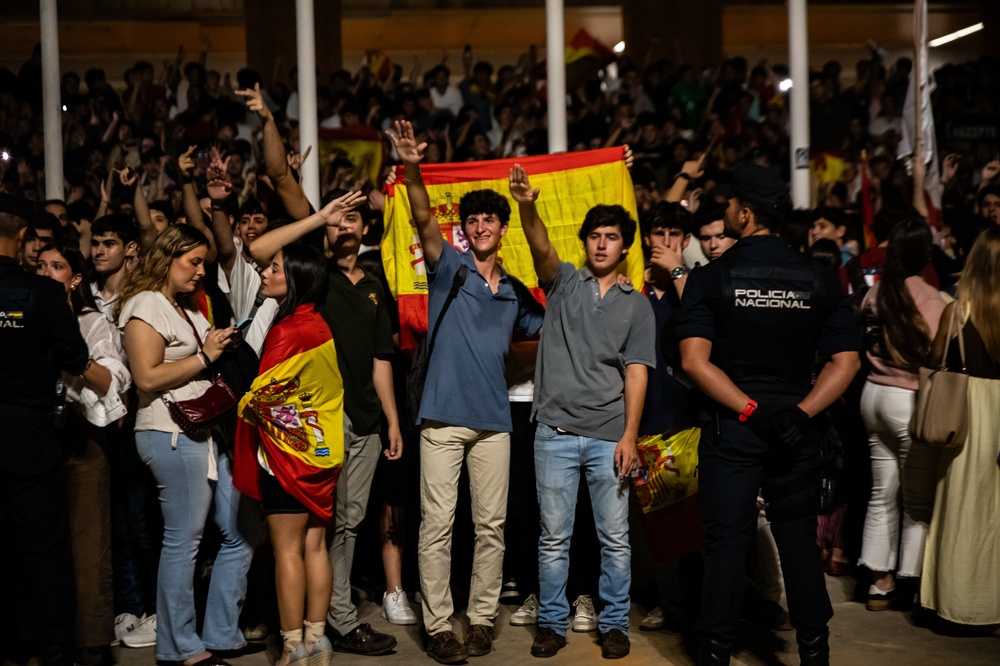
The launch of the regularization process became the focus of a growing wave of disinformation, hate speech, and anti-migrant narratives, amplified by far-right actors including the political party Vox, the neo-Nazi organization Núcleo Nacional, and digital influencers, which portrayed immigration as a security, economic, and cultural threat.
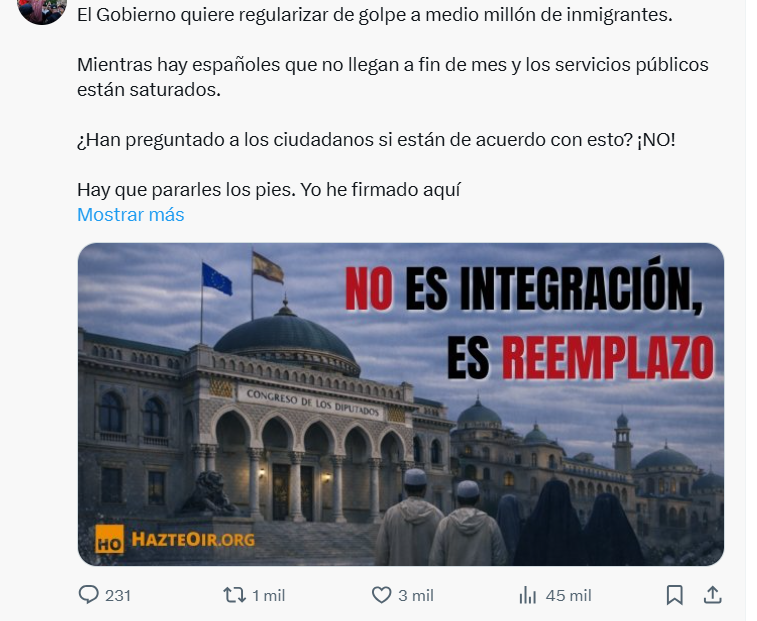
The debate also contributed to the circulation of “remigration” narratives, a concept increasingly promoted across Europe by far-right actors and white supremacist networks, as well as conspiracy theories alleging a deliberate “replacement” of the Spanish population.
Data from the Spanish Observatory on Racism and Xenophobia (OBERAXE), which monitors hate speech across Facebook, Instagram, X, TikTok, and YouTube through its FARO system, indicate a significant increase in hate speech targeting migrants in April, when the regularization was launched.
In Spain, people from North Africa and Muslims are consistently among the groups most targeted by online hate speech. This pattern was also evident during the period surrounding the extraordinary regularization: these groups were among the most affected targets despite not representing the largest share of applicants, reflecting a longer-standing Islamophobia.
The “Call Effect” and Ceuta Events
Although the regularization process applied only to migrants who were already residing in Spain before its announcement, far-right actors portrayed it as what they called a “call effect”, claiming it would attract further migration to Spain by offering the prospect of legal residency.
Images showing long lines outside the consulates and embassies of predominantly Muslim countries were circulated as evidence of an “invasion” or “collapse.” The queues reflected high demand for the administrative procedures required to apply for regularization, which in some cases placed considerable pressure on consular capacity.
Far-right accounts nevertheless presented these scenes as evidence of a new mass influx of migrants, turning people waiting to complete administrative procedures into a visual representation of the alleged threat.
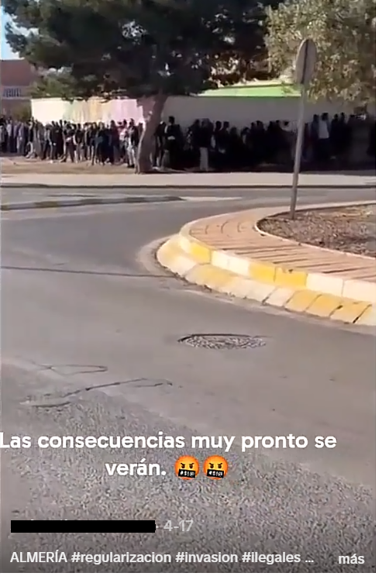
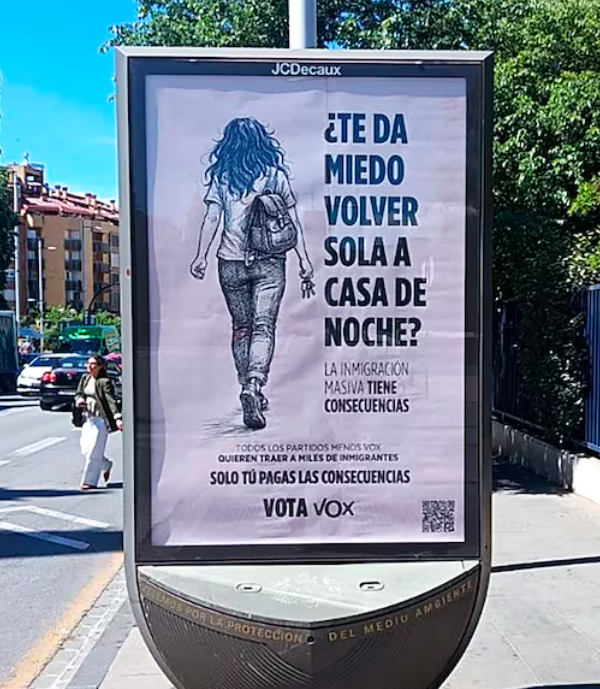
Some of this content also focused on the apparent absence of women in the queues, using it to reinforce narratives portraying the arrival of men from countries such as Morocco and Pakistan as a direct threat to white European women. These claims drew on unsupported associations between migration and sexual violence, weaponizing women’s safety to fuel anti-migrant fears, a long-standing trope in European far-right discourse.
Narratives linking immigration from the Global Majority to sexual offenses have become increasingly prominent in far-right political and media discourse in Spain, using these claims to justify more restrictive migration policies and reducing a complex issue to simplistic and racist causal explanations.
The “call effect” narrative was further amplified following the events in Ceuta, a Spanish enclave on the North African coast, between July 30 and 31, when between 72,000 and 80,000 migrants managed to cross into the enclave.
Thousands of people set out in the early hours from the Moroccan side of the border, attempting to enter Spanish territory simultaneously by swimming. Most subsequently returned voluntarily to Morocco. Those who remained in Ceuta faced protests and violence, including an arson attack on one of their camps and efforts to block humanitarian aid. Around 140 people reportedly lost their lives during the crossing, while many others were injured.
The events triggered a new wave of disinformation and online hate. One of the most widespread claims directly linked the arrivals to the extraordinary regularization, suggesting that people had been drawn to Ceuta by the prospect of obtaining legal residency. The claim disregarded the eligibility requirements of the regularization process and the fact that the application period had already closed a month earlier.
The events coincided with the circulation of misleading information about a Spanish Supreme Court ruling concerning so-called “hot returns”. The ruling established the conditions under which police can reject people attempting to enter Spain by sea at the border and when the ordinary procedure must instead be applied, but it was widely misrepresented as facilitating access to asylum and entry into mainland Europe.
Both the Spanish and Moroccan governments identified this misinterpretation as one of the factors that encouraged the mass arrival of migrants. It also spread through Moroccan WhatsApp, Facebook, and Instagram groups, where messages encouraged people to attempt the crossing and pointed to a specific date.
The arrival of migrants from Morocco was accompanied by a broader wave of misleading content online. Videos recorded in other locations or at different times were circulated as footage from Ceuta, including scenes of violence and vandalism used to fuel fear and panic around the arrivals.

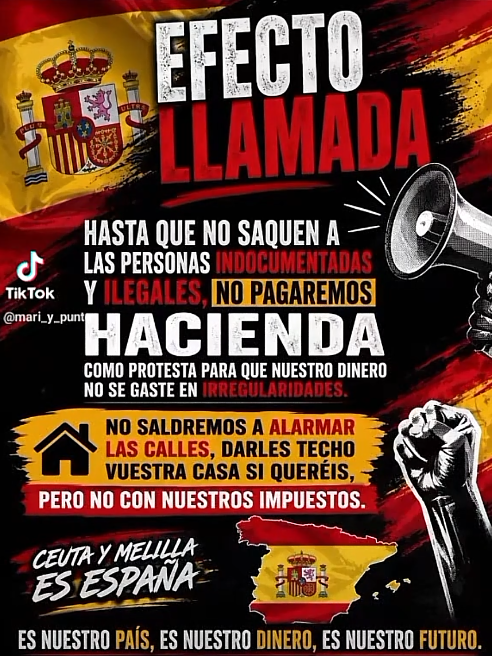
The events in Ceuta unfolded against a broader backdrop of anti-migrant narratives that had already circulated around the extraordinary regularization. These portrayed migrants as placing growing pressure on healthcare and housing as well as benefiting from generous government support, while Spaniards were being left behind. They also drew on a longstanding claim in far-right circles that government assistance to immigrants is intended to secure electoral support.
This argument was used to oppose regularization, claiming that migrants who obtained regular status through the process would help the PSOE win future elections, overlooking the fact that only Spanish citizens can vote in general elections.
The narrative further drew on wider social and economic pressures affecting younger generations, particularly high youth unemployment and the housing crisis, which have been used to portray immigration as evidence that the state is prioritizing migrants. This framing was previously applied to other unrelated events that generated public anger. In January 2026, as the regularization was already being publicly debated, a railway accident killed 46 people, prompting several actors to claim that the Spanish state was abandoning its own citizens while offering regularization to migrants.
Remigration and the Reconquest
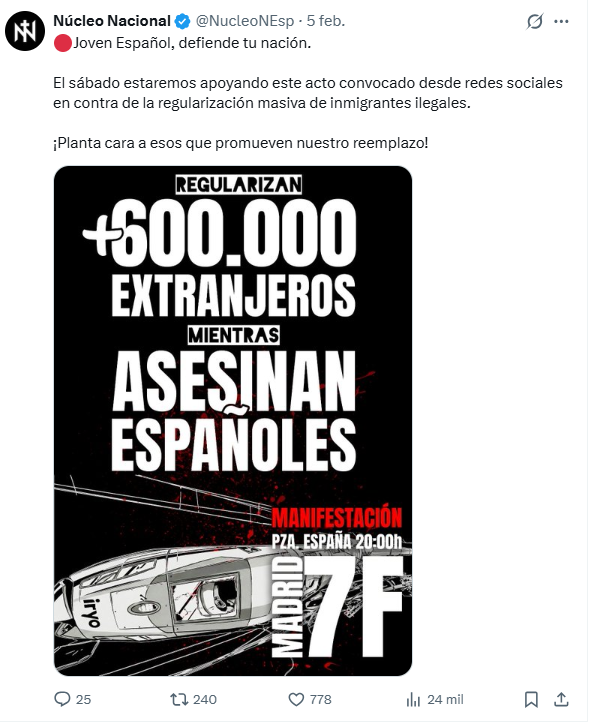
The regularization process became a fertile ground for the spread of “remigration” ideas, which have been increasingly embraced by different sectors of the far right in Spain, including the political party Vox and neo-Nazi organizations such as Núcleo Nacional, which recently registered as a political party under the name Noviembre Nacional.
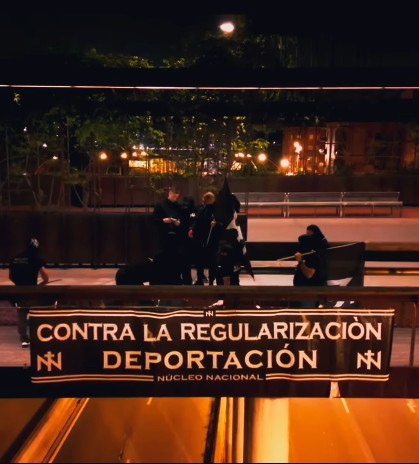
The latter has built much of its political agenda around the idea of mass deportation of migrants regardless of their legal status, portraying Spain as a country in decline and immigration as an “invasion” leading to the ethnic replacement of the Spanish population.
The group is organized around ethnonationalist ideas and the concept of “Blood and Soil,” directly referencing the völkisch imagery that inspired Nazism, as well as the idea that nationalist struggle is the only way to “recover” the country.
Using warlike slogans referring to the active defense of Spain and the expulsion of migrants, the group has established more than ten chapters across Spain and openly uses aesthetics and symbolism associated with Nazism and fascism. It has also organized rallies and tactical training sessions featuring openly racist discourse.
This framing also draws on historical references within the far right to the “recovery” of Spanish territory from perceived enemies, particularly through the invocation of “Reconquista“, a series of campaigns by Christian polities to reclaim Muslim-controlled territory in the Iberian Peninsula from the eighth to the fifteenth centuries.
Some far-right actors use these historical references to promote Islamophobic and white supremacist narratives, framing their present-day mission as a new chapter in a historical struggle against Muslims and contemporary political agendas as a continuation of medieval conflicts.
It is also reflected in the broader circulation of openly Islamophobic content online, including videos featuring chants such as “Christian Spain, never Muslim,” as well as derogatory slogans directed at Muslims through references to pork and practices such as eating ham.

The risks associated with the spread of this content should not be considered in isolation. In July 2025, Spain had already witnessed how anti-migrant online hate speech and disinformation contributed to anti-migrant riots in the town of Torre Pacheco, in southern Spain.
Following the assault of an older man by young people of North African origin, false and manipulated images were shared through Telegram accounts and social media by the group Deport Them Now to promote and coordinate violent citizen patrols targeting migrants, including explicit calls for “manhunts.” In the days that followed, riots, acts of vandalism, assaults, and attacks on Muslim-owned businesses took place.
The extraordinary regularization became a catalyst for anti-migrant and Islamophobic narratives that were already gaining ground within Spain’s far-right ecosystem, amid growing support for the far right among young people in the country. The rapid spread of hate speech, alongside the emergence of new actors, is particularly concerning given their increasingly sophisticated use of social media and propaganda to reach new audiences and facilitate offline mobilization.
The regularization also shows how a single political measure can become a focal point for broader anti-migrant sentiments that can resurface and gain renewed prominence around subsequent events, as seen in Ceuta, further connecting transnational far-right political actors, extremist groups, and online communities.
These dynamics highlight the need for platforms to adopt crisis-response protocols for events that may trigger coordinated campaigns targeting migrants and racialized communities. It should include stronger early-warning and risk-monitoring mechanisms to identify emerging discriminatory terms, slurs, conspiracy narratives, and supremacist content, as well as increased moderation capacity during periods of heightened risk.
Cooperation with fact-checking organizations and the proactive promotion of verified information from authoritative sources could also help counter false claims and reduce their potential reach, including through pre-bunking efforts. For politically sensitive initiatives such as the extraordinary regularization, these efforts should be implemented proactively, before harmful narratives gain traction and contribute to offline mobilization.
(Urszula Mrozowska is a researcher specializing in online hate, far-right extremism, online recruitment, and disinformation in the Spanish-speaking digital sphere. She previously worked in Trust & Safety, analyzing harmful online trends across Europe and Latin America, and has collaborated with research organizations and social media platforms on issues related to online extremism.)