In early January 2026, the Sri Lankan news cycle was inundated with details of a scandal involving long-awaited educational reforms spearheaded by Prime Minister and Minister of Education Dr. Harini Amarasuriya. The scandal pertained to the inclusion of a URL to an adult gay chatroom website, Buddy.net, in a Grade 6 English textbook chapter on building friendships and pen-pals. Soon, the planned reforms were halted, public officials at the Ministry resigned, and social media was split between calls for Amasuriya’s resignation and calls for a deeper investigation into what the premier’s supporters considered a clerical but serious oversight.
The proposed reforms were formulated over successive governments and in partnership with international agencies such as the United Nations Population Fund (UNFPA). This includes comprehensive sexuality education (CSE), a topic that has drawn strong opposition from multiple religious lobbies as a ‘Western import’ destructive to culture.
Previous attempts to introduce age-appropriate CSE have been shut down by such groups, citing mentions of sexuality, sexual orientation, and pleasure as gateways to homosexuality and ‘sexual deviancy’ in children. The criminalization of same-sex relationships via sections 365 and 365A in the still-active British colonial Penal Code underpins such dogma. As such, religious and nationalist groups also form the strongest opposition against attempts to repeal these sections or recognize equal rights for LGBTIQ+ and gender non-conforming people.
The Mothers Movement (MM), a self-styled non-profit organization, has emerged as a key oppositional voice against educational reforms since plans were announced in late 2025. In the last two years, the group has become infamous for its anti-LGBTIQ+ disinformation and mobilization. Before the scandal broke, MM had branded the proposed education reforms as part of ‘a concerted effort to indoctrinate children with the LGBTIQA++ agenda’. Within hours of news breaking about Buddy.net, MM Chairperson Shanuka Elangesekere posted on Facebook: “We know this is a website used by sexual deviants and sex traffickers. We must ask: what is the purpose of including this in an educational curriculum? It is a ploy to lure our children into sexual exploitation, to destroy their minds, bodies, and values.”
On the surface, MM appears to be a group retrenching existing hate narratives in a country where LGBTIQA+ identities are criminalized and contested. A loose causal relationship could also explain MM’s rhetoric as a localized manifestation of the global uptick in anti-trans and anti-LGBTIQ+ hate, buttressed by the existing structural discrimination against these communities. A deeper dive into the group’s activities, membership, allies, and rhetorical choices reveals a much more organized effort at reorganizing Sri Lanka’s far-right priorities and networks.
Mothers Movement and the Anti-Rights Landscape
Sri Lanka’s anti-rights landscape is mainly shaped by Sinhala and Buddhist nationalist groups operating with a fervor to safeguard the majority Sinhalese Buddhist community’s culture from ethnic and religious minority groups and what they view as Western conspiracies to diminish Sinhalese Buddhist culture.
In the last two decades, it has been dominated by major players such as the Bodu Bala Sena (BBS, or Buddhist Power Force), headed by monk Galagoda Aththe Gnanasara, and political parties including Jathika Hela Urumaya (JHU) and Sinhala Ravaya. Many of the groups thrived under close ties to the majoritarian political establishment, notably the Rajapaksa family, one of the country’s most influential political dynasties.
In recent years, Sinhalese Buddhist nationalism was espoused in a few key ways, including but not limited to: anti-Muslim hate speech on social media, incitement to violence and exclusion of Muslim communities at public rallies, and disinformation on mass conversions and “forced sterilisation” of Sinhalese and Buddhist mothers. Groups such as BBS rose to prominence around 2014 and paralleled significant global far-right narratives at the time. This included stoking fears about the “Islamisation” of Sri Lanka, Muslim population growth replacing Sinhalese Buddhists (similar to the Great Replacement myth), and the threat of “Islamist jihad” to national security due to the transnational influence of groups such as ISIS.
2022 marked a turning point. As pro-democracy Aragalaya/Porattham protests intensified demands for an end to Rajapaksa rule, citizen participation cut across ethnoreligious fault lines. It challenged a political order which had long relied on the weaponization of divisive, anti-minority nationalism to fortify the powerful family regime. The influence vacuum left by these groups is being strategically filled by various actors. Amongst these, MM stands out for its role in capitalizing on a national policy question, weaving Sri Lanka’s anti-rights landscape into a transnational foray, and shaping a new ideological frontier that scaffolds far-right movements in Sri Lanka.
Old Billo, New Frontiers
While it is unclear when the MM was established, the group’s first entry into the digital public square can be traced to a series of Facebook posts on July 22, 2024, in the lead-up to a hotly anticipated national election. The messaging across these posts ranged from opposition to a Private Member’s Bill in parliament to repeal sections 365 and 365A (colonial-era codes used to criminalize same-sex relationships), and cautions to “parents of young children” about “Western programs to perpetuate homosexual ideology which removes manhood from men and womanhood from women.”
The actors aren’t new, either. MM’s founding members include Shenali Waduge, a political commentator known for her voracious support of Mahinda Rajapaksa. Her personal blog features several pieces criticizing the United Nations and its ‘bias’ against Sri Lanka, especially the UNHRC and its stance on war crimes committed by the state and the Rajapaksa government during the final stages of the military conflict with Tamil separatists. Other writing includes warnings of threats from Muslim and Tamil extremism to the promotion of Sinhalese Buddhist civilizational heritage.
MM Chairperson Elangasekere’s publicly listed affiliations include being a pastor at Agape Ministries (now operating as a trust under Agape Ministries Charitable Trust), an evangelical church claiming islandwide reach and overseas missions in Canada, Israel, Singapore, and South Korea. She is also the founder of the Israel-Sri Lanka Solidarity Movement (ISSOM), a group which is known for its sympathy for Donald Trump and what it considers America and Israel’s campaign against “global Islamic terrorism and jihadism”. Buddhist nationalist monks feature as speakers at several of ISSOM’s public events.
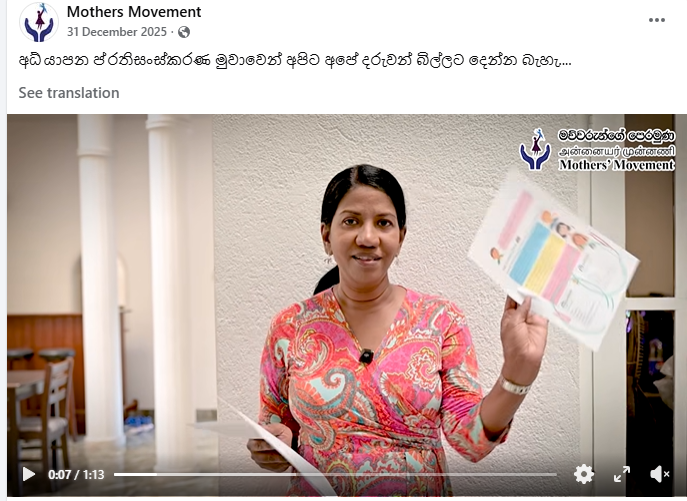
MM notably subsumes global far-right ideology and personas into these existing threads of hate. For example, the MM website includes language that it “considers Women as Mothers of the Nation and biological females as the foundation & heart of the Nation & civilizational existence”, a well-established dog whistle to target transgender women while simultaneously constructing cis women as biological and cultural reproducers.
Far-right figures such as Elon Musk and Dr. Miriam Grossman are repeatedly featured as global authorities on their mission. An August 2024 post, for example, features a snippet of an interview between Musk and Jordan Peterson with Sinhalese subtitles, where the former ascribes his decision to “wage war on the woke mind virus” to being “tricked” into agreeing to the gender transition process for his child, Vivian Jenna Wilson.
Later the same month, MM would go on to protest “foreign funded conspiracies to make [our] population infertile” outside the American Embassy in Colombo. Speaking to the media at the rally, MM representatives asked, “If the richest man in the world can be tricked into this woke LGBTQIA agenda, what of the innocent mothers compelled to do the same here?”
In early 2025, MM organized a march to express support for Trump, pledging their solidarity with the president’s actions to “reverse the damage done by LGBTQIA+++ woke agendas” and “protect family values”. A written petition further claims “the LGBTQIA and WOKE agenda is being unethically forced upon [us] as an economically vulnerable nation”, tied into preconditions of the International Monetary Fund and World Bank “handouts”.
The statement requests Trump to remove such alleged conditions and defund “US-funded NGOs”. In a previous demonstration outside the American Embassy, MM would similarly criticize ‘Western agencies’ such as USAID, UNFPA, UNICEF, and UNHRC for their role in undermining Sri Lankan values. Groups like BBS positioned themselves as the vanguard against corrosive ‘Western influences’, including and especially the American political establishment.
MM’s narrative strategy, instead, finds more stable ground—and a common enemy—in Western far-right rhetoric, which targets certain institutions for being “woke”, allowing the group to derive legitimacy from the transnational networks while ensuring their grievances remain local.
Compared with self-defined Buddhist majoritarian movements, MM claims to be a non-partisan movement open to mothers and concerned citizens of all denominations. In material terms, this has included platforming minority religious leaders at several points, including Archbishop Malcom Cardinal Ranjith, a vocal opponent of section 365 repeal and, more recently, of the education reforms. Minority religious leaders, including the Archbishop, have been at odds with —and the target of—the Sinhalese Buddhist nationalist movement.
However, MM’s renewed campaign against education reforms and LGBTIQ+ decriminalization includes a slow but sure encapsulation of Sinhalese Buddhist nationalist tropes and groups alongside these alliances.
MM’s most-viewed post on Facebook, shared on October 29, 2025, features the government whip Dr. Nalinda Jayatissa discussing reducing birth rates. The video is captioned with “LGBTQIA++ is the main reason for dropping birth rates. Girls’ schools have especially been affected by the epidemic.” In comparison, a four-minute clip produced by MM on January 5, 2026, claims “LGBTQIA+ is a UN project to sterilize the Sinhala and Tamil communities.”
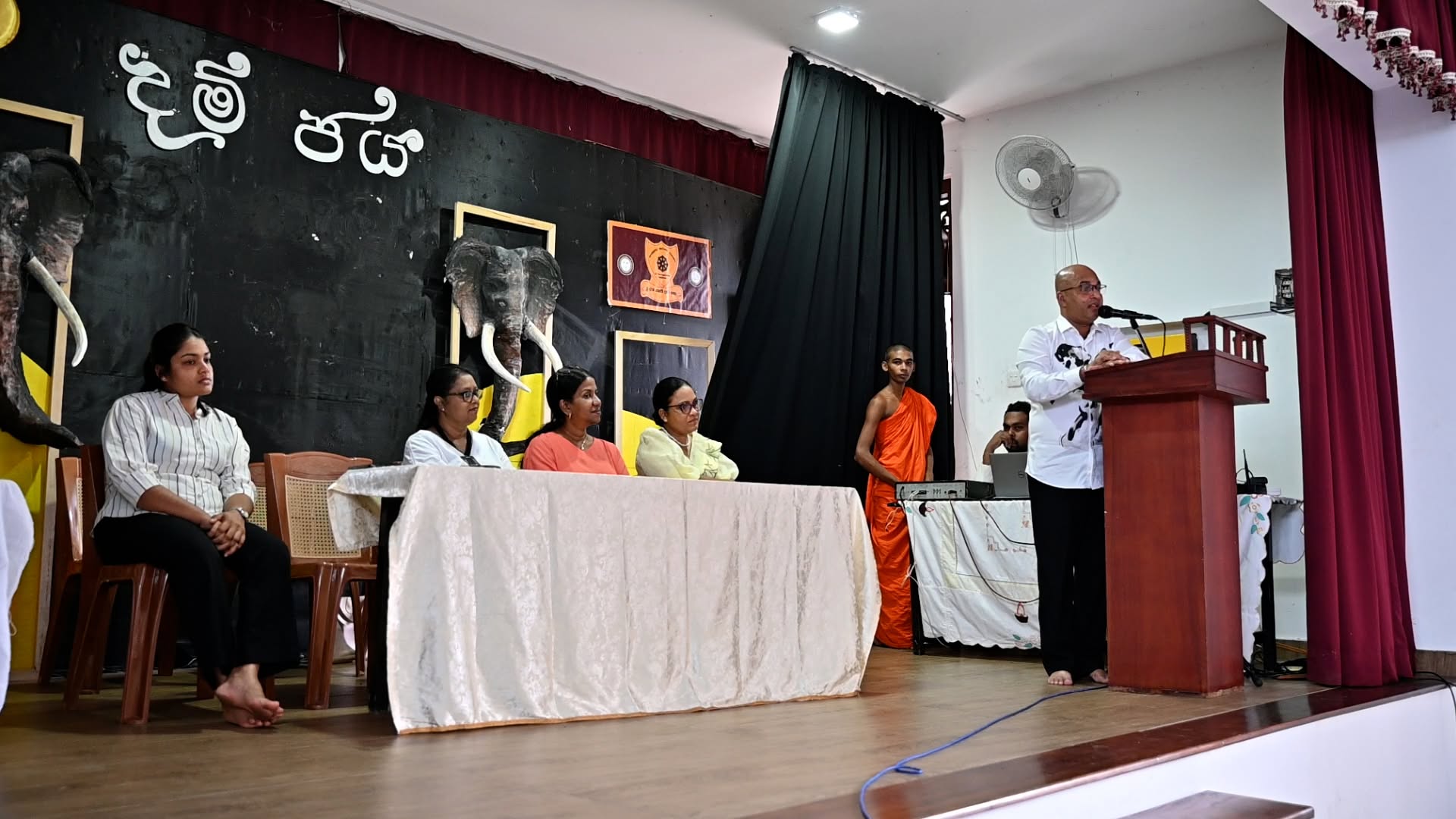
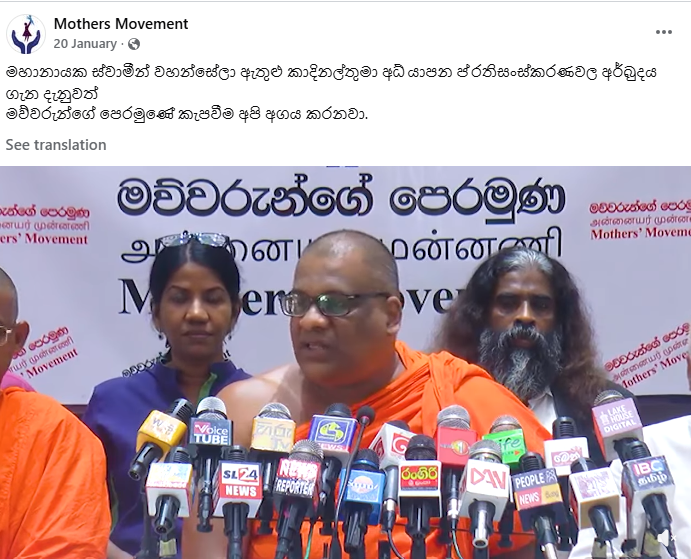
Later in the same month, Galagoda Aththe Gnanasara and BBS co-founder Dilantha Withanage sat in the front row at an MM press conference against the educational reforms. In a 12-minute appeal, Gnanasara lamented the education system, which has “failed to raise the children of this country as productive people regardless of Sinhala, Tamil, Muslim, Burgher, Malay, Catholic identity”. The monk, infamous for his militant rallying cries, was measured in his delivery, calling for denominational unity to oppose a Western process and to look to leaders like Donald Trump for Sri Lankans to “save [our] children from this disaster”. “We are not creating billo (boogeymen); we are educating people about a destructive epidemic,” said Elangasekara during the same appearance.
Consensus in Contradiction
MM’s continued—and at times contradictory—alliance with older nationalist groups is only the tip of an iceberg of subtext.
In its first public campaign, for example, MM members, including Elangasekere and convenor Dharshini Lahandapura, were seen donning t-shirts with the words “I will protect my child with my life”, handing out flyers advising the general public on “protect[ing] your child from the deviant sexual LGBTIQ+ epidemic”.
A Sinhala language crawler across the video states the MM’s purpose of organizing is to “prevent the sexual abuse of children enabled by same-sex laws”. Nanda Malini’s “Ammawarune” (“Dear Mothers”), an ode to mothers’ love and grief in times of war, serves as the background music.
The group’s name, Mother’s Movement, is starkly reminiscent of the (Southern) Mother’s Front, a 1990s mass protest movement that demanded accountability for state-sanctioned disappearances and killings during the second Janatha Vimukthi Peramuna insurgency. In the public imagination of Sinhalese-speaking southern Sri Lanka, the Mother’s Front remains a poignant symbol of motherhood as a force for justice.
As such, MM also taps into this collective subconscious to legitimize its campaigns as a frontline response to what is increasingly framed as attempts to destroy children and families by authorities at home and abroad. “A strong warning to lawmakers: we will not let you sacrifice our children,” reads a featured post on the group’s Facebook page.
By replacing the militant delivery and anti-minority hate speech with evocative language surrounding motherhood and children’s wellbeing, MM has built a successful campaign that keeps the far-right flame alive within the post-2022 influence vacuum.
In fact, MM’s operational strategy is insightful in showing how transnational far-right ideology can become locally entrenched, where contradictions are neutralized and the broader political zeitgeist is captured. The group has grown to 11,000+ followers on Facebook since July 2024. Reactions to the group remain mixed. The comments under the groups’ Facebook posts include criticisms of key members’ affiliation with the Rajapaksas and suspicion over their motives. Many comments also defend the current government’s actions and, more recently, the Prime Minister. On the other hand, positive reactions to MM’s work coalesce around the common interest of safeguarding children from sexual harm.
Sri Lanka is also a case study of how electoral victory does not neatly translate into public buy-in for progressive change when such codependencies are underaddressed. The ruling National People’s Power’s (NPP) landslide win in 2024 followed on the heels of a wide-reaching manifesto which included a commitment to repeal sections 365 and 365A and to education reforms, including comprehensive sexuality education. This would have proved challenging, regardless of the party in power or how one interprets a center-left populist wave in the throes of economic and political instability.
It is especially worrying that groups like MM are banking on their ability to re-inject specific majoritarian, nationalist anxieties into serious policy conversations, thereby hindering democratic governance. The majority Sinhalese’s codependency on Buddhist nationalism provides an optimal environment that leaves social and political space open to ideological capture, driven by older, unresolved anxieties about reproduction, population size, and cultural perseverance.
Education reforms have been halted until 2027, while a 2023 bill to repeal section 365 remains untouched in parliament, despite Supreme Court decisions deeming it constitutionally sound and requiring only a simple majority. As such, looking towards Western far-right groups’ successes in weaponizing anti–trans language to influence policymaking and undo progressive change raises serious red flags about the space MM is carving within sociopolitical discourse.
A window of opportunity does exist, as public discourse questions MM’s alliances with the old guard. While it is not an invincible firewall, the recency effects of NPP’s electoral popularity, the public appeal of figures like Amarasuriya, and what was rejected during the 2022 protests add a layer of friction between the general public and MM’s attempts at achieving the kind of all-encompassing influence that older groups had.
As such, early intervention requires reflexivity rather than reactivity, in which progressive elements, including a well-meaning government, must name and tackle the underlying structural forces being scaffolded by the MM before the friction gives way, matched with a stronger commitment to protecting the LGBTQIA+ community from the extensive damage caused by MM and other allied groups.
(Saritha Irugalbandara is a Researcher at the Center for the Study of Organized Hate (CSOH), focusing on digital extremism and online harms across South Asia.)