

For many young men, a search for advice on improving their appearance can quickly become something else entirely. What begins with questions about grooming, fitness, or style often leads into online spaces that claim physical appearance determines every aspect of a person’s life, from dating prospects to social status. In these communities, attractiveness is presented as an objective hierarchy where some people are destined to succeed while others are condemned to fail because of their genetics.
The term “looksmaxxing” refers to the act of enhancing one’s physical appearance, primarily used online by young men. While originally rooted in incel (involuntary celibate) forums as a strategy for overcoming perceived genetic disadvantages, looksmaxxing has expanded into a broader online ecosystem that promotes appearance optimization through practices ranging from grooming and fitness to more extreme cosmetic procedures.
Looksmaxxing content has spread, expanding from niche forums to mainstream social media platforms such as TikTok, YouTube, Reddit, and Discord. As looksmaxxing communities have grown, discussions of attractiveness have increasingly become racialized, with users constructing hierarchies that rank ethnic groups according to their purported desirability. Within these discussions, South Asian men are frequently portrayed as occupying the bottom of racialized attractiveness hierarchies, with users citing skin tone, facial features, height, physique, and “genetics” as evidence that they possess the lowest “sexual market value” (SMV).
Looksmaxxing has migrated from fringe incel forums to mainstream platforms and has carried with it racialized and deterministic ideas about attractiveness. For South Asian men, repeated exposure to online narratives that rank them as inherently undesirable normalizes internalized racism and serves as an entry point into black pill and manosphere ideologies.
Constructing Racialized Attractiveness
Sexual market value (SMV) is a prevalent acronym among looksmaxxers, referring to the perceived desirability of an individual in the dating market compared to those around them. Users evaluate SMV through a combination of physical characteristics, including facial symmetry, jawline, height, body composition, skin tone, race, hair, and perceived genetic potential, as well as social status, wealth, and confidence. Although inherently subjective, these standards are framed as an objective metric, creating ranking systems to evaluate attractiveness.
Within these discussions, it is frequently claimed that South Asians have the lowest SMV and thus occupy lower positions within dating markets. As a result, masculinity becomes framed as something that can be quantified, ranked, and competed over through racialized standards of attractiveness.
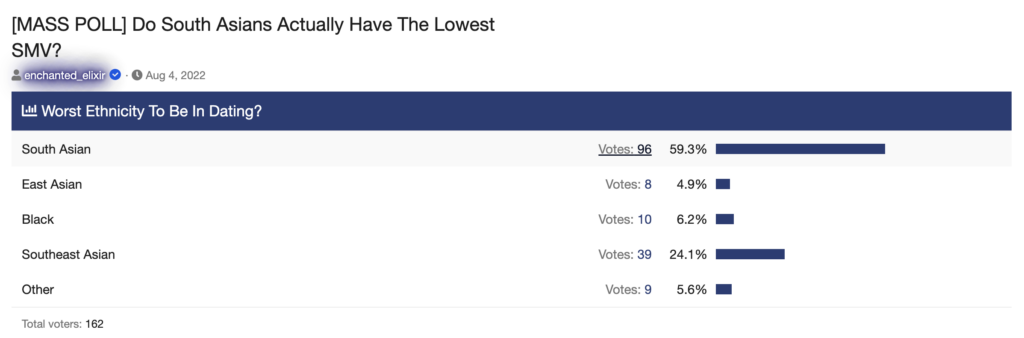
This hierarchy is reinforced through discussions of “South Asian genetics” presenting short statures, higher body fat, lower muscle mass, dark skin, hyperpigmentation and wide, short faces as biological disadvantages. This is framed as evidence that South Asians are less desirable and hold less value in dating markets. Rather than recognizing that beauty standards are socially constructed, these communities present them as objective consequences of genetics.
This mirrors core black pill beliefs. “Black Pill,” in this context, refers to the idea that the ability of an individual to find a sexual partner is predetermined by genetics. Looksmaxxing serves as a pipeline into this ideology by amplifying the belief that dating outcomes are predetermined by race and genetics.

The layered effect of these narratives is the construction of an “ideal male” whose defining characteristics closely align with Eurocentric beauty standards. Height, lighter skin, angular facial features, and other features associated with whiteness are presented as markers of superior attractiveness and masculine worth. Conversely, physical features associated with South Asian identity are framed as biological deficits requiring correction or compensation.
Through this framework, attractiveness becomes a racialized hierarchy in which masculinity itself is measured according to white beauty ideals. This, in turn, reinforces black pill beliefs that an individual’s social worth is predetermined by their ethnicity.
Eurocentric Beauty Standards and Internalized Racism
Colorism has been rooted in South Asian history through caste hierarchies and British colonialism. Over time, dark skin became associated with manual, outdoor, “low-caste” labor. The presence of the British Empire in South Asia furthered this prejudice, as the colonial administration favored lighter-skinned individuals for higher-status jobs. This pattern associated light skin with intelligence and status. Colorism among South Asians persists today and has been amplified by looksmaxxers.
Users across racial backgrounds will recommend that South Asian users lighten their skin, claiming that doing so will make them more desirable in an environment where colorism is prevalent. These recommendations include relatively mild practices, such as using vitamin C or kojic acid to reduce hyperpigmentation. More extreme interventions, however, include skin bleaching and Glutathione injections, which are marketed to “brighten” or lighten skin tone. In this way, existing colorist norms expand beyond South Asian communities and are amplified online. Forum posts often include image comparisons intended to demonstrate that identical facial structures receive higher attractiveness ratings when paired with lighter skin.
South Asian users are pressured to compensate for their ethnicity through enhancing appearance, wealth, and status. Some users will even advise South Asian users to “fraud their pheno,” meaning to modify their appearance to minimize features associated with South Asian identity.
When racial identity is framed as the primary obstacle to romantic success, South Asian users may become increasingly receptive to black pilled assumptions that attempts to improve their appearance are ultimately futile. This worldview can evolve to a search for explanations beyond the individual, as black pill ideologies reframe involuntary celibacy as the product of biological and systemic hierarchies. From there, frustration is often redirected towards women who are portrayed as collectively responsible for reinforcing these hierarchies through their dating preferences.
Even among South Asian users themselves, forum discussions frequently reflect this ethnic self-deprecation, with individuals describing their race as a barrier to attractiveness and romantic success. Rather than challenging these assumptions, other users often reinforce them by recommending ways to compensate for or conceal South Asian features.

Looksmaxxing as a Pipeline
This internalized sense of racial inferiority can evolve into a more fatalistic worldview, particularly as looksmaxxing presents physical transformation as the primary path to romantic success. For South Asian users repeatedly told that their ethnicity makes them inherently less desirable, rejection is increasingly interpreted as evidence of an immutable racial disadvantage. In doing so, these narratives reinforce the black pill belief that attractiveness and romantic success are largely determined by genetics and race.
While many looksmaxxing content creators are not necessarily affiliated with extreme misogynistic communities, looksmaxxing often frames women as “targets” or “conquests,” creating space for misogynistic grievance when users fail to achieve the relationships they believe they deserve.
Black pill and manosphere communities build on these assumptions by portraying women as gatekeepers of the “sexual marketplace” who are responsible for men’s perceived exclusion. Among some South Asian incels, who are derogatorily referred to as “currycels,” this grievance is further racialized through claims that South Asian women prefer white men, reinforcing both misogyny and racial resentment.
These patterns are not representative of all looksmaxxing communities. However, spaces that normalize racial hierarchies of attractiveness, genetic determinism, and SMV reproduce many of the core assumptions of black pill ideology. While most users will not adopt extremist worldviews, repeated exposure to these narratives may make black pill and manosphere ideas appear increasingly credible, shifting self-improvement into fatalism and personal insecurity into grievance. Over time, this may increase users’ susceptibility to adjacent online communities associated with misogynistic harassment and, in some cases, real-world acts of violence.
(Srinidhi Venkitasamy is an undergraduate student at Florida State University pursuing dual degrees in Political Science and Human Rights & Social Justice. As an Oslo Scholar and intern with the Center for the Study of Organized Hate, she examines digital harms, online extremism, and the role of technology in shaping identity-based violence and human rights.)