Introduction
India has witnessed a sharp and sustained rise in hate speech targeting religious minorities, particularly Muslims and Christians. The Hate Speech Events in India report, published by the India Hate Lab, underlined this rise by documenting a year-on-year 97% increase in hate speech incidents since 2023, underscoring the scale and acceleration of this trend.1
The United Nations Strategy and Plan of Action on Hate Speech defines hate speech as “any kind of communication in speech, writing or behaviour, that attacks or uses pejorative or discriminatory language with reference to a person or a group on the basis of who they are, in other words, based on their religion, ethnicity, nationality, race, colour, descent, gender or other identity factor.”2
Hate speech is expressed in various forms. In India, a new and distinct form has emerged: music. This genre of hate music—known as Hindu nationalist or Hindutva pop music, or H-Pop3—directly promotes beliefs aligned with Hindu nationalist (Hindutva) ideology, deploying it to vilify and dehumanize Muslims and Christians, and to stoke feelings of anger and fear among the Hindu majority. The genre promotes the legitimacy of Hindu dominance over other religious minority groups, insisting that Hindu supremacy in India stems from “original” inhabitants of the land, overriding India’s pluralistic constitution. Hindutva pop goes a step further, directing violent threats and dehumanizing rhetoric towards Muslims and Christians, urging listeners to act through bodily harm, boycotts, and dispossession.
The report is divided into the following sections. Section 1 provides an overview of hate music and presents the platforms selected for this study: YouTube, Spotify, Meta Music Library, and Apple Music. After the key findings and methodology are discussed, Sections 4 and 5 analyze specific trends on each platform, including the themes present within H-Pop songs, followed by a profiling of particularly popular artists and producers in Section 6. Section 7 examines the monetization of Hindutva pop hate music on these platforms. Section 8 details the content policies or Terms of Service for each platform, specifying categories of violation related to hate content. To assess the enforcement of these policies, a sample of songs that met the threshold of violation was reported to the platforms, and the results of platform actions are discussed. Section 9 concludes by examining the role of Big Tech platforms in facilitating the spread and proliferation of H-Pop music, while underscoring the dangers that such complicity creates in the offline world. Finally, Section 10 offers recommendations for YouTube, Spotify, Meta, and Apple Music to enforce content policies on hate more effectively and to design user-friendly reporting mechanisms.
The Origins of Hate Music
The rise in popularity of Hindutva pop in India reflects a global phenomenon in which hate music has emerged as a potent vehicle for incitement and violence. One of the most historically significant and enduring strands of hate music is white power music. This genre is believed to have originated in the United Kingdom in the 1980s, with a band named Skrewdriver gaining widespread popularity for songs laced with white supremacist rhetoric.4 White power music promotes the idea that white people are racially superior to all others and must therefore enjoy dominance, while facing perceived threats from immigrants and other racial communities.5 The band’s frontman, Ian Stuart Donaldson, is often called “the founding father” of white supremacist music.6
The success of white power music led Donaldson to later found Blood and Honour, a neo-Nazi music network that supported similar music and far-right movements.7 Blood and Honour also created a music label, Resistance Records, which produced and disseminated music resulting in high profit, a testament to its popularity. In 1985, white supremacist music spread to the United States, and the first openly white power band, named Final Solution, was founded. The white power music scene expanded rapidly into a multi-million dollar enterprise, with live concerts, independent radio stations, and merchandise sales. This network of white power bands became so influential that they were reportedly funding political parties.8 By 2002, there were at least 350 white power bands active across the United States and Europe. Since then, however, the genre’s popularity has declined in the United States, and, according to the Southern Poverty Law Center, only 11 active hate music chapters remained in the country as of 2023.9
Hate music has nonetheless continued to spread in other parts of the world, with real-life consequences. The International Criminal Tribunal for Rwanda (ICTR), established to investigate the 1994 genocide, charged singer Simon Bikindi with inciting the genocide through songs that implicitly called for the slaughter of Tutsis.10 In Myanmar, the genocide targeting Rohingya Muslims was partly driven by local musicians found to be inciting violence and persecution against Muslims.11 Similarly, in 2012, a gunman killed six worshippers at a Sikh gurdwara in Wisconsin before shooting himself. The perpetrator was later found to be a musician who created white supremacist music and had been part of several hate music bands.12
Over the past decade, India has seen a rise in hate music aligned with Hindutva (or Hindu nationalist) beliefs deployed to instigate hatred and violence against minorities, particularly Muslims and, at times, Christians, resulting in spikes of hate-fueled violence, especially during Hindu festivals across the country. In 2024, a Hindu procession in Bahraich, Uttar Pradesh, descended into violence—resulting in the damaging of multiple properties and one person’s murder—after the procession insisted on playing a song with violent innuendo toward Muslims, despite protests from local Muslim residents.13
In 2023, a Ram Navami festival procession played a song outside a mosque in Mumbai, the capital city of Maharashtra state, calling upon Hindus to pick up swords to protect the “motherland” against enemies, referring to Muslims, leading to clashes between the two communities.14 Ram Navami celebrates the birth of the Hindu Lord Rama, a central figure in the epic Ramayana. The city of Khargone in Madhya Pradesh witnessed a similar outbreak when a Ram Navami procession involving men brandishing swords and sticks passed through Muslim neighborhoods and mosques while playing songs that included calls for violence against Muslims.15 The ensuing clashes killed one person and displaced dozens of families after their homes were damaged. Shops were looted and set ablaze, and mosques were desecrated.
Despite the morbid aftermath of these incidents, Hindutva pop artists continue to thrive in popularity both online and offline. A central reason for the growth is the monetization these artists receive as online personalities. Their songs find a home on two of the biggest social media platforms: as videos on YouTube and as audio used for Reels on Meta’s Instagram. Audio streaming platforms similarly allow these artists to earn royalties and reach a wide user base, thereby enabling the dissemination of hate-filled rhetoric at scale. The world’s largest streaming service, Spotify, with over 750 million active users, as well as the second largest, Apple Music, with over 120 million active users, host such music. The visibility afforded by the world’s biggest online platforms is central to the survival and growth of the H-Pop industry.
Beyond monetization, the genre thrives on the active patronage of music as a driver of hate and polarization by the ruling Bharatiya Janata Party (BJP) and its ideological parent, the Rashtriya Swayamsevak Sangh (RSS). This political backing, combined with the sheer impunity afforded to H-Pop artists and their entrenched popularity within the broader Hindu nationalist ecosystem, has allowed the industry to flourish unchecked.
This report examines the scale of India’s growing extremist music scene and the critical role that online platforms play in enabling its reach. From YouTube and Instagram to streaming giants like Spotify and Apple Music, these platforms provide Hindutva pop artists with the infrastructure to build their brands, grow audiences, monetize their content, and disseminate hate-filled tracks to hundreds of millions. Through a first-of-its-kind database of Hindutva pop songs catalogued by themes of violative content, top artists, and producers, this report demonstrates how these platforms, despite their own content policies, have allowed hate music to flourish largely unchecked. The findings are intended to stimulate future research and inform policy measures around combating the spread of hate music online and the dangerous role it continues to play in indoctrination and the spurring of offline violence against religious minorities and other vulnerable communities.
Key Findings
- This study identified 523 Hindutva pop hate songs across YouTube, Spotify, Apple Music, and Meta’s Music Library that violate each platform’s own content policies by promoting hatred, dehumanization, and incitement to violence against religious minorities, primarily Muslims and Christians.
- 210 songs were identified on YouTube, 109 on Spotify by 53 artists, 103 on Meta’s Music Library, and 101 on Apple Music by 59 artists. YouTube songs alone have been viewed over 198 million times; Meta’s Music Library songs were used in more than 5.9 million Instagram Reels.
- 1 in 2 hate songs hosted on platforms explicitly calls for violence. 263 (50 percent) of the 523 violative songs identified across YouTube, Spotify, Apple Music, and Meta directly threaten or incite violence against religious minorities, while the remaining 260 songs promote or incite hatred through slurs and dehumanization.
- Three YouTube channels account for over 40 percent of identified hate songs, yet continue to operate as verified accounts, monetize and grow their subscriber bases.
- Ads for 103 brands appeared on hate music videos, including 78% of violative YouTube videos and 83% of those calling for violence. Advertisers documented include OpenAI’s ChatGPT, Google’s NotebookLM, Amazon Prime, Adobe, Dell, Levi’s, Kellogg’s, Flipkart, and the Reserve Bank of India.
- YouTube’s “Super Thanks” fan-funding feature was enabled on 55 percent of violative videos. Mayur Music, which hosts 25 violative songs, has been awarded YouTube’s Silver Creator Award.
- On Meta, 20 of 30 prominent Hindutva pop singers studied had monetized Facebook accounts.
- A sample of 225 songs (43 percent of the dataset) were reported to four platforms in October 2025 for content policy violations. By May 2026, 207 songs (92 percent) remained live, with only 18 removed, a takedown rate of 8 percent.
- Compared to YouTube and Meta, Spotify and Apple Music lack functional reporting tools, in which submitting a single report through Spotify’s live chat required more than 33 minutes.
- Enforcement is superficial and easily circumvented. Artists whose channels are terminated create new ones. For instance, singer Sandeep Acharya’s accounts have been suspended at least three times, yet 21 of his 26 violative songs remain available across other YouTube channels.
Methodology
This report examines songs that contain hate speech, dehumanization, and incitement to violence against people on the basis of religious identity. It further documents the role of four major platforms—YouTube, Spotify, Apple Music, and Meta Music Library—in hosting, disseminating, and monetizing this content. The analytical framework is grounded in each platform’s own published policies on hate speech, hateful conduct, and incitement to violence.
The research proceeded through four interconnected stages.
The first stage involved a systematic review of the content policies and terms of service that each of the four platforms maintains to govern hateful, discriminatory, and incendiary content. These platform-specific standards, including YouTube’s Hate Speech Policy, Spotify’s Hate Content and Hateful Conduct Policy, Meta’s Community Standards on Hate Speech, and Apple Music’s content requirements pertaining to legality and regional appropriateness, served as the evaluative framework for subsequent stages of the research. Having established the applicable standards for each platform, we could identify songs that, despite meeting the threshold for violation under a platform’s own rules, were permitted to remain accessible and continued to be monetized by the artists and music labels that produced them.
Secondly, a comprehensive database of songs was compiled through multiple, complementary methods designed to ensure broad and representative coverage. We conducted keyword searches in both English and Devanagari (the script used for Hindi) using terms commonly associated with Hindu nationalist groups and the creators of hate music. Search terms included “Love Jihad,” “Bhagwa gaana/songs,” and “Hindutva gaana/songs,” as well as “हिन्दू राष्ट्र भजन (Hindu nation devotional song),” “गौ रक्षक भजन (Cow protector devotional song),” and “हिंदुत्व भजन (Hindutva devotional song).”
These searches were supplemented by systematic monitoring of the social media accounts of Hindutva influencers who routinely use such music as background audio in their Instagram Reels, as well as a review of video footage from processions organized by Hindu nationalist groups, in which this music is regularly played. These videos were sourced from YouTube, X, and Instagram.
Building on initial leads, we identified key actors, particularly YouTube channels that function as music record labels, and monitored their output over the research period. These channels produce and host music across a range of genres, including hate music, and were examined systematically for additional content. Once a preliminary catalogue had been assembled, each song was searched across all four platforms to determine the full extent of its distribution.
Data collection took place between January 2025 and January 2026, and was updated on a rolling basis to capture newly released songs as they were produced.
Across the four platforms, a total of 523 songs were identified that met the threshold for violating respective platform content policies. Given that the focus of this report is on platform accountability, instances of the same song appearing on multiple platforms have been counted as separate entries to reflect each platform’s independent hosting decision.
Identified songs were classified across several dimensions: the specific platform policy violated; the nature of the violation (incitement to violence, dehumanization, promotion of supremacist beliefs, or a combination thereof); the artists, and, where applicable, the channels responsible for production and dissemination; and available engagement metrics, including views, likes, comments, and Reel usage. This classification enabled the identification of key patterns, including the concentration of output among a small number of prolific creators, the channels most central to the dissemination infrastructure, the scale of audience engagement, and the platform guidelines most frequently breached.
The next stage assessed both the efficacy and the accessibility of the content reporting mechanisms each platform makes available to users. Reports were manually submitted for approximately 37% of the songs identified on each platform, flagging content assessed to be in violation of the platform’s guidelines.
Platform responses were tracked over the subsequent three months, recording the time taken to respond, the nature of any action taken, and whether acknowledgment of the report was provided to the user. This exercise yielded firsthand evidence of platform responsiveness (or lack thereof) to user-initiated reports and documented significant variation in the usability, transparency, and effectiveness of reporting systems across the four platforms.
The final stage investigated the monetization of hate music on YouTube and Meta, with the aim to document how both social media platforms and content creators alike profit from hate music. Advertisements from major brands appearing in-stream alongside hate songs were documented on YouTube. Other fan-funded monetization opportunities offered to creators on the platforms, including “Super Thanks” tips and premium memberships, were also documented. The monetization status of Facebook profiles associated with 30 Hindutva Pop singers were checked using the WHAT TO FIX’s Meta Monetization Archive.16
Hate Music and Trends
This section examines the presence and reach of Hindutva pop music across the four platforms selected for this study: YouTube, Spotify, Apple Music, and Meta’s Music Library. Across these platforms, a total of 523 songs were identified that violate the platforms’ own respective content policies, with 210 on YouTube, 109 on Spotify, 103 on Meta’s Music Library, and 101 on Apple Music.
FIGURE 1. DISTRIBUTION OF HATE SONGS ACROSS PLATFORMS
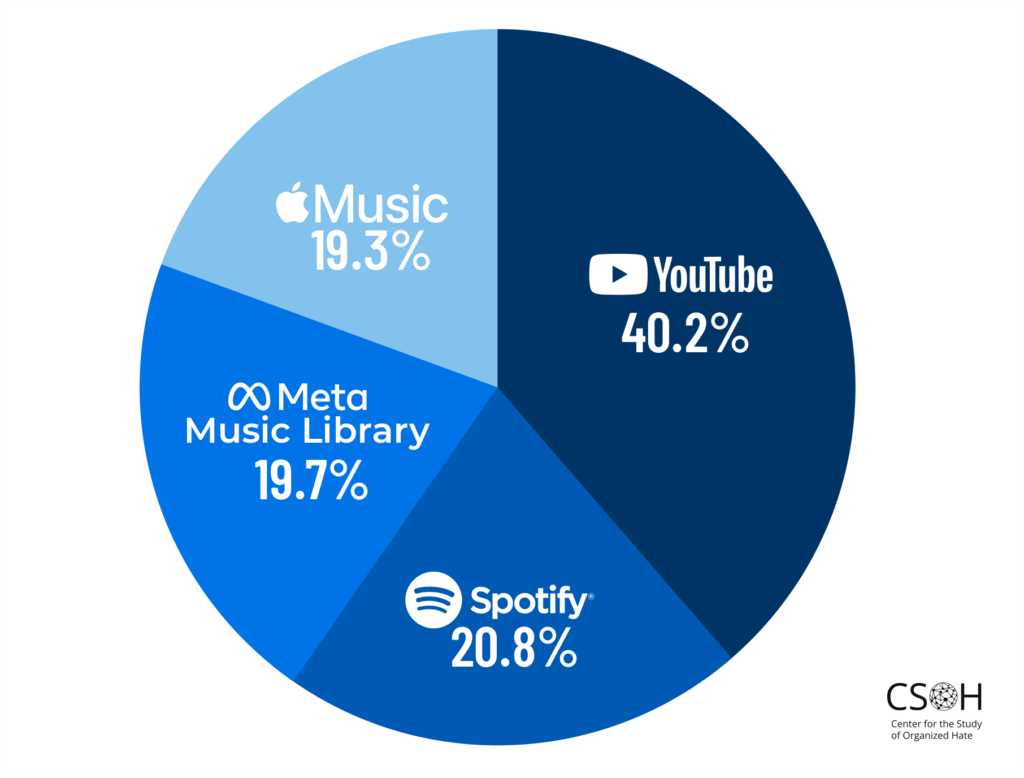
These songs were created by hundreds of artists: 98 on YouTube, 67 on Meta’s Music Library, 59 on Apple Music, and 53 on Spotify. In terms of reach, the songs on YouTube alone garnered over 198 million views, while on Meta, they were used in more than 5.9 million Reels, each of which further amplified their reach to millions of additional users. Spotify and Apple Music do not consistently provide public data on the number of times a song has been streamed.
For each platform, we first outline the relevant content guidelines and then document the volume, themes, and engagement metrics of the violating songs. It should be noted that major social media platforms, including YouTube and Meta, have been downgrading protections against hate speech in their public community guidelines17 or internal content moderation policies18 as well as cutting-back on enforcement through human moderators19 and fact-checkers.20 Against this backdrop, the findings reveal a consistent pattern: hate music that openly incites hatred and violence against Muslims and other religious minorities is not only permitted to remain but is monetized and algorithmically amplified, allowing it to reach vast audiences.
Youtube
YouTube is the world’s most popular social media platform, present in over 100 countries and used by over 2.7 billion people each month—meaning roughly one in every three people on earth is a YouTube user.21 India is YouTube’s largest market, with an estimated 500 million users, which is nearly twice the number in its second-largest market: the United States, at 253 million.22 This makes it especially critical to examine the role the platform is playing in fomenting hate and violence against marginalized communities in its largest market.
YouTube’s Hate Speech Policy takes a two-pronged approach to regulating hate speech on its platform. Its publicly available guidelines state that the platform does not allow “content that promotes violence or hatred against individuals or groups” based on attributes such as religion, age, caste, ethnicity, race, nationality, or immigration status, among other categories.23 The platform also prohibits creators from posting content that encourages violence against individuals or groups on the basis of these same attributes. When such content is posted repeatedly by the same channel, YouTube imposes penalties and, after three “strikes,” claims to terminate the channel.
Despite these explicit guidelines, YouTube serves as the largest harbour for hate music originating from India. The platform hosts at least 210 hate songs created by 98 artists (singers and DJs) all of which exist on the platform in direct violation of its stated guidelines.
These 210 songs were uploaded across 100 different channels with a combined subscriber base of over 76.4 million, equivalent to more than 15% of YouTube’s total Indian user base. This figure does not account for overlap across channels, which is likely given that audiences drawn to a specific ideological genre tend to cluster around shared content ecosystems. Despite YouTube’s stated guidelines against creators who repeatedly post hateful content, channels promoting Hindutva pop hate music were not only permitted to operate but also continued accumulating subscribers.
Of the 210 songs, 104 (or 49%) directly incite or threaten violence against Muslims and have been viewed at least 97 million times. The remaining songs—while stopping short of explicit calls for violence—promote hatred against Muslims and other religious minorities, deploying dehumanization, slurs, and conspiracy theories that cultivate fear and anger and create conditions for real-world harm against the target group.
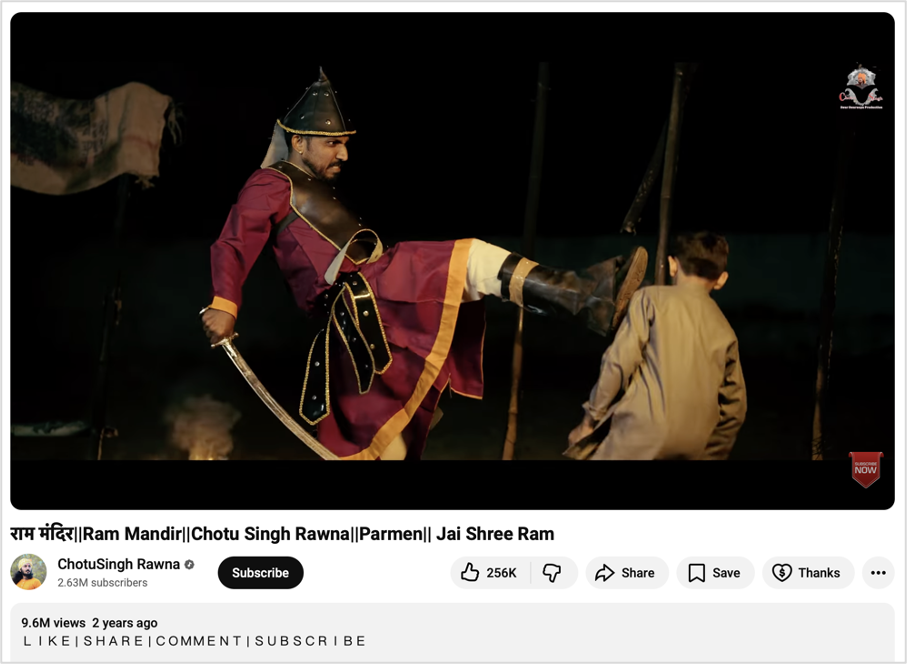
Many of these songs combine hateful rhetoric with polarizing visuals to amplify their impact. One song, titled “Ram Mandir,”24 features dramatized visuals depicting Mughals—the Islamic empire that ruled much of the Indian subcontinent from the 16th to the 19th century—as invaders killing children and assaulting women, staging their brutality for maximum effect.
The song’s lyrics describe these purported historical atrocities before pivoting to attack Indian Muslims as the inheritors of such brutality and threatening them with violence.
As of May 2026, the song had been viewed 9.6 million times and accumulated over 256,000 likes and more than 19,000 comments.
These songs target religious minorities, and Muslims in particular, issuing a range of threats: from explicit calls for their extermination to incitements for Hindus to “avenge” imagined injustices through violence.
By framing the Mughal empire as a monolithic force of religious destruction, these songs render contemporary Indian Muslims collectively guilty for the actions of medieval rulers, recasting present-day violence as legitimate historical redress. The logic is elastic, extending beyond Muslims to any community perceived as threatening Hindu dominance, including Christians, who are frequently portrayed in Hindu nationalist discourse as agents of foreign influence and forced religious conversion. In this framework, the specific identity of the target matters less than their designation as the “other”: non-Hindu, and therefore suspect and a threat to the Hindu-majority nation. Hindutva pop exploits this with precision, converting historical grievance into contemporary incitement to violence against any religious minority.
Another song, titled “Jo Bhi Saamne Usko Cheerenge Aur Faadenge”25 (“Whoever comes our way, we’ll rip them, tear them apart”), is explicit in its threats. The lyrics vow to “chop and tear apart” anyone who stands in the way of Hindus and their quest for supremacy, while calling on Hindus to unite against their “enemies.” This song, however, is based on a Sufi qawwali that was released seven years ago with the same song title. The words are the same, only the religious object is swapped: the original song threatens to chop and tear apart anyone who comes in the way of Islam. This qawwali has over 4.7 million views and more than 41,000 likes on YouTube. Without explicitly naming any community, the song threatens the “enemies” of Islam with brutal violence. The song has remained on YouTube for over eight years despite violating the platform’s guidelines. By May 2026, “Jo Bhi Saamne Usko Cheerenge Aur Faadenge” had accumulated over 590,000 views and more than 10,000 likes on YouTube. Laced with violent threats, it is frequently played during Hindu nationalist processions coinciding with religious festivals.
Similarly, “Bhogol Hi Badal Jaayega”26 (“Even the map will be reshaped”), sung by Gaurav Bittu Raja, warns of chaos when Hindus rise with their swords, insisting that “enemies” will be beheaded and their existence wiped out if they oppose Hindus. The song has over 368,000 views and more than 3,900 likes, as of May 2026.
In our dataset, 106 of the 210 YouTube songs specifically promote hatred against Indian Muslims, portraying them as an existential threat to Hindus and amplifying anti-Muslim conspiracy theories such as “love jihad”—the Hindu supremacist claim that Muslim men systematically lure Hindu women into relationships in order to convert them to Islam. These songs collectively garnered over 76 million views and 1.4 million likes. While stopping short of explicit calls for violence, these songs cultivate deep anger, fear, and hatred toward Muslims among Hindu listeners. This targeted hatred serves as a potent driver of radicalization and can precipitate real-world violence.
YouTube is notable among the four platforms for including a distinct prohibition on content that promotes supremacist beliefs. This category is of particular relevance when studying Hindutva hate music, as many songs, without directly referencing other communities, advance supremacist rhetoric that deepens the otherization of the religious minorities they target. Despite creating this prohibition, however, YouTube has failed to enforce it. At least 7 songs on the platform promote Hindu supremacist beliefs: from claims that Hindus have a rightful claim over lands where mosques currently stand and calls for India to be declared a Hindu nation, to assertions that Muslims will ultimately be compelled to accept Hindu supremacy.
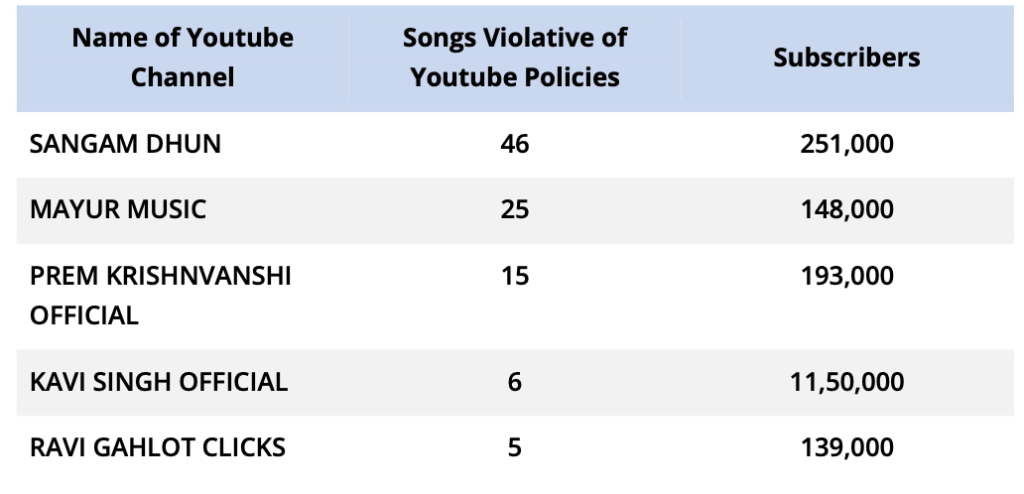
46 of the 210 songs (nearly one in every four) originate from a single YouTube channel, Sangam Dhun,27 which has over 251,000 subscribers and has posted more than 2,500 videos since its creation in 2020. Its repertoire includes songs calling on Hindus to brutally attack “enemies” (a thinly veiled reference to Muslims), as well as songs demanding that Muslims and other religious minorities “leave India” if they refuse to accept Hindu supremacy.
A further 25 songs come from Mayur Music,28 a channel with over 149,000 subscribers that has posted 590 videos since its creation in 2019. Mayur Music’s catalogue includes songs that frame Hindu-Muslim relations as a religious war and urge Hindus to take up the fight. It also includes songs calling for India’s secular republic to be replaced by Hindu supremacy, and songs that abuse Muslims as “jihadis” and traitors.
A third channel, Prem Krishnvanshi Official,29 accounts for 15 of the 210 songs. Founded by a singer of the same name who specializes in anti-Muslim hate music, the channel, with 193,000 subscribers and 665 videos, features songs by multiple artists ranging from those that describe Muslims as “snakes,” threaten to demolish Muslim places of worship, and encourage physical violence against the community.
These three channels are further explored in Section 6 of the report, given their disproportionate share of music production.
Spotify
Spotify is the world’s largest audio streaming platform, with more than 750 million users across 180 markets.30 It has also emerged as India’s largest paid audio streaming service, with over 3 million paid subscribers,31 making it a critical channel through which Hindutva pop artists disseminate their hate music to a wide, paying audience.
Spotify first published its Hate Content and Hateful Conduct policy in May 2018, and after backlash from the music industry, updated it in June 2018 to remove provisions around hateful conduct of artists.32 It, however, retained and reiterated its position on hate content clearly: “Spotify does not permit content whose principal purpose is to incite hatred or violence against people because of their race, religion, disability, gender identity, or sexual orientation. As we’ve done before, we will remove content that violates that standard. We’re not talking about offensive, explicit, or vulgar content—we’re talking about hate speech.”33
Spotify’s guidelines on Dangerous Content additionally prohibit the following:34
“Content that advocates or glorifies serious physical harm towards an individual or group”, as well as “Content that incites violence or hatred towards a person or group of people based on race, religion, gender identity or expression, sex, ethnicity, nationality, sexual orientation, veteran status, age, disability or other characteristics associated with systemic discrimination or marginalization.” This includes,
- “praising, supporting, or calling for violence against a person or groups based on the characteristics listed above”
- “dehumanizing statements about a person or group based on the protected characteristics listed above”
- “promoting or glorifying hate groups and their associated images, and/or symbols.”
Despite these explicit prohibitions, Spotify hosts 109 Hindutva pop songs in direct violation of its own regulations. These are songs that incite hatred and violence against people on the basis of religion, call for or praise violence against religious groups, and primarily target Muslims.
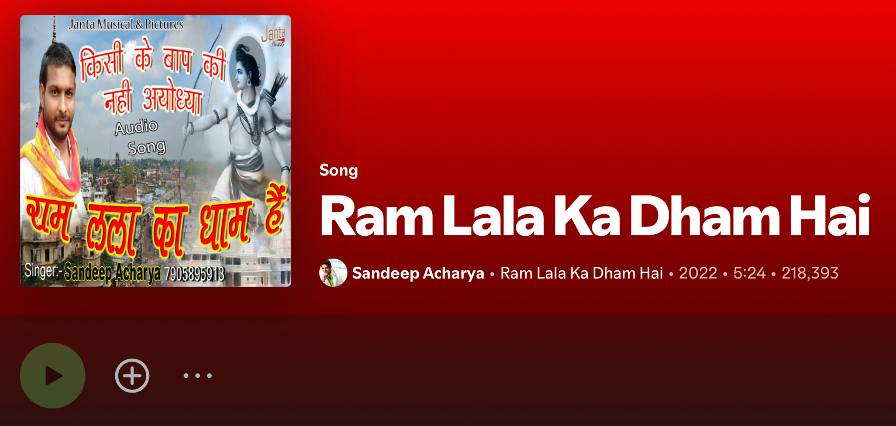
One such song, “Ram Lala Ka Dham Hai”35 (“This is Lord Ram’s Abode”) by singer Sandeep Acharya, threatens a “great war” against anyone who threatens Hindus or the Hindu religion. The song has been streamed on the platform over 218,000 times.
Another song, “Hindu Chalisa”36 by artist Kalki, deploys rock instrumentation to frame the present moment as a time of war for Hindus and calls for enemies to be beheaded:
Original (Hindi)
Adhaarmiyon ka praan lo…
Jahaan na Durga Puja ho,
Vahaan na dharm dooja ho,
Jo bole Shiv se unchaa ho,
Vo sir hee dhad se kaat do.
Translation (English)
Snuff out the lives of non-believers,
Where there is no worship of Durga,
There, no other religion must exist.
Whoever says he is higher than Shiv,
Chop his head off.
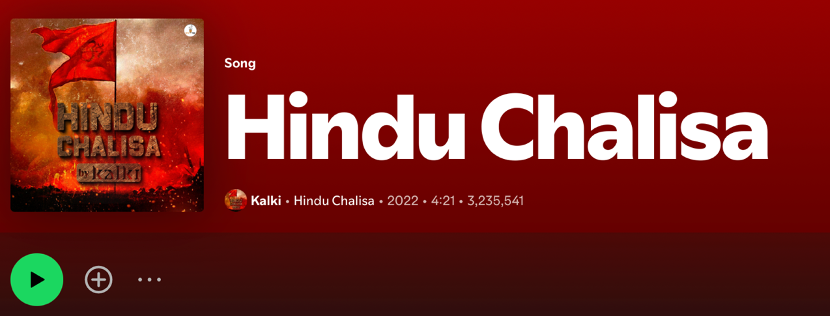
As of March 2026, the song has been streamed on the platform over 3.1 million times.
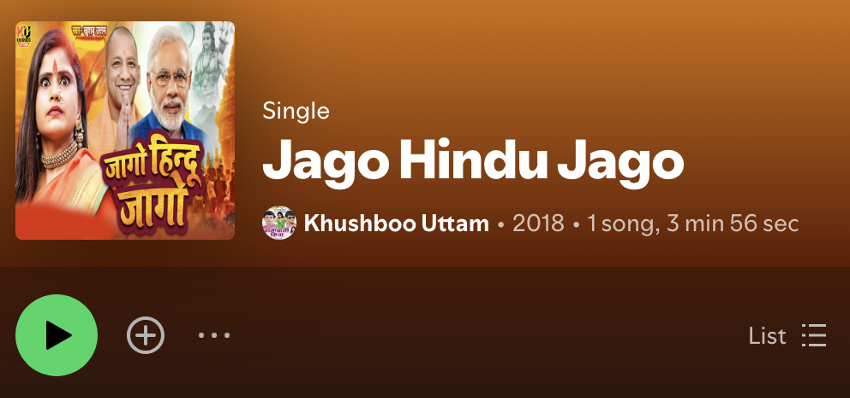
Of the 109 songs, 51 include direct calls to violence against Muslims or content praising and encouraging such violence. One song, “Jago Hindu Jago”37 (“Wake Up, Hindu”) by artist Khushboo Uttam, refers to Muslims as “black snakes” and calls for “traitors” to be shot dead in order to protect Hindus and Hindutva:
Original (Hindi)
Bharat Ma ke Gaddaaron ko Seene Pe Goli Maro,
Hindu Ko Bachlalo, Hindutva Ko Bachalo…
Bharat Mein Baithe Kale Naagon Ko Bahar Nikalo
Translation (English)
The traitors who betray Mother India, Shoot Them In Their Chests,
Save Hindus, Save Hindutva.
The Black Snakes Inside India, Kick Them Out.
A further 44 songs incite hatred against Muslims specifically and encourage listeners to view them as inherently worthy of being hated. One song, “Band Hona Chahiye”38 (Must Be Shut Down) likens Muslims to demons, and asks all madrassas, educational institutes that impart Islamic teachings, to be shut down in the country, and claims that it would reduce hatred in the country. Other songs in this category warn Hindu listeners that Muslims represent an existential threat to their community.
Meta Music Library
India is Instagram’s largest market, with over 413 million users accounting for more than 13% of the platform’s total global user base of over 3 billion.39 Meta’s Community Standards on hate speech seek to protect against “direct attacks” on people on the basis of religion, among other protected characteristics.40 The platform also prohibits dehumanizing speech, harmful stereotypes, serious insults, and content likely to contribute to imminent physical harm.
Meta’s Music Library provides users access to licensed songs for personal, non-commercial use.41 This audio bank allows users to draw music to create Reels and supplement posts and stories. We found that Meta’s Music Library hosts 103 songs that violate these standards. These songs were used to create over 5.9 million Reels by users, each amplified further through shares and algorithmic engagement, meaning the actual reach is significantly greater than the base figure suggests.
One song alone, “Bharat Ka Bacha Bacha Jai Shri Ram Bolega” (“Every Child In India Will Hail Lord Ram”), exists in at least four different versions on Meta and has collectively been used to create over 730,000 Reels. The song calls Hindus lions, threatens to slay the enemies of Hindus, and demands that India be declared a Hindu nation.
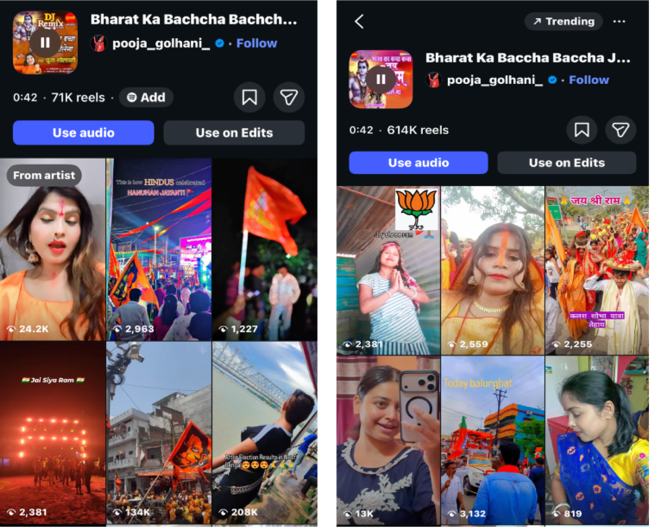
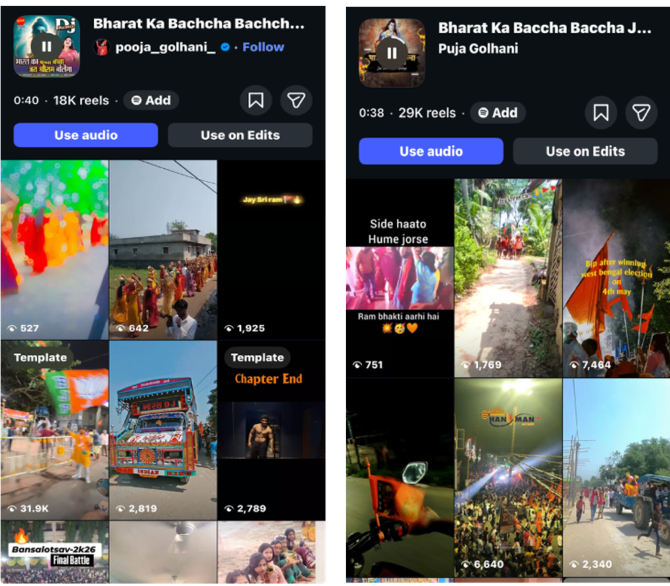
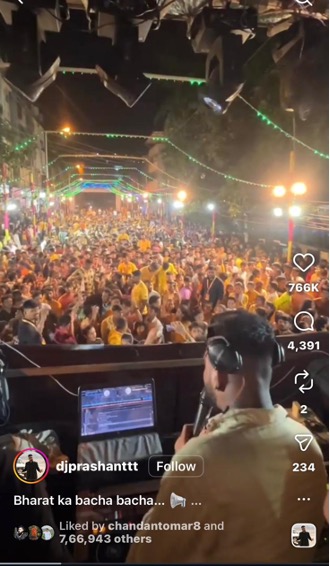
The reach of each individual Reel built around this song dwarfs even the 730,000 creation figure. One Reel42 featuring a DJ performing the song before thousands of revelers at an open-air concert has accumulated over 5.7 million views and 766,000 likes.
Of the 103 songs, 46 actively encourage or incite violence toward Muslims. Together, these were used to create nearly 1.4 million Reels. A further 57 songs contain abusive or dehumanizing language targeting Muslims, stoking hatred against the community. These songs were used to create over 4.5 million Reels.
The presence of Hindutva pop on Meta’s Music Library also deepens an existing nexus between the platform and real-world communal violence. A CSOH report published in 2024, Streaming Violence: How Instagram Fuels Cow Vigilantism in India,43 documented the presence of cow vigilante groups and individuals on the platform, a third of whom had posted videos of vigilantes physically assaulting people transporting cattle, many of them Muslims. The ready availability of hate music celebrating cow vigilantism and the violence used to enforce it actively reinforces this environment.
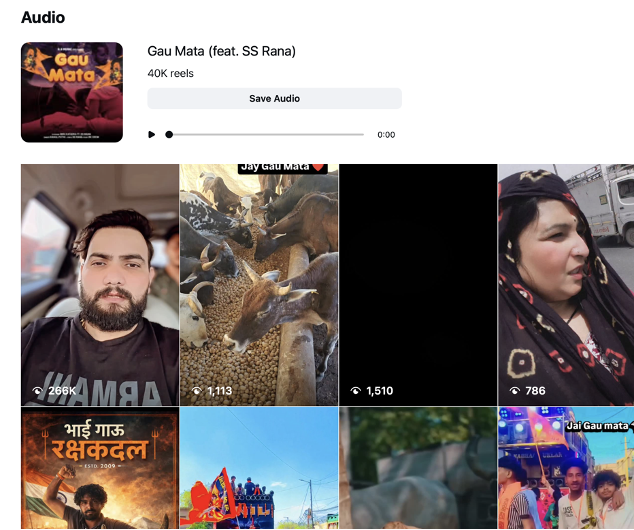
“Gau Mata” (“Mother Cow”) by singers Biru Kataria, Rahul Puthi, and other co-artists is widely used as Reel audio on Instagram by cow vigilantes and their supporters. The song refers to Muslims as “katwe,” an anti-Muslim slur referencing circumcision, and warns that if Hindus take up arms, Muslims will not be left alive and will be “burned alive. The song has been used in over 40,200 Reels, with each Reel multiplying its reach further.
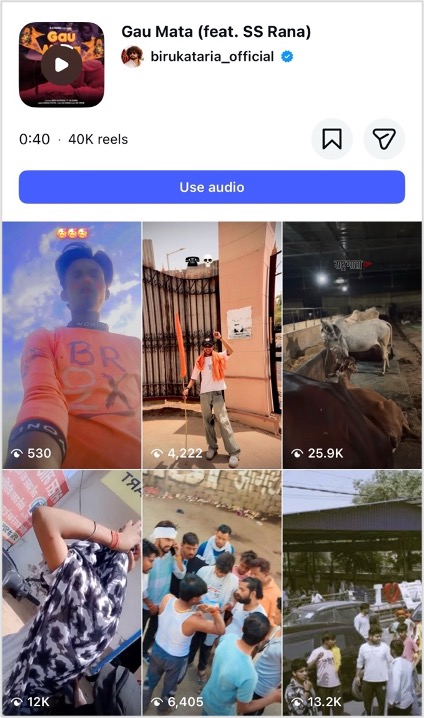
Numerous cow vigilante accounts use the song as audio over videos depicting high-speed vehicle chases of cattle-transporting trucks and assaults on their drivers.
Another example is “Bhagwa Se Dar Lagta Hai Toh Bharat Chod Do” (“Leave India If You Fear Saffron”) by Ved Prakash Shukla, which framas Muslims as enemies of Hindus and demands that these “enemies” leave the country. As of May 2026, over 104,000 Reels have been created using this track on Instagram.
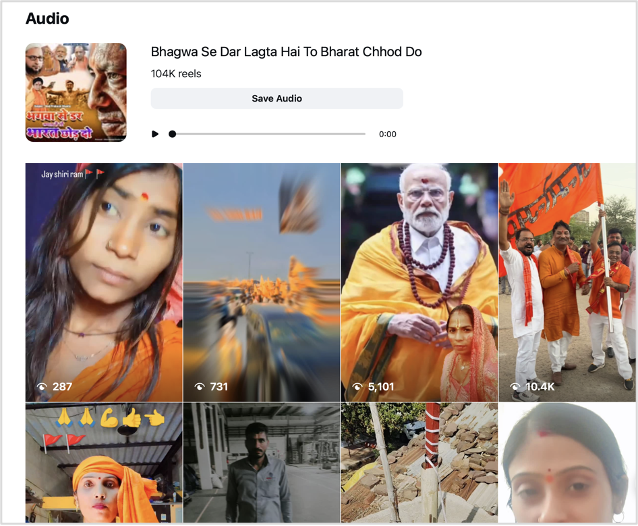
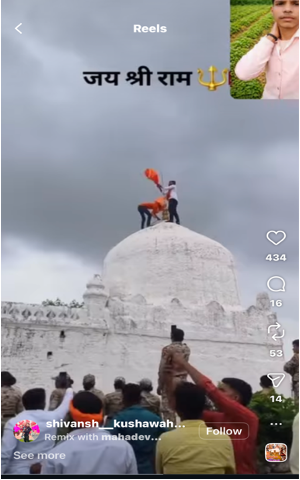
Individual Reels built around the song have achieved enormous reach: one Reel featuring visuals of a Ram Navami procession with saffron flags had over 496,000 views, more than 39,000 likes, and over 6,600 shares. Another Reel with similar visuals had over 480,000 views, more than 44,000 likes, and over 11,000 shares. While no longer appearing in our search results, these two Reels alone reached at least 976,000 additional users in February 2026, illustrating how a single song in Meta’s Music Library can travel far beyond its initial audience through the Reel ecosystem. Additionally, another Reel depicts a group of men climbing atop what seems to be a mosque, and replacing a green flag with a saffron flag (commonly associated with Hindu nationalism), while the song plays in the backdrop. The Reel has over 3,500 views.
Apple Music
Apple Music has over 108 million subscribers worldwide, including 7.5 million subscribers in India, according to some estimates.44Unlike the other three platforms examined in this report, Apple Music does not publish distinct hate speech guidelines or standards, nor does it provide an explicit listing of prohibited content in relation to hate speech.
Instead, the platform requires only that content follow “local regulations and cultural sensitivities” and be legal and “appropriate” for the country in which it is accessed: “You also agree that these materials will not violate any laws, contribute to or encourage infringing or otherwise unlawful conduct, or otherwise be obscene, objectionable, or in poor taste.”45 Apple Music’s Terms of Service for artists also prohibit hate speech in artist content and lyrics without elaborating in detail on what kind of content would constitute such violation.46
In the absence of platform-specific guidelines, and applying Indian laws on hate speech and discrimination as the relevant standard, at least 101 songs on Apple Music violate local laws and meet the hate speech framework used in this report to categorize songs as hate music. Several are explicitly anti-Muslim, inciting hatred and violence against the community.
Apple Music hosts at least nine songs that promote the anti-Muslim conspiracy theory of “love jihad.” Each of them contains the term “love jihad” in its title and alleges that Muslims are conspiring against Hindus and entrapping Hindu women into converting to Islam, while some explicitly incite listeners to carry out violence against Muslims. One song, “Love Jihad”47 by Rapper Sohan, claims that there are more than 300,000 cases of “love jihad”—a figure with no basis in fact, and one that contradicts the Indian government’s own 2020 statement48 that the term has no legal recognition. The song includes Sohan calling upon Hindus to “wave the saffron flag on the chests” (“Sanatan ke veeron, jai shri Ram bolkar chaati pe bhagwa lehrana”) as implicit retribution against Muslims.
The dangers of this conspiracy theory are not hypothetical. The spread of “love jihad” rhetoric has correlated with a documented pattern of violence against Muslims across India, with false accusations serving as a pretext for targeted attacks, lynchings, and mob violence against Muslim men in particular. In August 2025, a mob of Hindu men lynched a 20-year-old Muslim man, Suleiman Pathan, when he was sitting in a cafe with his friend, a Hindu woman, in the town of Jamner in Maharashtra.49 Police investigations concluded that the men believed Pathan’s friendship with the Hindu woman constituted an incident of “love jihad.” Many of the men belong to a Hindu nationalist group, Shiv Pratisthan Hindusthan, whose founder Sambhaji Bhide has encouraged his followers to kill Muslim men who “befriend” Hindu women.50
“Cheer Ke Rakh Denge”51 (“We Will Rip You Apart”) by Kajal Singh threatens to chop Muslims into pieces and distribute the remains to dogs. It refers to Muslims disparagingly as “Maulanas”–twisting an honorific for Islamic religious scholars into a slur–and declares that Hindus will show them no sympathy.
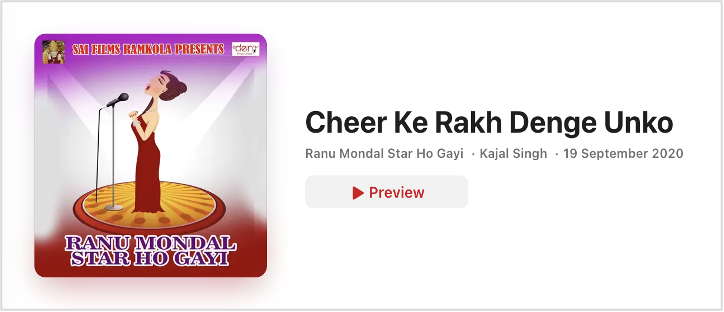
Three other songs, “Tel Laga Lo Dabur Ka Naam Mita Do Babur Ka” (“Apply Dabur’s Oil, Erase Babar’s Name”),52 “Naam Mitado Babar Ka” (“Wipe Babar’s Name Off”),53 and “Babur Ke Pilon Sun Lo Tum” (“Hear This, You Offsprings of Babur”),54 refer to Muslims as the heirs of 16th century Mughal Emperor Babur, and call for their extermination. All remain available on the platform. A song with similar lyrics sparked communal violence in the city of Bahraich in Uttar Pradesh in 2024, killing one person and destroying the homes and shops of many others.55
Apple also fails to scrutinize the album art that accompanies these songs, even when the visuals reinforce and amplify harmful messaging.
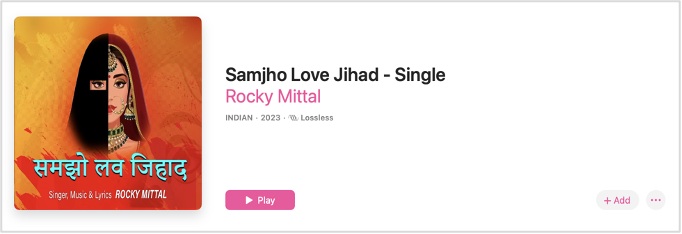
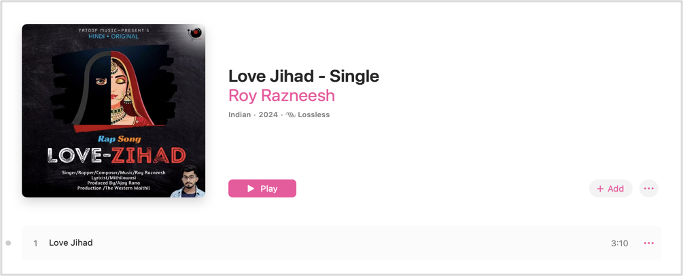
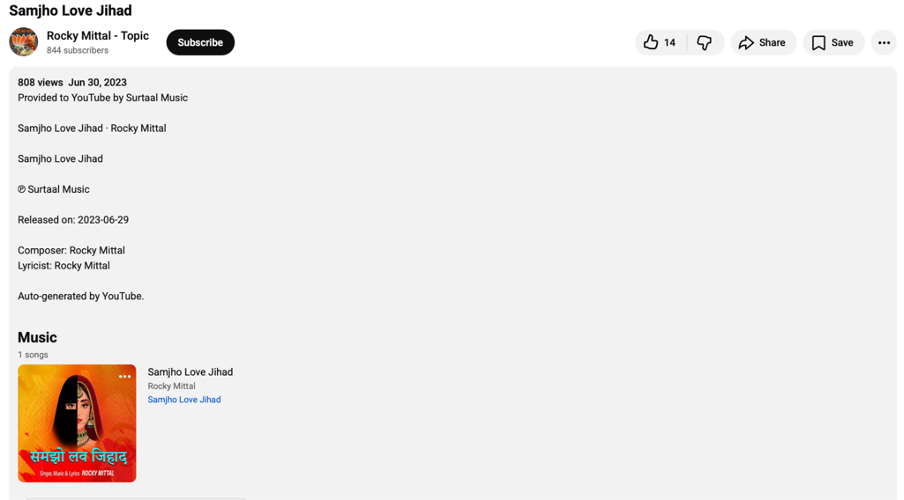
“Samjho Love Jihad”56 (“Understand Love Jihad”) warns Hindu women against Muslim men and carries album art featuring a Hindu woman in a face veil, an image widely associated with Hindu nationalist propaganda. The song portrays interfaith relationships as inherently destructive, attempting to frame Muslim women as oppressed, and presenting such unions as a catastrophe for Hindu women. “Love Jihad”57 by artist Roy Razneesh features similar album art.
Such rhetoric does not operate in isolation. The hijab and face veil is frequently invoked in Hindu right-wing campaigning around inter-faith marriages between Hindu women and Muslim men: a popular campaign slogan is “Durga ban, tu Kali ban, Kabhi na Burqe wali ban” (Be Goddess Durga, or even Goddess Kali, but never become a Burqa wearer), a narrative that portrays a Muslim woman’s face covering as a sign of abuse and persecution.58 In 2022, the BJP-led government in Karnataka banned girls from wearing hijabs and face veils in educational institutions following a sustained campaign by Hindu nationalist groups.59 More recently, the Chief Minister of Bihar, Nitish Kumar, pulled down the face veil of a female doctor in public,60 violating her autonomy through choice of religious clothing. Together, these incidents visually code Muslim identity as a threat to Hindu women and Hindus more generally, invoking an irrational fear that can result in real-world abuse and violence.
Themes of Hindutva Pop
Across all four platforms—YouTube, Spotify, Apple Music, and Meta—content that promotes or incites violence and glorifies hate speech is explicitly prohibited under each platform’s own guidelines. Yet, Hindutva pop songs that meet the threshold for violation remain available and unmoderated across all four platforms. The following section details the dominant themes that recur across the Hindutva pop music catalogue identified in this study.
Threats of Violence
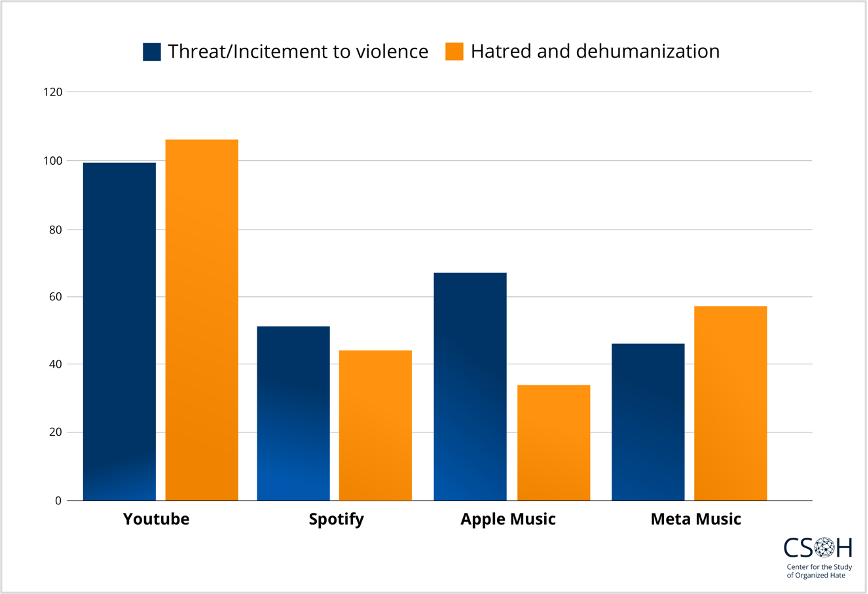
104 of the 210 songs on YouTube contain explicit violent themes targeting India’s religious minorities, particularly Muslims. These songs either glorify or encourage violence against Muslims. On Spotify, 51 of the 109 songs found to violate the platform’s guidelines praise violence against Muslims. On Meta’s Music Library, 46 of the 103 violating songs issue explicit calls for violence against Muslims and were used to create over 1.4 million Reels. On Apple Music, 67 of the total 101 songs contained calls to violence or encouraged violence against minorities, especially Muslims.
FIGURE 2. CATEGORIES OF HARM ACROSS PLATFORMS
Almost all of these songs refer to Muslims either directly by name or through barely-concealed language, such as commonly-used slurs and implicit references.
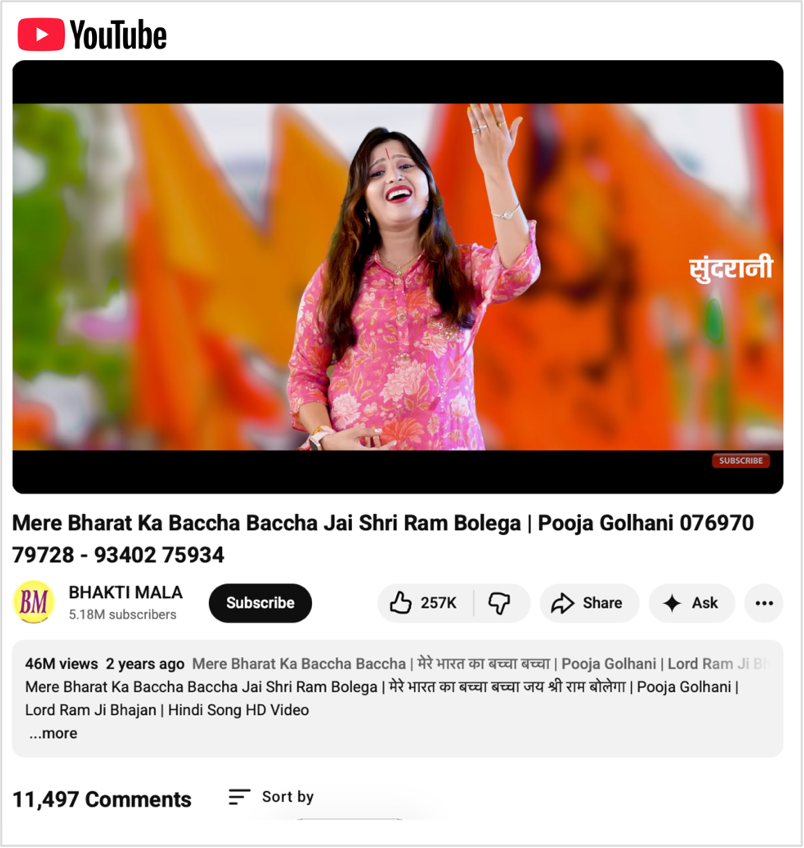
The most-viewed song on YouTube that issues violent threats against Muslims using coded language is “Bharat Ka Bacha Bacha Jai Shri Ram Bolega” (“Every Child In India Will Hail Lord Ram”) by singer Pooja Golhani. The song warns Muslim “enemies” that they will be “slayed” if they obstruct Hindus. Multiple versions of the song exist on YouTube; one of the most popular61 versions has accumulated over 43 million views, 241,000 likes, and over 10,700 comments.
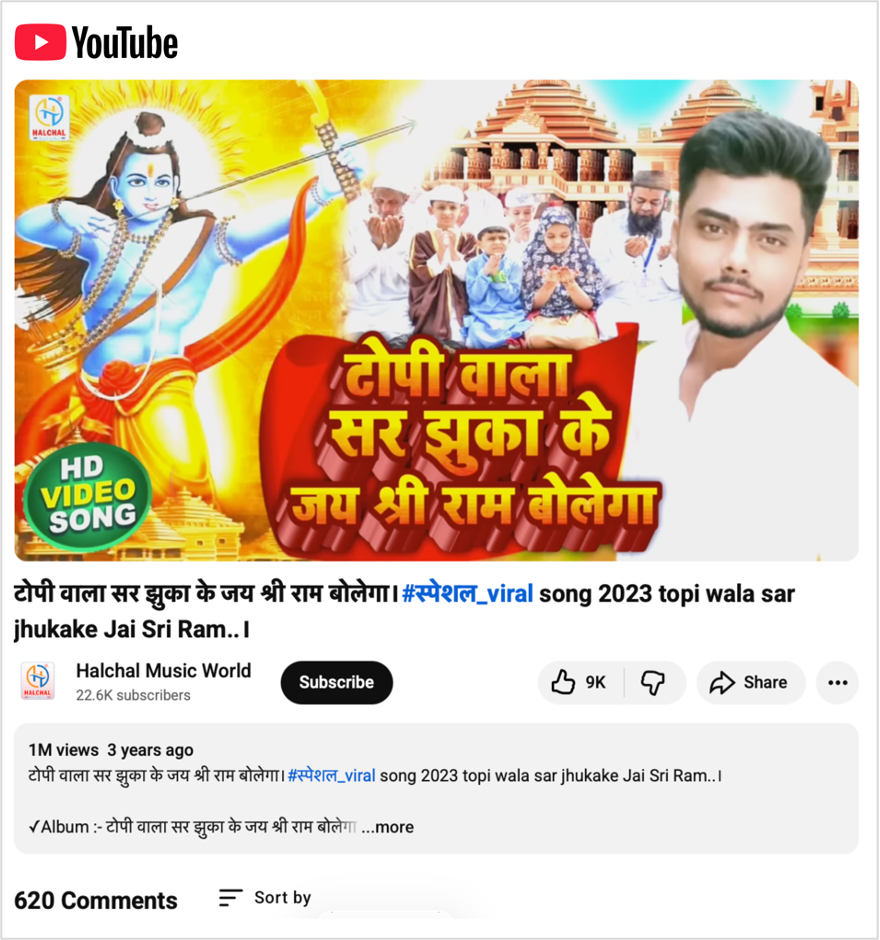
“Topi Wala Sar Jhuka Ke Jai Shri Ram Bolega”62 (“The Skullcap-Donned Man Will Hail Lord Ram”), refers to Muslims with the slur “Topiwala” (used to mock and stereotype Muslim men who wear the traditional skullcap), and warns that they will be forced to accept Hindu supremacy through violence. Sung by Ajit Tandia, the song has over 980,000 views and more than 8,700 likes on YouTube.
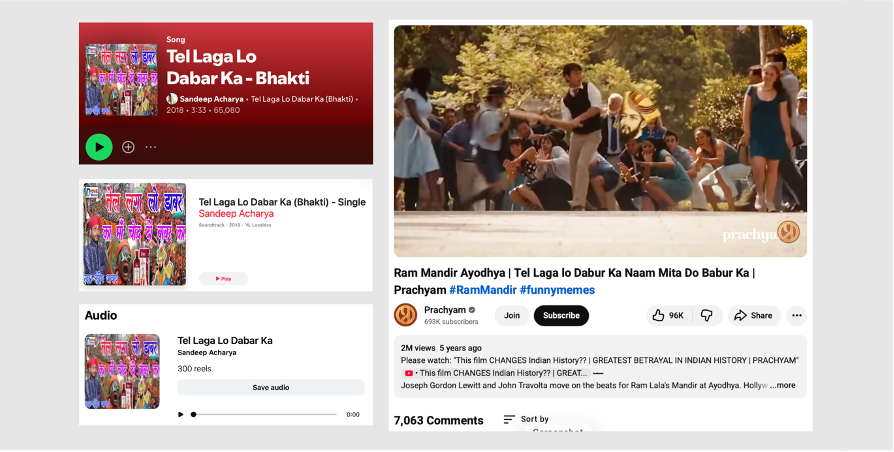
Other songs promote explicit and direct threats of brutality. “Tel Laga Ke Dabur Ka, Naam Mita Do Babur Ka”63 (“Apply Dabur Oil, Wipe Off Babur’s Legacy”) speaks of wiping out all signs of Muslim identity and burning them alive. Interestingly, the YouTube video consists entirely of a compilation of scenes from Hollywood movies, which may serve a dual purpose as clickbait as well as a content moderation evasion tactic. The song is available across all four platforms.
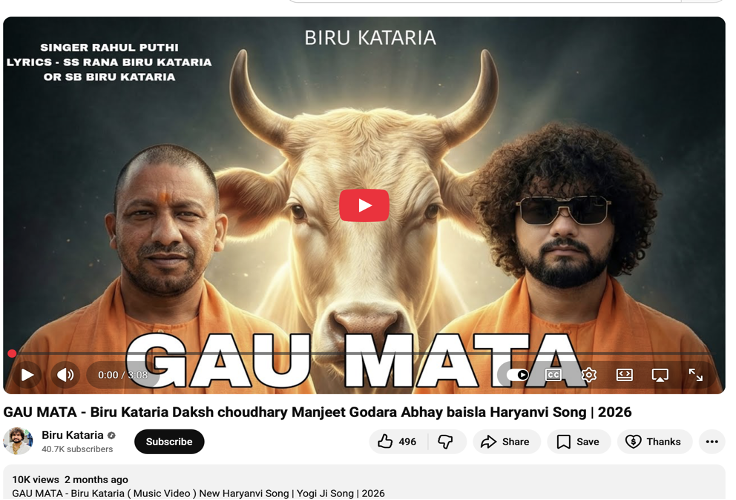
“Gau Mata” (“Mother Cow”) by singer Biru Kataria uses the slur “katwein” (a derogatory reference to circumcision) to refer to Muslims and threatens to “burn alive” and “chop” them if they slaughter cows. The song was available on YouTube until around mid-2025, by which point it had accumulated 142,000 views. By February 2026, it was marked as “not available” on the platform, although it is unclear whether this resulted from platform action or a decision by the channel. Nevertheless, Kataria re-uploaded64 the song in January 2026, and, by March, it had garnered nearly 11,000 views.
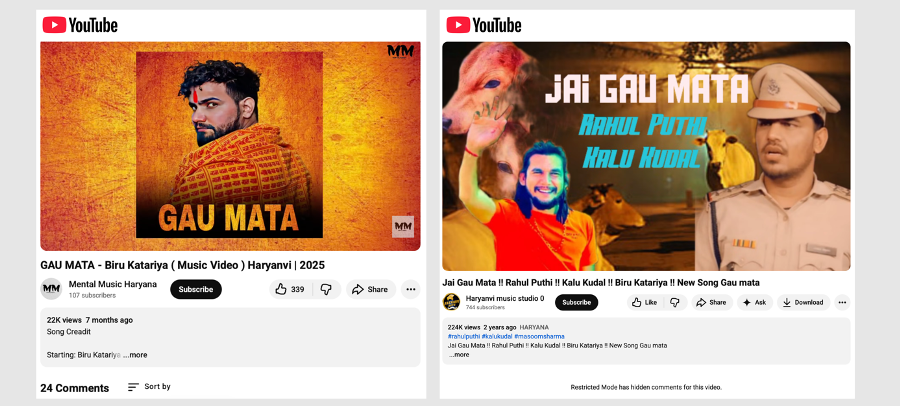
The song has also been uploaded by multiple other channels. For instance, a channel named ‘Haryanvi music studio 0’ uploaded an audio-only version65 of the song in October 2023. By April 2026, the song had over 204,000 views. Another channel, ‘Mental Music Haryana,’ had uploaded the same song in September 2025, and by April 2026, it had garnered66 over 20,000 views.
The song has likewise been used in more than 40,000 Reels on Instagram.
Some songs are extremely violent, with explicit language that unambiguously violates platform guidelines. “Cheer Ke Rakh Denge”67(“We Will Chop You Up”) warns Muslims to “go back to where they came from” or face being “chopped.”
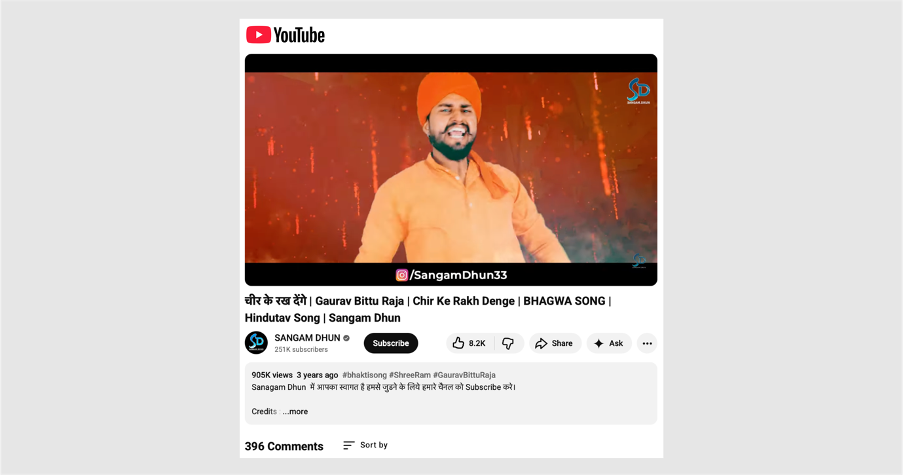
The song has been uploaded by two different YouTube channels and has been viewed a combined total of over 966,000 times, with more than 9,100 likes as of April 2026. “Laaton Ke Bhoot Kabhi Baaton Se Na Mante Hai”68 (“Those Who Need Kicks Won’t Listen To Words”), with over 52,000 views on YouTube, refers to Muslims as “Babur Ke Pillo” (“[Mughal Emperor] Babur’s Pups”), threatening to tear legs from their bodies if they “raise a finger against Hindus.” It further warns that countless Muslims will die when Hindus take up swords.
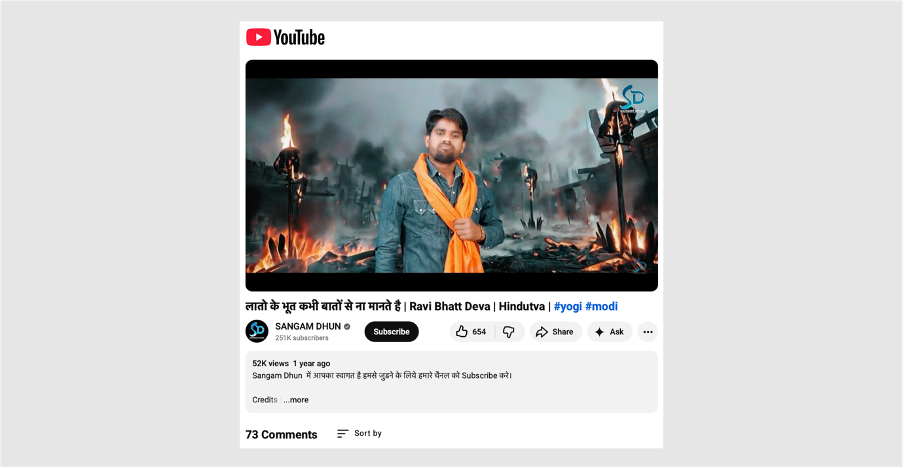
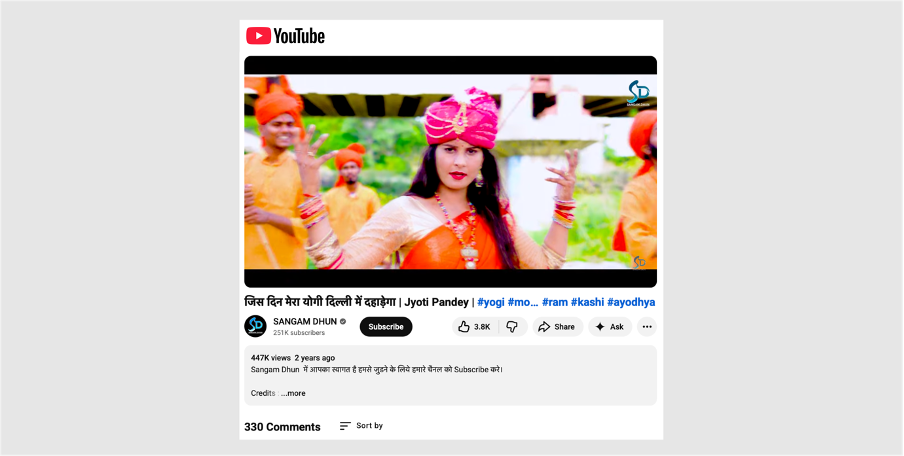
“Jis Din Mere Yogi Delhi Mein Dahadenge”69 (“The Day My Yogi Roars in Delhi”) by Jyoti Pandey envisions a future when Yogi Adityanath, the Hindu nationalist Chief Minister of Uttar Pradesh, becomes the country’s top leader: every Muslim will be killed and saffron Hindutva flags will be planted in every corner of India. The song refers to Muslims as “Afzal-Premi,” a pejorative widely used to brand Muslims as sympathizers of Afzal Guru, who was convicted of involvement in the 2001 Parliament terror attack—and that each of them will be individually targeted. The song has over 438,000 views and more than 3,800 likes on YouTube.
Hindutva pop music frequently invokes historical revisionism to justify present-day violence against Muslims. “Taj Mahal Nahin Tejo Mahalaya”70 (“It’s Not the Taj Mahal, It’s Tejo Mahalaya”) by Sandeep Acharya falsely71 claims that the Taj Mahal was built over a Hindu Shiva temple.
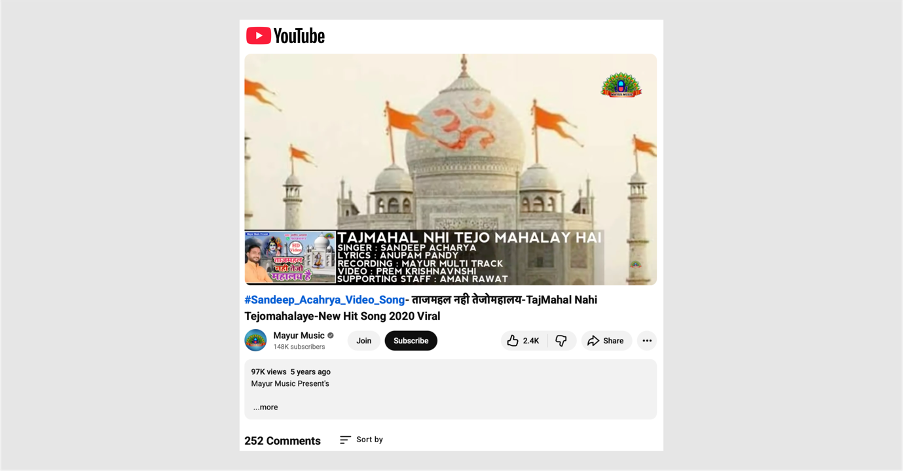
The song portrays Muslims as barbaric destroyers of Hindu temples who built mosques in their place, and asserts that Hindus will re-establish their dominance and “tear apart” any Muslim who stands in the way. It has over 97,000 views and more than 2,400 likes on YouTube.
Further examples of songs issuing such violent threats include “Gaddaro Ko Sabak Sikhana Hai”72 (“We Must Teach Traitors a Lesson”), which characterizes the Mughals as “despicable” destroyers of Hindu temples and declares that Hindus will “wipe out” Muslims in retaliation. The song has 1.6 million views and 17,000 likes on YouTube as of April 2026. “Awadh Dham Mein Math Hai Hamara”73 (“We Have an Abode in Awadh Dham”) similarly warns Muslims who “cast an evil eye” on Hindus of being smashed and killed. On YouTube, it has over 152,000 views and 1,600 likes.
Mobilizing Hindus Towards Violence
A distinct subset of Hindutva pop songs directly addresses Hindus by urging them to prepare for a “religious war” with Muslims. This call to action for Hindus simultaneously functions as a threat to Muslims. In most cases, the singers invoke conspiracy theories targeting Muslims and claims of existential threats facing Hindus to manufacture alarm, shock, and outrage.
Singer Kavi Singh,74 with over 1.15 million YouTube subscribers, has produced two such songs that remain unmoderated across all four platforms, despite violating guidelines. “Ran Bhoomi Taiyyar Karo, Gadaaron Par Vaar Karo” (“Get the Battlefield Ready, Attack the Traitors”) incites a direct violent confrontation between Hindus and Muslims.
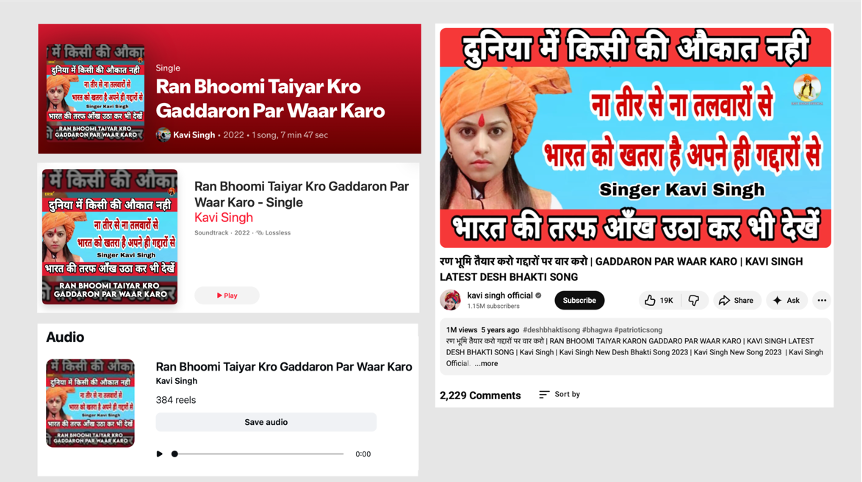
Another of Singh’s songs, “Dhara 30”75 (“Article 30”), calls for amendments to India’s secular constitution that would strip religious minorities of their existing rights, and declares that Hindus will have no choice but to fight if a religious war breaks out.
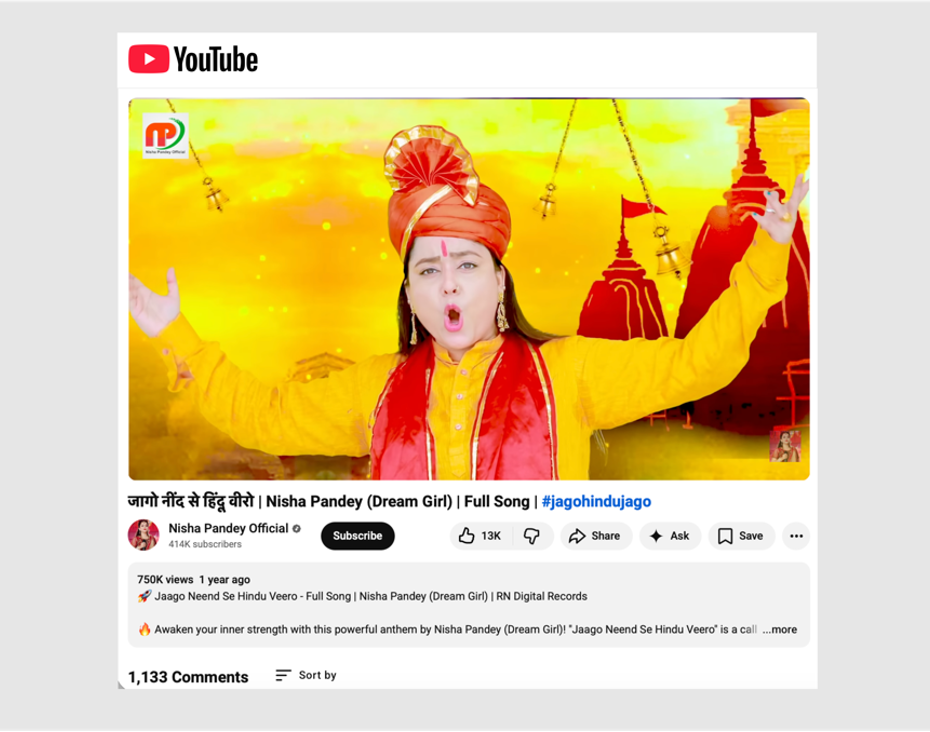
“Jaago Neend Se Hindu Veeron”76 (“Wake Up, Brave Hindus”) by Nisha Pandey frames the Hindu religion as under dire and imminent threat, urgently calling upon Hindus to take action. The song alleges that Muslims and Christians are threatening and forcibly converting Hindus. It has over 747,000 views and more than 13,000 likes on YouTube as of April 2026.
Such rhetoric reflects an uptick in anti-Christian hate speech and violence across India by Hindu nationalist organizations.77 India Hate Lab (IHL) data show that hate speech events targeting Christians rose from 115 in 2024 to 162 in 2025 – an increase of 41 percent.78 Although Christians only account for just 2.3 percent of the population, Hindu nationalist groups have stoked suspicion and anger against the community through unproven conspiracy theories. In December 2025, there were attacks on Christmas celebrations across seven Indian states, with mobs vandalizing and disrupting celebrations.79
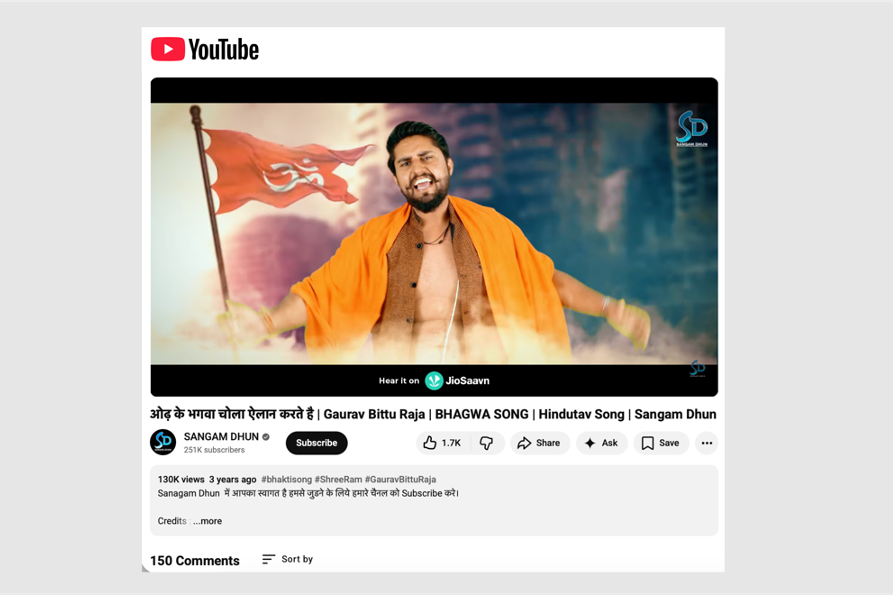
Muslims, however, remain primary targets. Another song, “Oadh Ke Bhagwa Chola Ailan Karte Hai”80 (“Clad in Saffron, I Declare”), refers to Muslims with the “Kafir” slur and declares that the tides have turned: “Hindus will answer every brick with a stone and avenge every insult they have ever faced.” The word kafir originates in Islamic contexts and historically refers to a non-believer, but in some contexts in India it is appropriated and used by Hindu nationalist actors as a derogatory label targeting Muslims.
On YouTube, the song has over 127,000 views and 1,700 likes.
“Yachna Nahi Ab Rann Hoga”81 (“No Appeal, Now There Will Be War”) by Sandeep Acharya declares that every Hindu will pledge to crush their enemies to dust when the time comes. The song has over 107,000 views and more than 1,400 likes on YouTube.
Prem Krishnvanshi’s song “Krishna Lalla Hum Aayenge, Mandir Wahin Banayenge”82 (“Little Krishna, We Are Coming to Build the Temple There”) urges Hindus to take to the streets to teach a firm lesson to Muslims who hate Hindus, since Hindus “can’t take it anymore.” The song has over 55,000 views and more than 1,600 likes on YouTube.
Threats to Demolish Places of Worship
A substantial number of Hindutva pop songs threaten to demolish mosques and other Muslim religious sites, or construct Hindu temples at sites where mosques currently stand as part of a broader Hindu nationalist mobilization campaign. Many songs frame these acts as historical retribution, urging Hindus to avenge the alleged destruction of Hindu temples by Muslim rulers in the past.
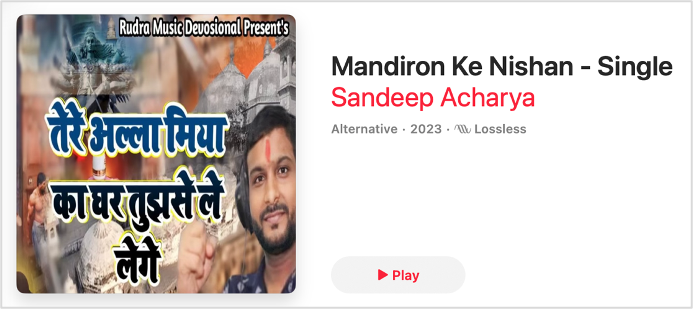
“Mandiron ke Nishan”83 (“Signs of Temples”) by Sandeep Acharya declares that Hindus will snatch “your Allah Miyan’s homes” (reference to mosques) in retaliation for the historical damage Muslims allegedly inflicted on Hindu temples. By mid-2025, the song had accumulated more than 7,000 views on YouTube. In February 2026, however, the video was unavailable, likely due to YouTube terminating the host account. The song nonetheless remains available on Apple Music.84
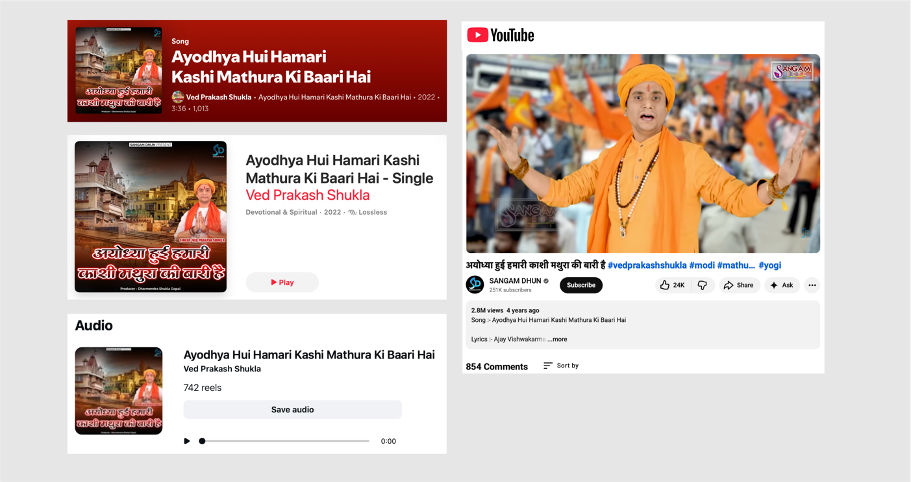
Several songs reference the ongoing Hindu nationalist campaign to construct temples at the sites of existing mosques in the cities of Mathura and Varanasi in Uttar Pradesh. “Ayodhya Hui Hamari, Kashi Mathura Ki Baari Hai”85 (“Ayodhya Is Ours, Kashi and Mathura Are Next”) calls upon Hindus to “reclaim” the lands of Mathura and Varanasi from Muslims and to build temples, declaring that such a move will demonstrate, as the song lyrics relay, “who the boss really is.” The song is readily available across all four platforms; on YouTube alone it has more than 2.8 million views and over 24,000 likes.
“Jahaan Jahaan Baitha Hai Khuda”86 (“In Every Place Your God Exists”) encourages Hindus to dig up every mosque in the country because Muslims have sparked a “war” against Hindus. The song’s title references the Gyanvapi mosque dispute in Varanasi, where Hindu nationalist groups have claimed87 that the 350-year-old mosque stands on land that once formed part of an adjoining Hindu temple. The song alleges that Muslims deliberately demolished temples to erect mosques in their place, and calls for violence to avenge every historical “wound” that Hindus have suffered at Muslim hands. As of April 2026, it has over 19,000 views on YouTube.
Hindu nationalist groups in Maharashtra have similarly been mobilizing support for a campaign to replace the Haji Malang Dargah—a Sufi shrine on the outskirts of Mumbai with a long history of syncretic worship shared between Hindus and Muslims—with a Hindu temple.88Three separate songs by varying artists call for the “liberation” of the shrine’s land and for a Hindu temple to be built in its place.
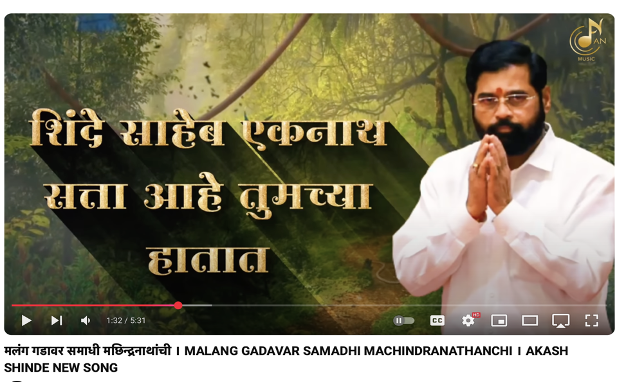
Together, these three songs have accumulated over 1 million views and more than 9,300 likes on YouTube as of May 2026. The visuals featured in these videos show images89 of local politicians who have publicly backed the demand, including Maharashtra Deputy Chief Minister Eknath Shinde.
Inciting Hatred
Three of the four platforms examined in this report have published guidelines that prohibit content promoting hatred against groups on the basis of religion. Apple Music, while lacking equivalent specific provisions, requires that content on its platform follow “local regulations and cultural sensitivities” and be legal and “appropriate” for the country in which it is accessed. Since Indian law prohibits “promoting enmity”90 between religious groups and acts that deliberately “outrage religious feelings,”91 Apple Music should not, by its own standards, host such content. Yet all four platforms host songs that actively stoke hatred against India’s religious minorities.
On YouTube, 106 songs fall within this classification, collectively garnering over 76 million views. Spotify hosts 44 songs that incite hatred and regard Muslims as worthy of being hated. On Apple Music, 34 songs use slurs or harmful stereotypes, promote or glorify hate speech, or dehumanize protected groups, including Muslims. On Meta, 57 songs glorify hate speech against Muslims and employ slurs or coded language to target the community, without issuing explicit calls for violence.
These songs create and sustain hatred against religious minorities in India through overlapping narratives: propagating conspiracy theories that allege Muslims are engaged in “love jihad” against Hindu women; claiming that Muslims are plotting to attack Hindus; insisting that Muslims historically destroyed and looted Hindu temples; and asserting that Muslims are conducting a covert war against the Hindu community.
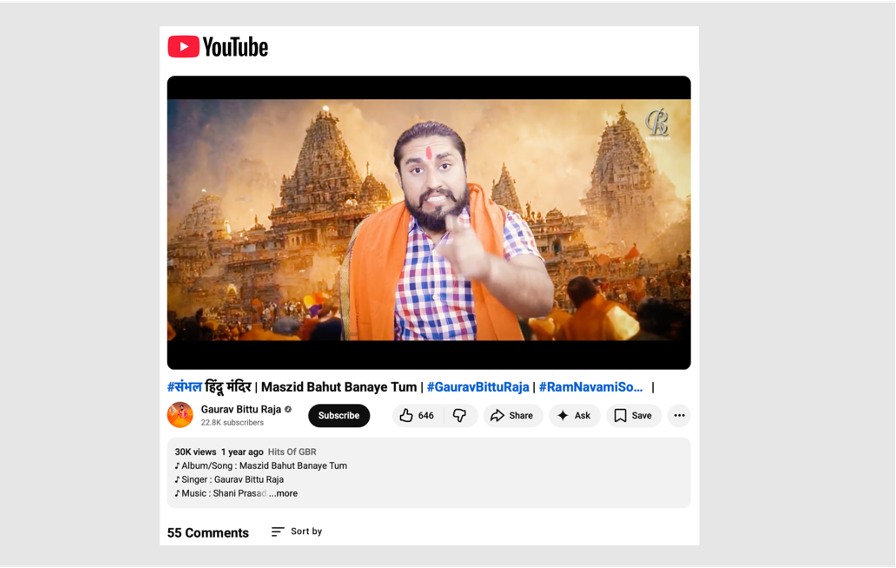
“Tod Tod Kar Mandir Saare Masjid Bahut Banaye Tum”92 (“You Broke Our Temples to Build Your Mosques”) by Gaurav Bittu Raja has over 29,000 views on YouTube, and is also available on Spotify. The song accuses Muslims of deliberately targeting Hindu temples to erect mosques in their place, of conspiring to “finish off” the Hindu religion, and of beheading Hindu men. The lyrics seek to cultivate feelings of anger, fear, and hatred directed primarily at Indian Muslims, but also toward Christians and communities in neighboring Muslim-majority countries such as Bangladesh and Pakistan.
Similarly, “Asteen Ke Saanp”93 (“Snakes in the Sleeve”) likens Muslims to snakes and backstabbers, while promoting the conspiracy theory that Muslims are having more children than Hindus and therefore represent a demographic threat to the Hindu majority.
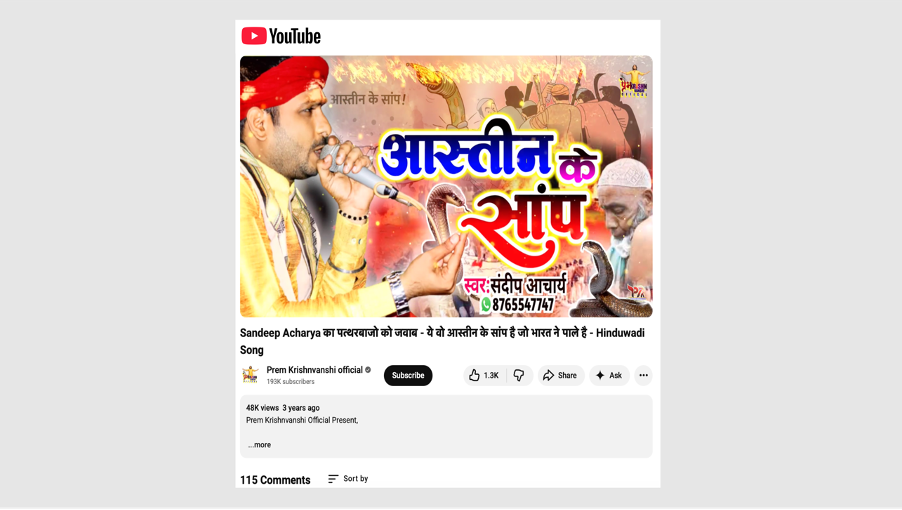
Such population replacement conspiracy theories have long served as a mobilizing narrative among Hindu nationalist groups. On YouTube, the song has over 48,000 views and more than 1,300 likes. Its album art reinforces the song’s dehumanizing rhetoric, depicting a Muslim man wearing a skullcap alongside images of snakes.
Targeting “Anti-Nationals”
Many Hindutva pop songs deploy terms such as “traitors,” “terrorists,” and “enemies” as synonyms for Muslims, portraying the community as actively working against India’s national interests. This narrative is often reinforced by linking Indian Muslims to Pakistan and Bangladesh, the country’s neighboring Muslim-majority nations. In the case of Pakistan, Hindu nationalist rhetoric frequently frames Indian Muslims as more loyal to Pakistan than to India, often accompanied by threats to “send” them there. More recently, political instability in Bangladesh and attacks on Bangladeshi Hindus have been weaponized by Hindu nationalist groups to further target Muslims in India. In December 2025, a 20-year-old Bengali-speaking Muslim man was branded a Bangladeshi and lynched by a mob in the eastern state of Odisha.94 In January 2026, another Muslim Bengali-speaking man, aged 32, was lynched by Hindutva men in Andhra Pradesh on the suspicion of being a Bangladeshi.95
In this context, eight songs on YouTube directly incite hatred or issue threats of violence. While the number of songs may appear modest, their collective reach underscores their popularity, with over 22 million overall views and more than 116,000 likes across different YouTube channels. Spotify features four of these songs, Apple Music hosts two, and Meta’s Music Library includes four, which have been used in at least 1,943 Reels.
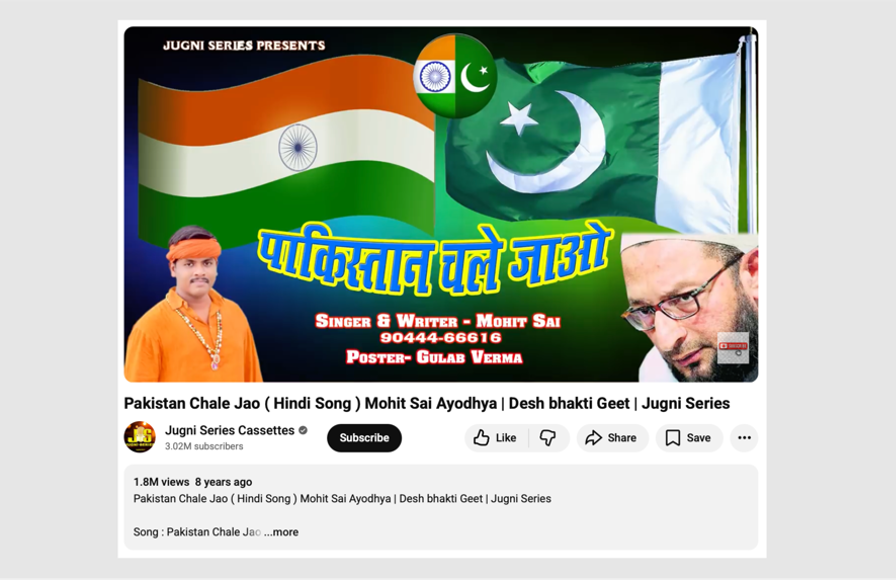
Many of these songs call for Pakistan to be “obliterated” and allege that Indian Muslims are effectively agents of Pakistan operating within the country. One of the most widely viewed, “Pakistan Chale Jao”96 (“Go to Pakistan”), brands Indian Muslims as traitors and demands that they be sent to Pakistan. The song calls upon Hindus to crush such traitors “like worms.” On YouTube, it has accumulated over 1.8 million views.
Several songs beyond the eight mentioned also refer to Rohingya Muslims and Bangladeshi migrants in abusive terms, reinforcing the framing of Muslims—even those who are dispossessed and marginalized—as fundamentally hostile to Hindus and to India. “Yogi Denge Azaadi”97 (“Yogi Will Free Us”) declares that Uttar Pradesh Chief Minister Yogi Adityanath will “exterminate criminals, traitors, and those who criticize the country.”
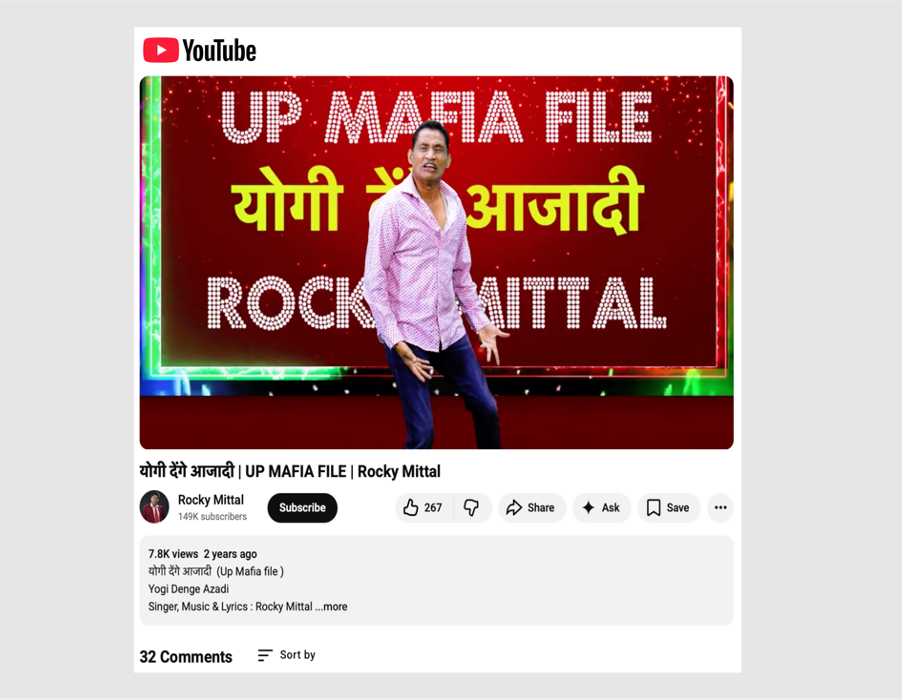
The song portrays Muslims through coded language, calling them “stone-pelters” and warning that they will no longer be able to carry out “love jihad.” It further asserts that Yogi will “free” India of Rohingya Muslims and Bangladeshi immigrants. As of March 2026, the song has over 7,400 views on YouTube, and is also available on Spotify, Apple Music, and Meta’s Music Library.
Weaponization of Violent Incidents
On April 22, 2025, a terrorist attack in Pahalgam, Jammu and Kashmir, killed 26 civilians.98 Survivors reported that the gunmen targeted Hindu men after ascertaining their religious identity.99 The Indian government described the attack as a “clear attempt to incite communal violence” in a press briefing.100 Hindu nationalists closely aligned with the ruling party weaponized the incident to stoke anger and hatred against Indian Muslims, equating all Muslims with the perpetrators and framing the attack as part of a broader Islamic conspiracy targeting Hindus.
Within hours of the attack, Hindutva pop artists began releasing songs targeting Indian Muslims. Five of these songs, marked by anti-Muslim bigotry and incitement to violence, collectively garnered over 1.1 million views on YouTube as of May 2026. Four of the five also accumulated more than 16,000 likes, while the fifth has had its like count disabled.
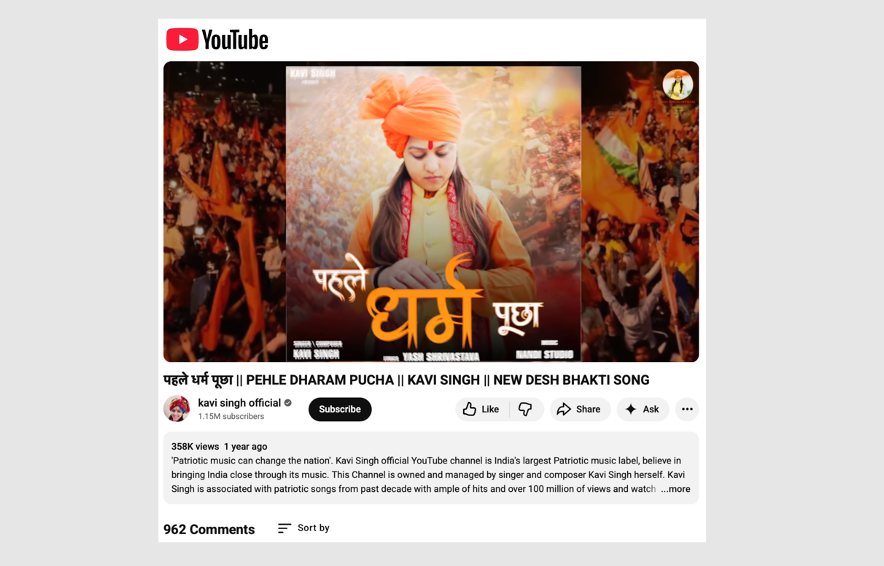
“Pehle Dharm Pucha”101 (“They First Asked Our Religion”) by Kavi Singh castigates Hindus for attempting to remain secular, claims that all Muslims conspire against Hindus, and mocks Hindus for their “inaction.” Released on April 23—just one day after the attack—the song has since garnered over 355,000 views on YouTube. Its lyrics leave little ambiguity about their intent:
Original (Hindi)
Hum Ne Badi Yeh Galti Kar Di, Tumko Yahaan Panah Dekar,
Desh Bana Tha Alag Tumhara, Kyun Gaye Nahi Parivaar Lekar.
Translation (English)
We made a mistake letting you stay on,
You got your own country, why didn’t you leave then?
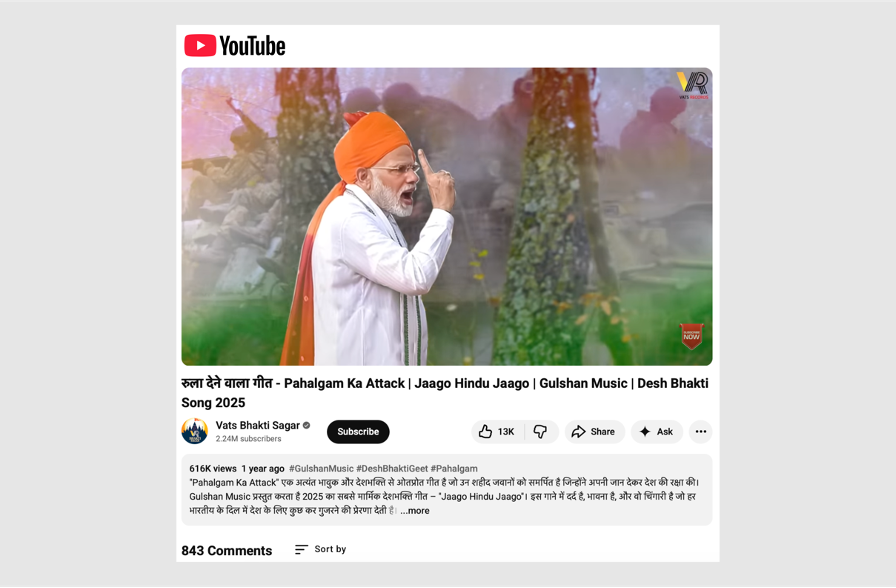
“Jaago Hindu Jaago”102 (“Wake Up, Hindus, Wake Up”) by Gulshan Music similarly appeals to Hindus to “wake up” to the Muslim “traitors inside the country.” It insists that being Hindu has “become a crime” in India and declares that it is “our turn now” to avenge the Pahalgam killings. Released two days after the attack, the song has over 613,000 views and more than 13,000 likes on YouTube as of April 2026. Both songs are also available on Spotify and Apple Music.
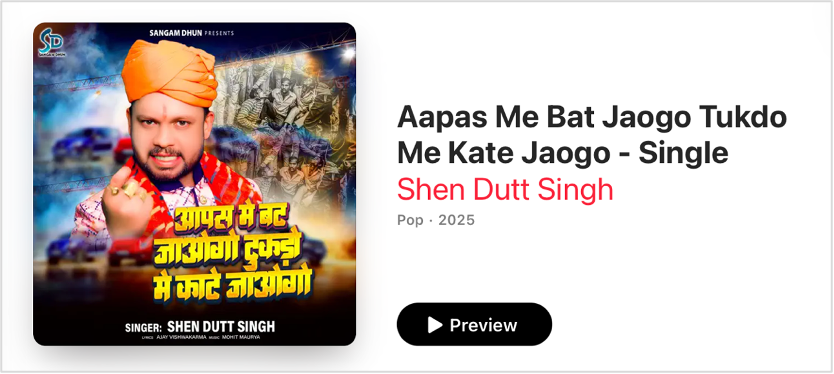
Another song available on both platforms, “Aapas Mein But Jaaoge Tukdo Mein Kat Jaaoge” 103(“If You Bicker Within, You Will Be Shred to Pieces”) by Shen Dutt Singh, invokes the Islamophobic conspiracy theory of “Ghazwa-e-Hind”: a claim that Muslims are engaged in a coordinated plot to transform India into an Islamic nation. The song refers to Muslims as “enemies” who have infiltrated India and are readily waiting to execute this conspiracy, warning Hindus that they will be slaughtered if they fail to unite.
“Hindu Ko Bachalo, Hindutva Ko Bachalo”104 (“Save Hindus, Save Hindutva”) by Lavkush Singh makes similar assertions, insisting that “traitors” living inside India pose a mortal threat to Hindus, who will be killed if they do not unite in response.
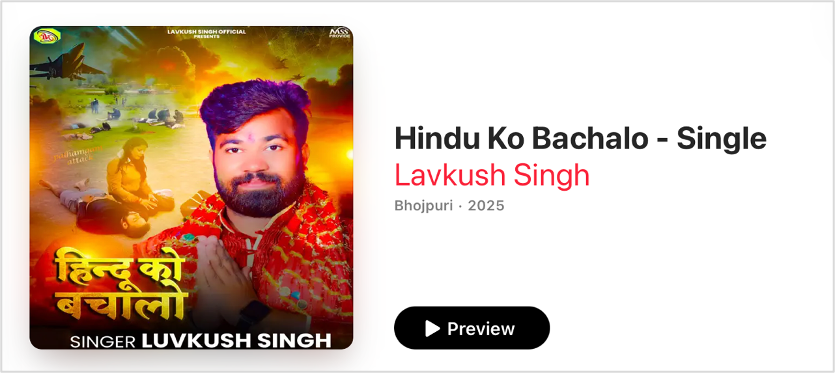
These songs coincided with and likely contributed to an environment normalizing anti-Muslim bigotry and violence at a time when the country was collectively grieving the terrorist attack, and correlated with a sharp spike in anti-Muslim hate speech and incidents of violence. Monitoring by India Hate Lab documented 64 anti-Muslim hate rallies within the ten days immediately following the Pahalgam attack, rising to a total of 113 hate crimes and hate speech incidents within three weeks105.
For instance, on Instagram, “Ab Maha Yudh Ho Jaane Do”106 (“Let the Great War Begin Now”) by Ritesh Pandey generated over 130,000 Reels, as of May 2026. The song, which asks for the terror attack to be avenged, insists that Hindus will “kill after declaring our religion”, without making any direct reference to Muslims.
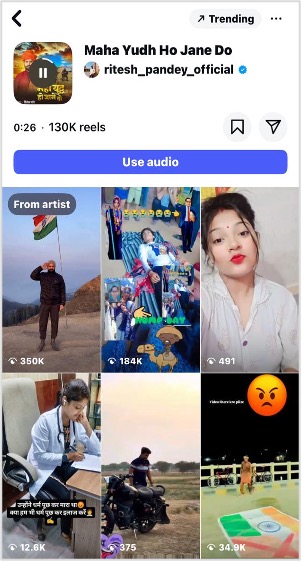
The content of these Reels illustrates the sophisticated ways in which Hindutva pop is deployed to evade content moderation while maximizing its hateful impact. One Reel features a woman in a doctor’s white lab coat with the text: “They killed on the basis of religion. Should we also cure patients on the basis of their religion?”
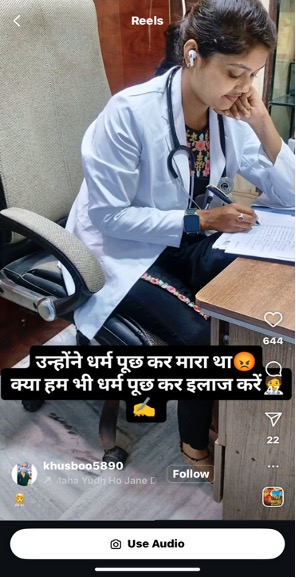
overlayed onto a video of a female medical professional
Similarly, Kavi Singh’s “Pehle Dharm Pucha”107 (“They First Asked Our Religion”), which frames Muslim presence in post-partition India as a historical mistake, was used in at least 117 Reels within days of its release. These Reels multiplied the song’s reach, with one accumulating more than 24,000 views, another over 21,000 views, and others collectively extending the song’s reach well beyond its original YouTube audience.
Profiling Hate Artists and Channels
This section profiles the most prolific artists and channels responsible for the creation and dissemination of Hindutva pop hate music in India. As the analysis below demonstrates, a small group of singers and creators accounts for a disproportionately large share of hateful content.
Youtube Channels
The 210 songs documented on YouTube constitute 98 artists and uploads across 100 different channels, which have a combined subscriber base of over 76.4 million. These songs have been collectively viewed 198 million times and garnered 3.1 million likes. This concentration of reach across a relatively small number of channels and artists illustrates that Hindutva pop music on YouTube is driven by a distinct and identifiable ecosystem of actors.
Significantly, YouTube has amplified some of this content through its auto-generation feature. For hateful and violent songs that had no accompanying video (such as still images or album art), YouTube has ‘auto-generated’ videos on its platform, i.e., it uses the album art of the song to create a video for it. This ensured that these songs reached viewers regardless of whether the uploader had produced any visual content. Such videos note in their description: “Auto-generated by YouTube.” By YouTube’s own admission, it does so to ensure that there is a “YouTube version of every track of every album.”108 “Currently, official music videos are available for recordings only when a label or artist invests (non-trivial) time and resources into producing one. Art Tracks automate the creation of versions for recordings even if they don’t have a produced music video,” YouTube’s Help Center has announced in a post.109
For instance, a song “Samjho Love Jihad”110 (“Understand what Love Jihad is”) by singer Rocky Mittal, reiterates the unproven conspiracy theory around “love jihad” and insists that the lives of Hindu girls were being “destroyed” by such Muslim men. The song’s words are reiterated by this visual (below), of a Hindu woman who is, ostensibly, entering into an interfaith relationship, represented by the face veil. This visual has been generated by YouTube by using the album art of the song. This is the only version of the song that exists on the platform; if not for this auto-generated video, this song would not have existed on YouTube.

We identified at least 13 songs that would have had no presence on YouTube were it not for this auto-generation feature, accumulating over 3.2 million collective views and 60,300 likes. Their lyrics contain explicit threats against Muslims, including calls to shoot them dead, demands that they be expelled from India, and assertions that India belongs exclusively to Hindus. These songs violate YouTube’s own hate speech policy, and yet the platform actively generates and hosts video content for them, amplifying their reach to millions of users.
Three YouTube channels (mentioned below) alone account for hosting 78 of the 210 songs identified (approximately 40% of the total). These channels feature some of the most incendiary Hindutva pop content, but continue to operate on YouTube as verified channels despite clearly violating YouTube’s own content policies.
TABLE 1. TOP 5 YOUTUBE CHANNELS HOSTING HATE MUSIC
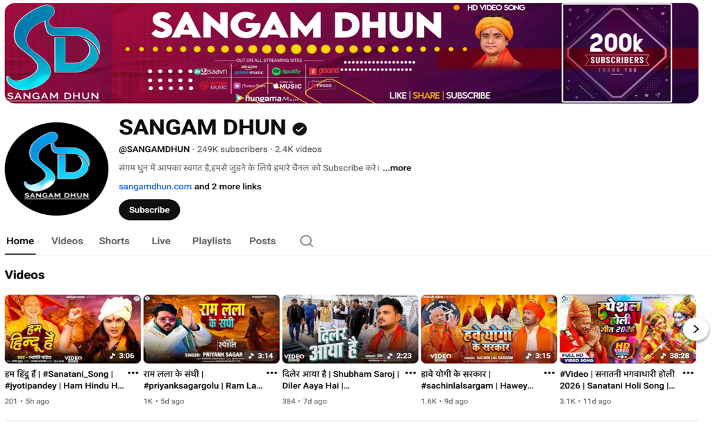
Sangam Dhun
46 of the 210 songs on YouTube originate from a single channel: Sangam Dhun.111 These songs have accumulated over 15.7 million views and more than 237,000 likes. Established in March 2020, Sangam Dhun is a verified channel with over 251,000 subscribers.
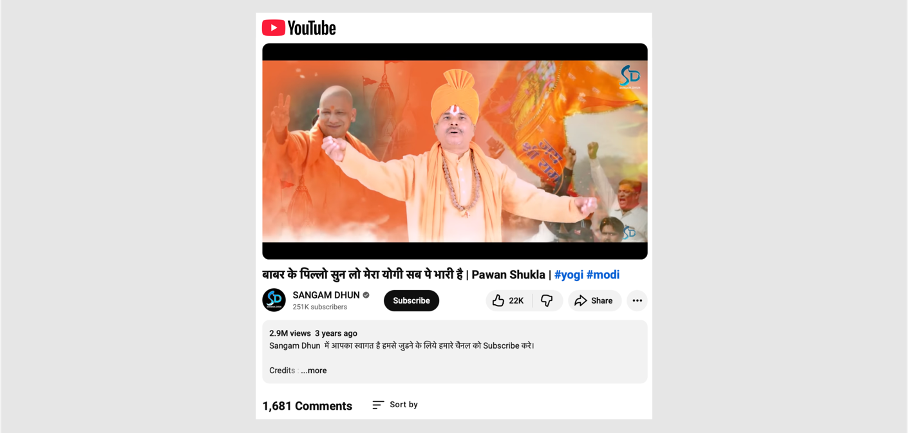
Of the 46 songs, 29 deliver explicit calls for violence, either by threatening or actively encouraging violence against Muslims. They have garnered over 4.7 million views and 89,000 likes. “Babur Ke Pillo Sun Lo Tum”112 (“Pay Heed, Babur’s Pups”) features a man brandishing a sword and warns that those who harmed Hindus in the past will not be spared, referring to Muslims as “Aurangzeb Ka Pilla” (“[Mughal Emperor] Aurangzeb’s Pups”) and insisting they will be forced to chant Lord Ram’s name. As of May 2026, the song has over 2.9 million views and 22,000 likes.
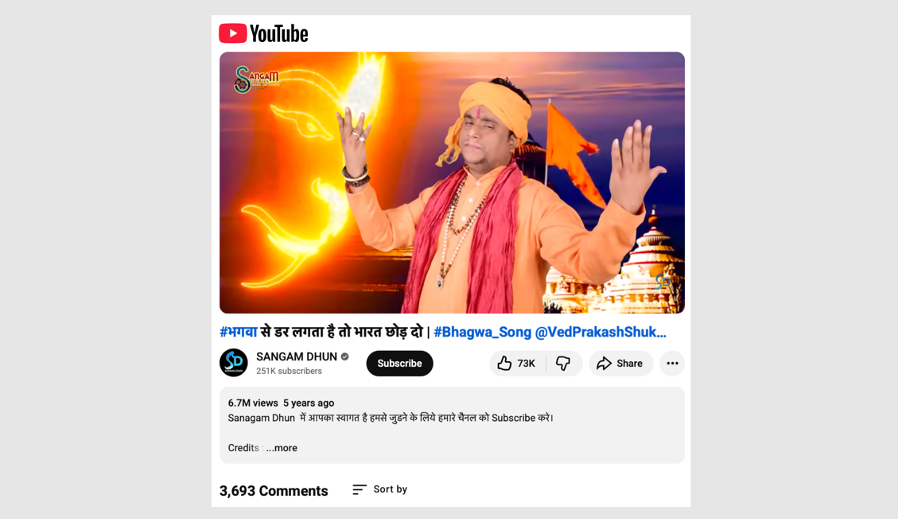
Seventeen songs promote hatred against Muslims. Together, these songs have garnered over 16.8 million views and 176,000 likes as of May 2026.
The most viewed song on the channel is “Bhagwa Se Dar Lagta Hai Toh Bharat Chod Do”113 (“If You Fear the Saffron, Leave India”). Each time the singer, Ved Prakash Shukla, delivers the title line, the song’s visuals feature images of Muslims and Muslim politicians. It frames Muslims as enemies and demands that they change their ways or leave the country. The song has over 6.7 million views and 73,000 likes as of May 2026.
Sangam Dhun’s catalogue spans the full spectrum of Hindutva pop hate: from songs delivering explicit threats of brutal violence against Muslims, to demands that Muslims leave India if they cannot accept Hindu supremacy, to songs deploying terms such as “traitors” and “jihadis” as slurs, and content exhorting Hindus to excavate temples beneath existing mosques. The 46 songs on this channel were created by ten different artists who appear regularly on the channel as well as maintaining their own individual presence on YouTube. One artist, Gaurav Bittu Raja, who has contributed to 9 of the 46 songs, runs his own YouTube channel114 with over 22,500 subscribers.
Mayur Music
YouTube channel Mayur Music115 has over 149,000 subscribers with a page banner advertising the Silver Creator Award,116 an award received from YouTube given in recognition of surpassing 100,000 subscribers. This is despite the channel hosting content that incites violence. For instance, a song with over 546,000 views released in advance of a state election, “Ram Lalla Ko Chodke Allah Allah Gaoge”117 (“Will You Chant Allah’s Name Instead of Ram?”), uses abusive language toward Muslims and mocks Islamic rituals and practices.
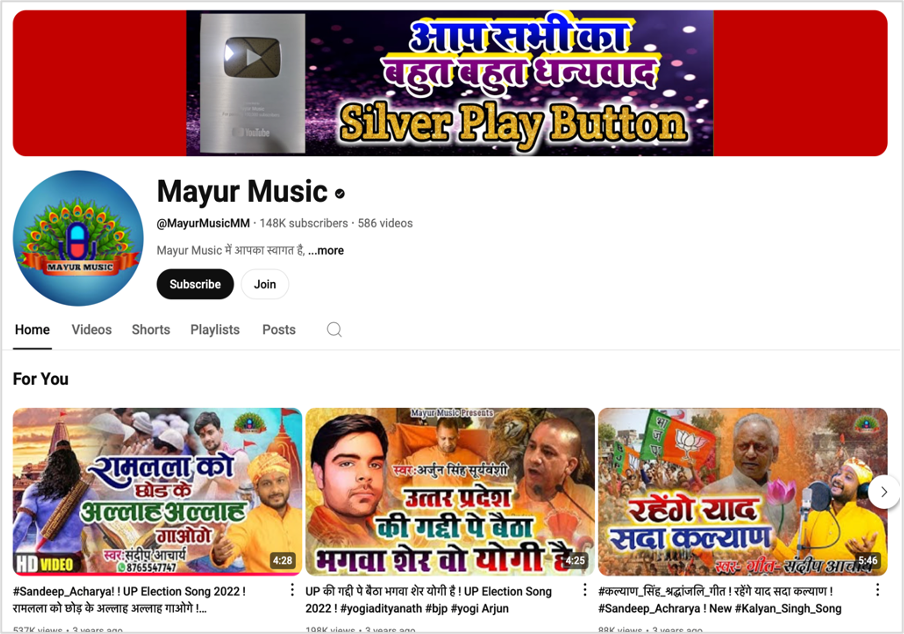
We identified 25 distinct songs hosted by Mayur Music that violate YouTube’s hate speech policy. These songs have collectively accumulated over 5.21 million views and more than 88,000 likes. While being a smaller channel than Sangam Dhun, Mayur Music plays a critical role in providing visibility to numerous Hindutva pop artists by hosting some of the most extreme anti-Muslim content within our dataset, including songs that target Muslims using the slur “Puncturewala” and a song118 that calls on Hindus to marry Muslim women as an act of retribution against “love jihad.” Puncturewala is a Hindi descriptive occupational term that refers to repairmen who fix punctures in tires. However, in Islamophobic discourse in India, it has been redesignated as a derogatory slur aimed at Muslim men. The term plays on the stereotype that Muslim men are limited to low-income jobs involving menial labor or blue collar jobs, like repairing punctured tires, and is used to belittle them.
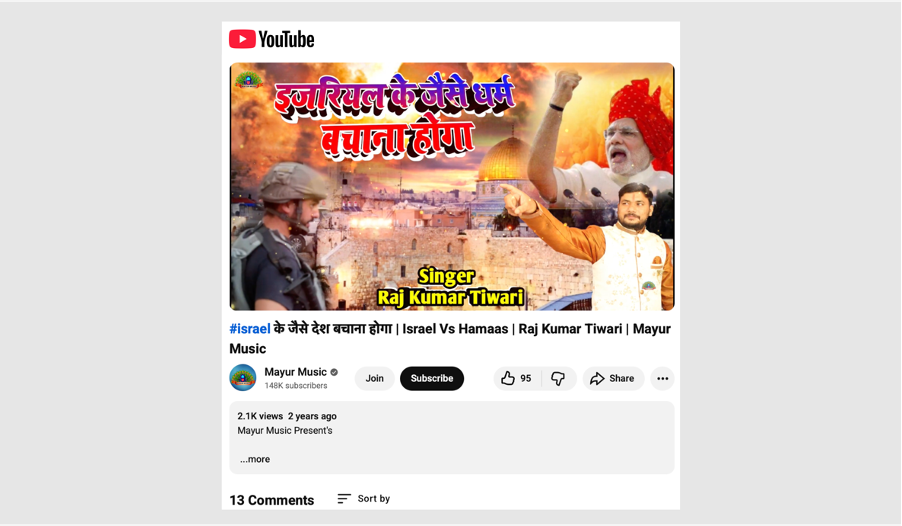
Another song, “Israel Jaisi Dharm Bachana Hi Hoga”119 (“We Must Save Our Religion Like Israel Does”) by Rajkumar Tiwari, praises Israel’s genocide against Palestinians in Gaza and suggests that a comparable model targeting Indian Muslims may be the only means of saving the Hindu religion.
Another song, “Ayodhya Jeet Chuke Hai, Mathura Bhi Jeet Lenge”120 (“We Have Won Ayodhya, Will Win Mathura Next”), with over 258,000 views and more than 4,400 likes as of May 2026, describes Muslims as “snakelings” and as inherently destructive, declaring that Hindus will build a temple in place of an existing mosque in the city of Mathura.
Prem Krishnvanshi Official
YouTube channel Prem Krishnvanshi Official,121 founded by one of the most prolific Hindutva pop artists, Prem Krishnvanshi, is the third largest contributing channel in this report. The verified channel has over 193,000 subscribers. It hosts 15 songs that violate YouTube’s policies by promoting hatred and/or inciting violence against Muslims, collectively garnering over 696,000 views and over 15,000 likes, as of May 2026.
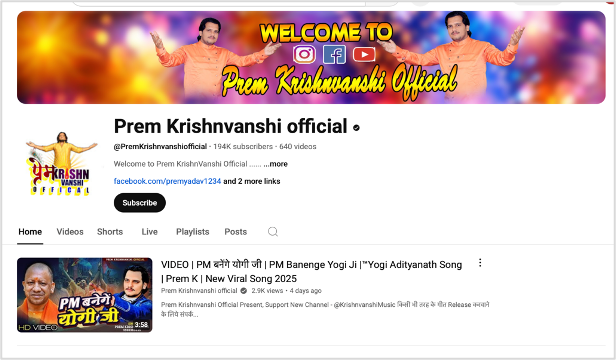
Prem Krishnvanshi is a widely-recognized figure in the Hindutva pop world. An engineering graduate originally from the northern Indian city of Lucknow, he has received an award122 from the Yogi Adityanath-led Uttar Pradesh government in recognition of his music. Of the 210 songs on YouTube, 21 have been sung by Krishnvanshi, reaching more than 861,000 views and over 16,000 likes across the platform, as of May 2026.
Fourteen of these 21 songs promote hatred against Muslims, and these songs were viewed over 494,000 times and received more than 10,800 likes. The remaining eight contain explicit threats of violence or promote the idea of violent reprisals against Muslims, accumulating over 407,000 views and 6,500 likes.
While Prem Krishnvanshi Official is the main channel, Krishnvanshi’s songs are distributed across three different channels, which together have over 343,000 subscribers. Prem Krishnvanshi Official likewise features songs by various artists in addition to himself: of the 15 violative songs hosted on Krishnvanshi’s channel, 11 are sung by Krishnvanshi, while the remaining three are performed by a singer named Arjun Singh and one by Sandeep Acharya.
Nine of the 15 songs incite hatred against Muslims, deploying dehumanizing rhetoric that ranges from likening Muslims to “snakes in the sleeve”123 and insinuating that they are engaged in a covert campaign124 to transform India into an Islamic nation, to branding them as terrorist sympathizers and “blood-sucking beasts.”125 These nine songs have garnered over 538,000 views and more than 12,500 likes as of May 2026.
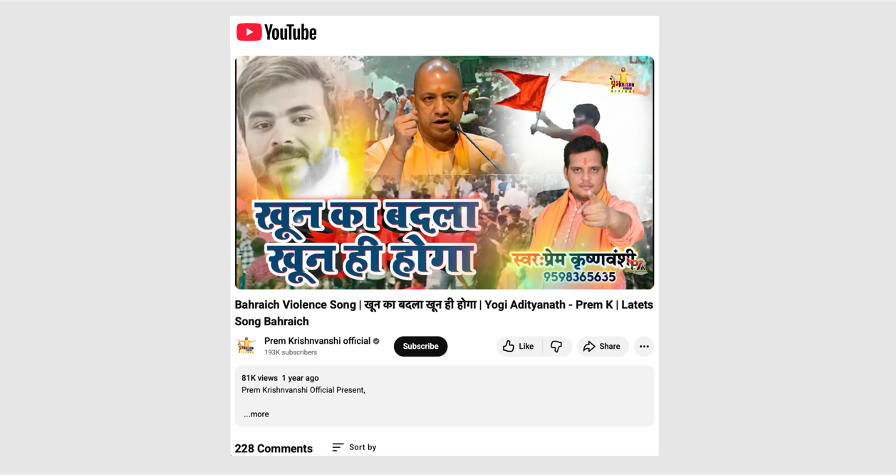
Six of the 15 songs contain explicit calls for violence against Muslims. “Khoon Ka Badla Khoon Se Lenge”126 (“We Will Avenge Blood with Blood”) by Krishnvanshi declares that Hindus will take up arms to avenge blood with blood, insisting that the Muslim enemy will be shot in the chest. As of May 2026, it has over 80,000 views.
Sandeep Acharya
Sandeep Acharya is one of the most prolific Hindutva pop artists in India, contributing 20 of the 210 songs on YouTube. These 20 songs alone have accumulated nearly 19 million views and more than 240,000 likes, making Acharya the artist with the second largest contribution, following Prem Krishnvanshi, who accounts for 21 songs.
We tracked Acharya’s presence on YouTube between January 2025 and March 2026 and found that his primary channel was terminated by the platform toward the end of 2025. This was not the first time: Acharya’s YouTube channels have been suspended on at least two prior occasions, in 2022 and in 2023. On each occasion, he created a new channel and resumed uploading content.127 Acharya established a new channel titled “Sandeep Acharya Official,”128 and began uploading songs from August 2025 onward. His songs are now spread across 12 different channels, including his own.
Acharya’s songs have repeatedly been linked to anti-minority riots,129 a consequence of the unvarnished abusive language and explicit violent threats directed at Muslims. “Bharat Mein Jo Deshdrohi Hai”130 (“The Traitors Living in India”) is frequently played by Hindu nationalist supporters at religious processions. The song uses the term “traitors” to refer to Muslims and deploys sexually explicit language against them. While the original song has been removed by YouTube, multiple users have uploaded the song onto the platform, including an EDM remix131 that has accumulated over 449,000 views.
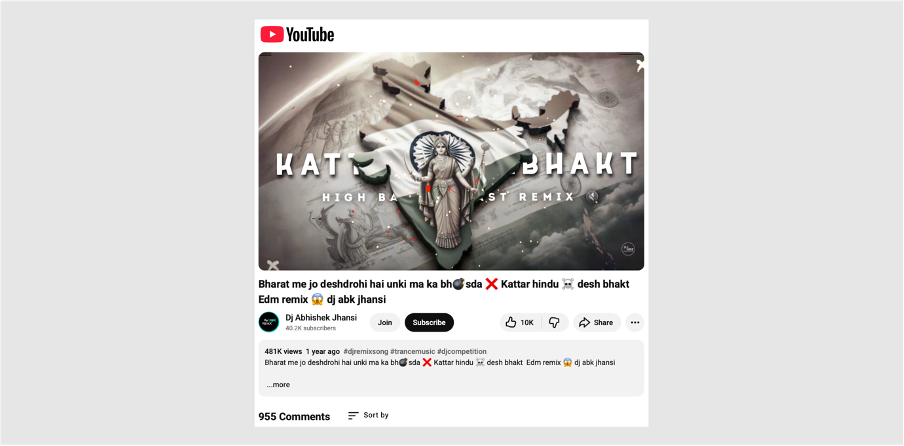
In another song, “Ayodhya Mein Babur Sauchalaya Banwaunga”132 (“I Will Build a Toilet in Ayodhya in Babur’s Name”), Acharya declares his intention to construct a public toilet in the name of the Mughal emperor Babur, serving as a thinly veiled act of symbolic degradation directed at Muslims. The song has over 82,000 views on YouTube. Another popular song of his, “Puncture Puntram Kabhi Na Mitram”133 (Puncture Boy [Muslims] Can Never Be Our Friend) refers to Muslims using the pejorative of a ‘puncture’ repairman and advocates a social boycott of Muslims. The song has over 173,000 views and more than 6500 likes, as of May 2026.
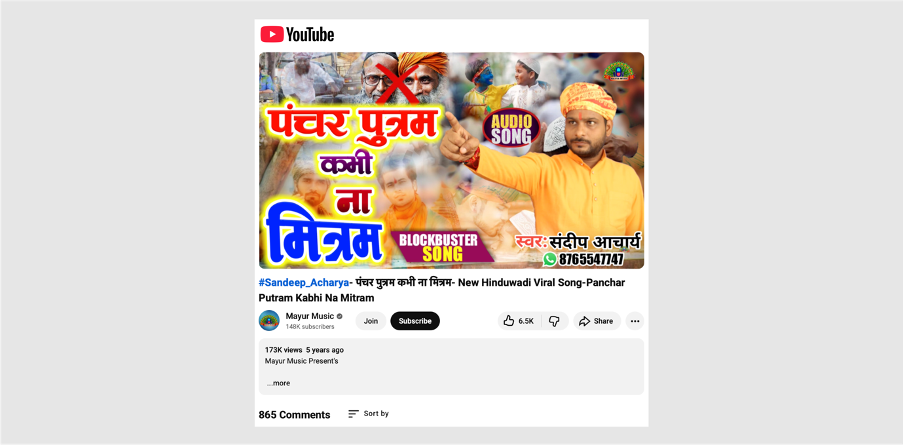
Beyond the digital sphere, Acharya regularly performs at concerts across India, drawing crowds anywhere from a few hundred to thousands of people, who come to hear both his music and his incendiary speeches live on stage.
Monetization
Not only do platforms fail to protect users from Hindutva hate music, but they also profit when users stream and engage with this harmful content. They also provide creators of such music with opportunities to monetize, thereby directly funding the Hindutva pop ecosystem.
This becomes most apparent when platforms run advertisements on hateful content. Advertisements are the most critical source of revenue for social media giants like Google and Meta.134 Platforms profile and segment users for commercial targeting and provide advertisers with a number of tools to target audiences based on demographics and interests.135 Advertisements are then displayed to users through opaque algorithmic auctioning with little transparency to both advertisers and users.136 Thus, in effect, advertisers have limited control and transparency over the specific user-generated content that appears adjacent to their advertisements. In the past, YouTube and Facebook have faced backlash from brands for displaying their advertisements next to racist, misogynistic, hateful, and violent content. In 2017, several major brands suspended advertising on YouTube following an investigation that revealed their ads appeared next to extremist and hateful content.137 In 2020, civil society and several businesses joined the Stop Hate for Profit Campaign to demand more accountability from Facebook.138 Similarly, the now-discontinued industry initiative, Global Alliance for Responsible Media (GARM), worked towards the objective of enhancing transparency in advertising.139
However, the monetization of hateful content through advertisement revenue still persists. Recent studies have exposed similar patterns elsewhere. The Center for Countering Digital Hate (CCDH), for example, found that major brands’ advertisements continued to appear on misogynistic videos featuring Andrew Tate even after his ban from YouTube.140 While platforms have, in the past, faced advertiser backlash in the context of racist, anti-semitic, extremist, and misogynistic content in Europe and the U.S., there is very little advertiser pressure from Global South countries such as India, despite the well-documented prevalence of Hindu nationalist hate speech.141
Apart from profiting from hate through advertisement revenue themselves, platforms also provide creators an opportunity to monetize their content. Firstly, platforms distribute a share of advertisement revenue to eligible content creators. For instance, eligible members of YouTube’s Partner Program receive 55% of the net revenue from ads displayed/streamed on their public videos.142 Similarly, Meta’s content monetization program allows creators to earn a percentage of ad revenue from in-stream advertisements.143 Second, besides advertisement revenue sharing, platforms also provide affordances for creators to raise money directly from their audiences. Prominent examples include the “Super Thanks”144 and “paid channel membership”145 features available to eligible channels on YouTube. Eligible Creators can also do product placements and earn commissions from the sale of the tagged products in the shopping affiliate program.146
Third, while social media platforms directly host user-generated content and distribute advertisement revenue, streaming platforms like Apple Music and Spotify pay streaming royalties to artists through record labels or third-party music distributors.147 There is very little public information available on the earnings that musicians, especially smaller creators, make through these royalty payments.148 Meta Music Library also has a music revenue-sharing model where music rights holders receive a share of advertisement revenue for eligible videos that use their music.149 Finally, creators gain popularity online, and many perform at local political and religious events.150 For this reason, many singers studied in this report advertised their contact information for business inquiries on their social media profiles.
This section consequently examines the monetization of hate music on social media platforms YouTube and Meta.
Monetization on YouTube
We studied the monetization of Hindutva pop hate music on YouTube through advertisements in April 2026, more than six months after reporting 91 songs on the platform (78 of which remained online). Since advertisements are not always visible, the videos were manually viewed on YouTube using 2 different accounts and a guest login, and via a VPN with IP addresses from three different Indian cities.
Out of the 210 songs studied, we found 163 songs, i.e., approximately 78 percent, displaying in-stream advertisements. This percentage is even higher for songs that incite, encourage, or condone violence—86 of the 104, or approximately 83 percent, of such songs had advertisements running. This is in violation of YouTube’s own community guidelines enforcement and advertiser-friendly content guidelines, which prohibit hateful and derogatory content.151
The list of advertisers on Hindutva pop hate music includes 103 brands and services, including OpenAI’s ChatGPT, Google’s NotebookLM, Amazon Prime, Canva, Opera Browser, Adobe, and others.
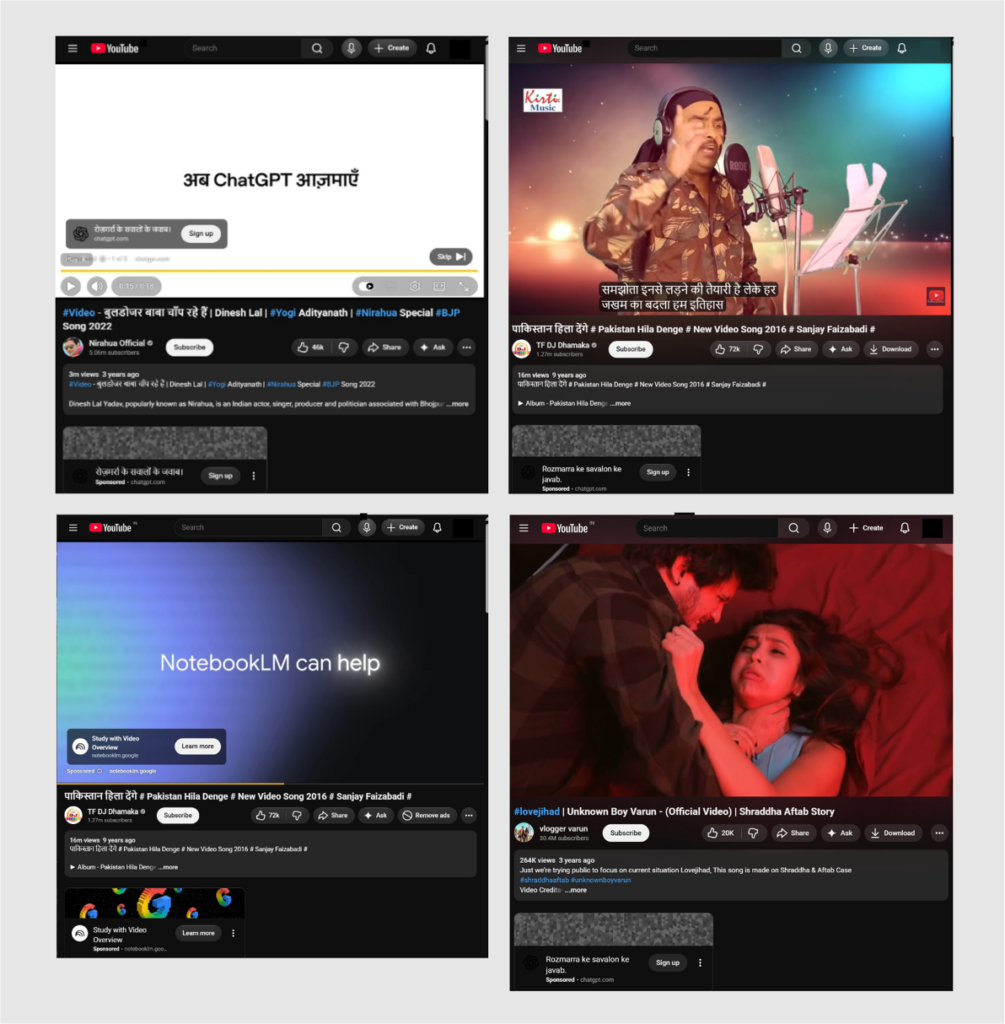
ChatGPT’s advertisements appear in-stream of several hate music videos promoting violence, as seen above. The first video is titled “Bulldozer Baba Chaanp Rahe Hai” (“Bulldozer Baba is stamping”),152 referring to the Uttar Pradesh Chief Minister Yogi Aditiyanath’s arbitrary policy of using bulldozers to demolish minority homes and properties.153 The song glorifies these demolitions by interspersing visuals of houses being demolished with animated speeches by Yogi Adityanath. A second ChatGPT advertisement appears in-stream for a song titled “Pakistan Hila Denge” (“We will shake Pakistan”),154 with the lyrics, “Bahut baha hai lahu hamara ab inki baari hai, ab naa karo samjahauta inse, ladne ki taiyaari hai” (“Enough of our own blood has been shed, now it’s their turn. Don’t compromise with them anymore, we are ready to fight). Google’s NotebookLM’s advertisement also appeared on this song.
A third ChatGPT ad appears in a song titled “Love Jihad”155 with graphic descriptions and images of violence perpetrated by a Muslim man on a Hindu woman in an attempted re-enactment of the tragic murder of Shraddha Walker by her Muslim live-in partner.156 This tragedy has been framed as an example of the baseless conspiracy theory “love jihad”,157 as discussed in previous sections.
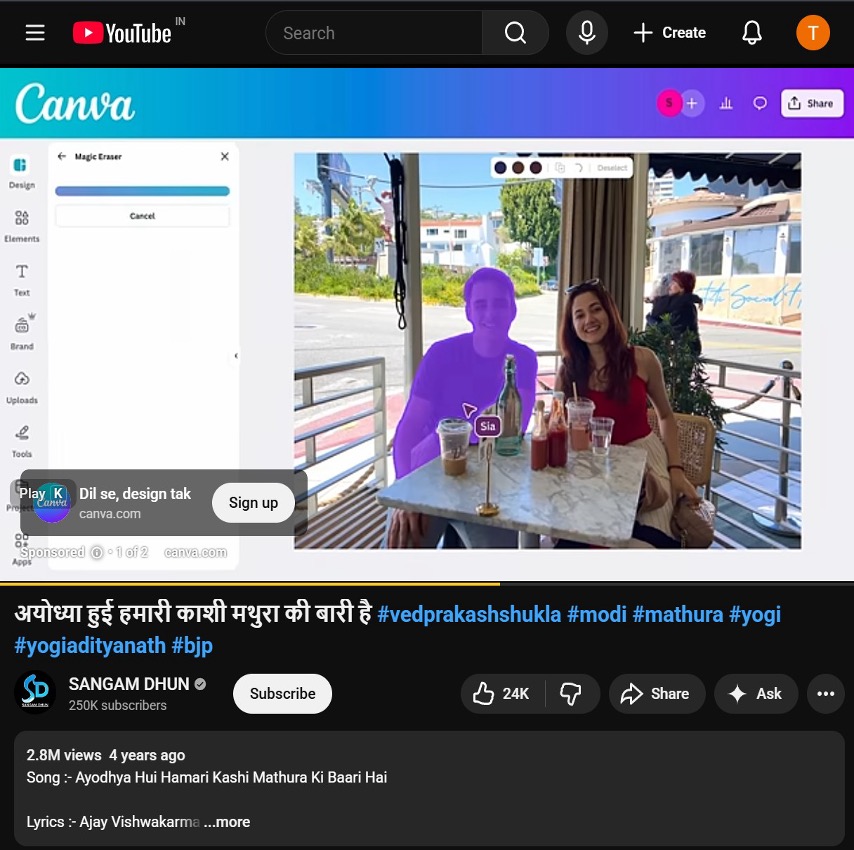
An advertisement from Canva appears in a song titled, “Ayodhya hui Hamari, Kashi Mathura ki baari hai” (“Ayodhya is ours, now it’s time for Kashi and Mathura”),158 referring to a popular Hindu nationalist slogan that emerged in the 1990s during the Ram Janambhoomi movement, which culminated in the destruction of the Babri Mosque in Ayodhya. The slogan is gaining momentum in the current political mobilization and judicial battles challenging the legitimacy of Muslim places of worship like the Gyanvapi Mosque and Shahi Eidgah Mosque, on claims that these are sites of ancient Hindu temples.159
Advertisements from international brands like Motorola, Dell, Haier, and consumer goods like Kellogg’s, Oreo, Nivea, Ponds, and clothing brands like Levi’s and Marks and Spencer appeared in hateful songs targeting Muslim minorities.
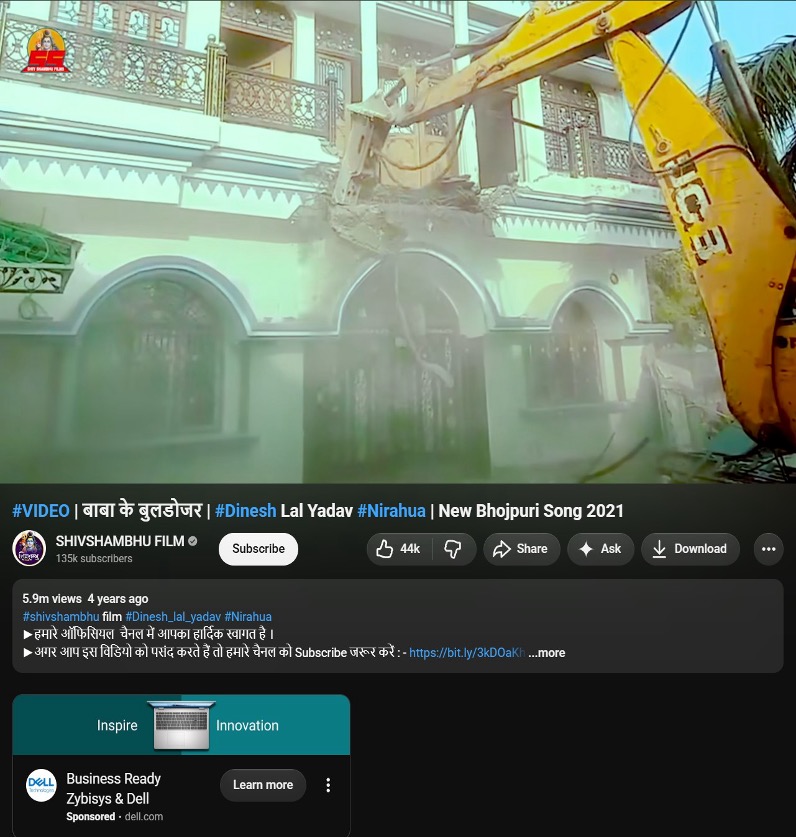
For instance, an advertisement from Dell appeared next to a song titled “Baba ke Bulldozer” (“Baba’s Bulldozer”, referring to Chief Minister Yogi Adityanath’s bulldozer policy),160 celebrating bulldozer demolitions of Muslim homes.
An advertisement from Levi’s appears in a song titled “Muslim betiyo ko ab ghar le aana hai” (“We need to now bring Muslim daughters in our homes),161 including the lyrics: “Love Jihad kya hota hai ab tumko yeh samjhana hai, Muslim beti ko bahu banakar ab apne ghar laana hai” (“We have to teach you what Love Jihad is, We have to bring Muslim daughters as daughters-in-law in our homes).
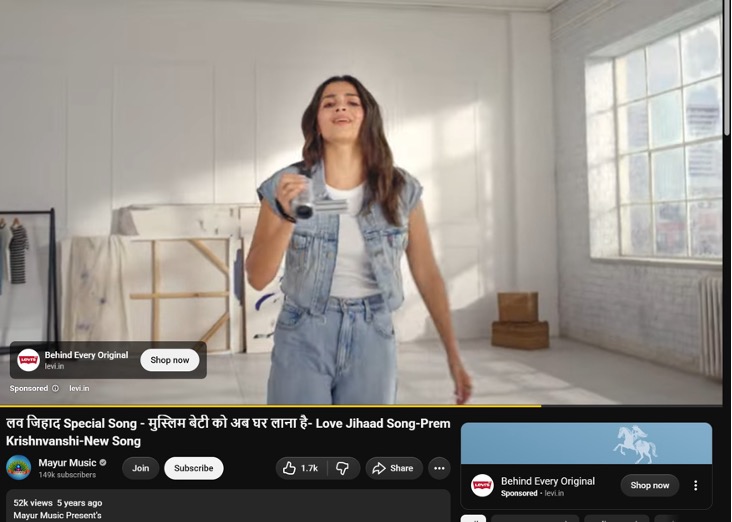
This song objectifies women as trophies in a religious and demographic war between Hindu-Muslim communities. It also reiterates Hindu nationalism’s construction of Muslim women both as objects of pity that need saving, and as objects of sexual desire that need conquering. The song adopts a tone of glorifying a noble mission in which Muslim women who are happy and willing to embrace civilized Hindu society are brought back (“ghar waapsi”) into the Hindu fold.
Motorola’s ads appeared in a song titled, “Gyanvapi Masjid mein mile Shiv, jahan jahan baitha hai Khuda vahan khudai hogi” (“Shiv was found in the Gyanvapi Mosque, there will be excavating wherever there is Khuda”).162
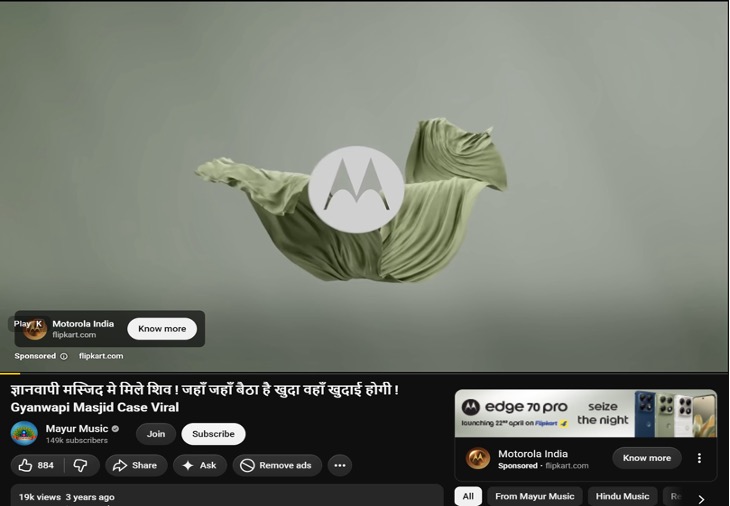
The title states that Lord Shiv has been found in the Gyanvapi mosque, referring to “shivling” reportedly found in the Gyanvapi Mosque complex in a controversial court-ordered videography.163 It further does a word play on Khuda (Urdu for God) and Khudai, which can mean both divinity and the act of digging/excavating. The song refers to the latter, proclaiming that all Muslim places of worship/divinity need to be excavated to find ancient Hindu temples. It calls for violence to accomplish this: “Jang lagi talwaron mein, dhaar tez karna hoga, jisne jaisa kaam kiya hai, waisa usko bharna hoga” (“We need to sharpen our rusted swords and serve justice to those who deserve it).
Another ad appears in a song titled “Bhagwa lehrayenge” (We will hoist the saffron flag),164 with visuals of saffron-clad men brandishing swords to lyrics like, “humse naa takrana, hum bhagwadhaari hai” (“Do not confront us, we are the saffron-wearers”).
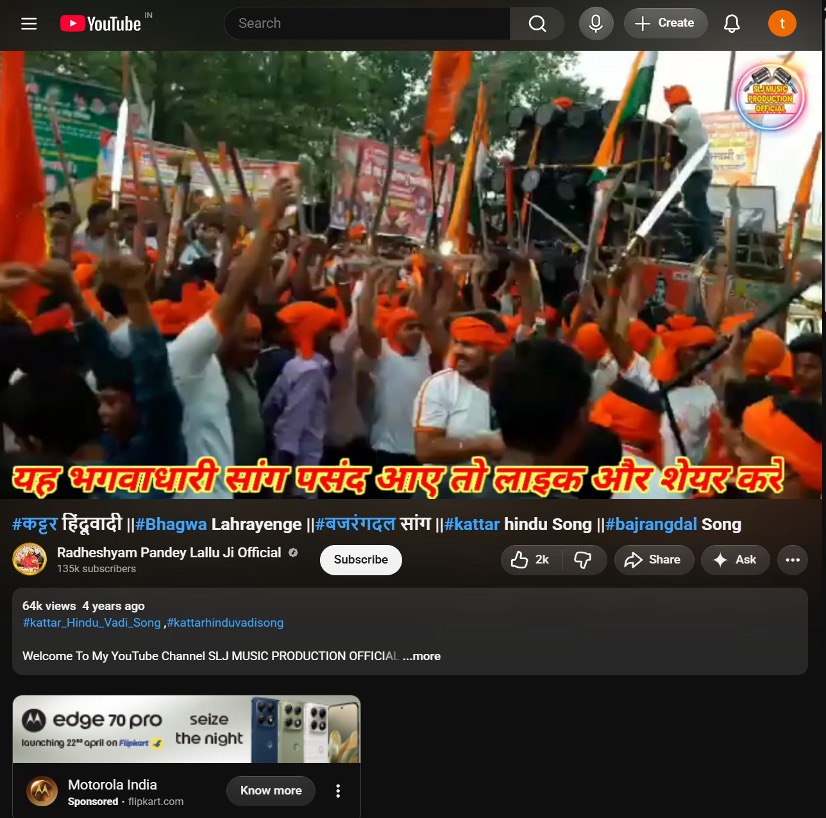
Popular confectionery brand, Raffaello’s ad appeared in a song titled “Naringhanand Jagave” (“Wake up call by Narsinghanand”)165featuring Yati Narsinghanand, who is seen gifting a sword to a group of men as several others wave guns and swords in the frame. The song urges listeners to pick up weapons to defend “Sanatan Dharma” ( Eternal Dharma, used as an alternative term for Hinduism): “dharm ki khatir aage badh kar ab hathiyar uthao” (“step forward for the sake of religion and take up weapons”). It is important to note that Narsinghanand is a hate-monger facing multiple criminal charges for delivering hate speeches, including calls for genocide of the Muslim community.166
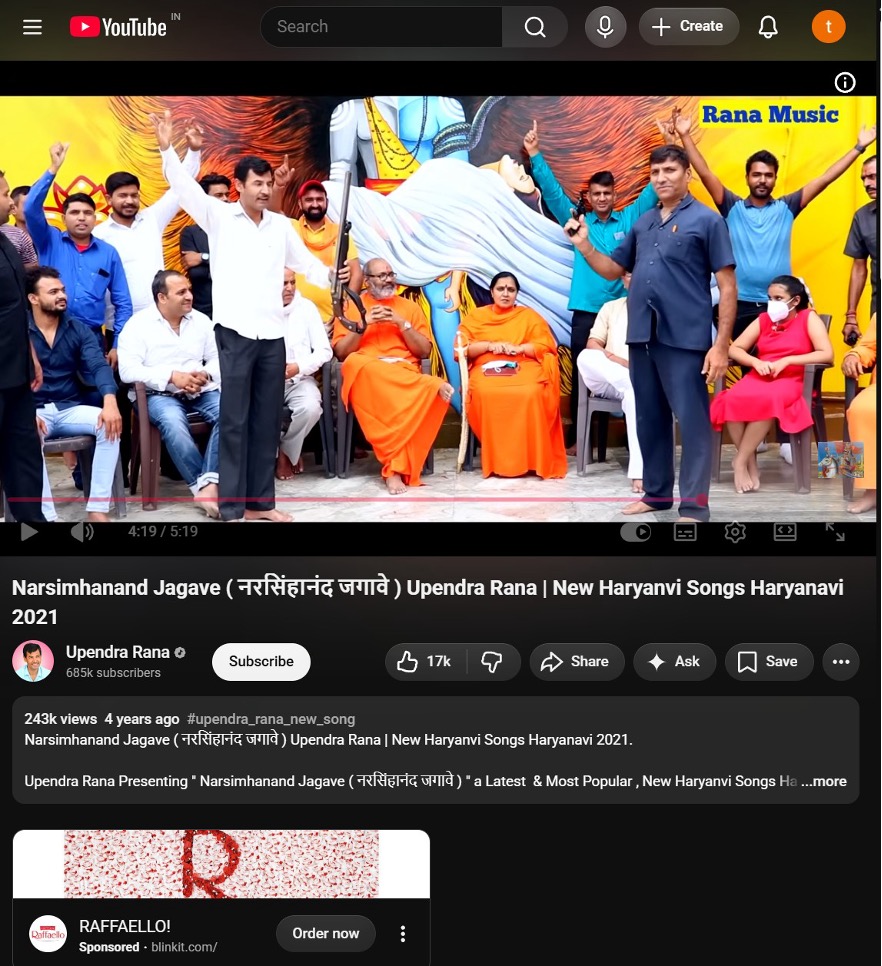
Similarly, Kellogg’s ad appears on the video titled, “Ayodhya jeet chuke, Mathura jeet hi lenge, phir chalenge hum sab Kashi” (“We have won Ayodhya, we shall win Mathura and then we will go to Kashi),167 with lyrics that call for hanging those who threaten the saffron (wave): “bhagwe ko ja aank dikhaye, usko ab taango phaansi” (“anyone who dares to challenge saffron, must be hanged”).
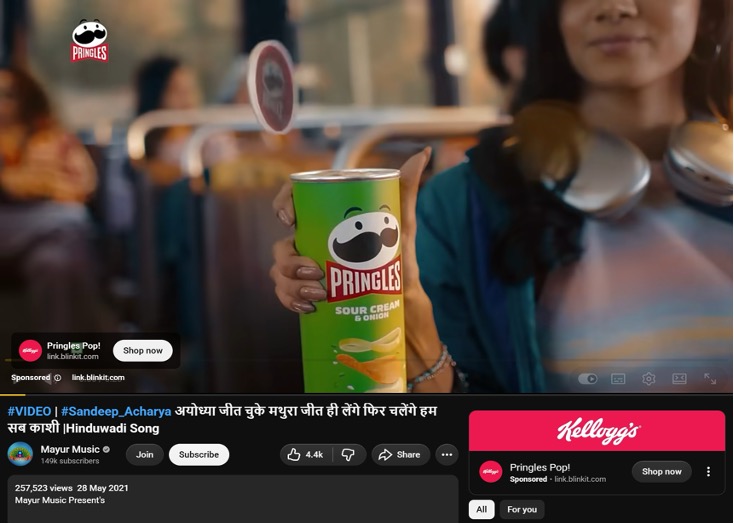
Oreo’s ad appears in the song titled, “Babar ke pillo sun lo, mera Yogi sab par bhaari hai” (“Listen, you pups/descendants of Mughal Emperor Babur; my Yogi is stronger than all of you”),168 which has a sword-brandishing singer proclaiming, “yaha Aurangzeb kaa har pilla ab ram ram chillayega” (“every puppy/descendant of Mughal Emperor Aurangzeb will now scream the name of Lord Ram”).
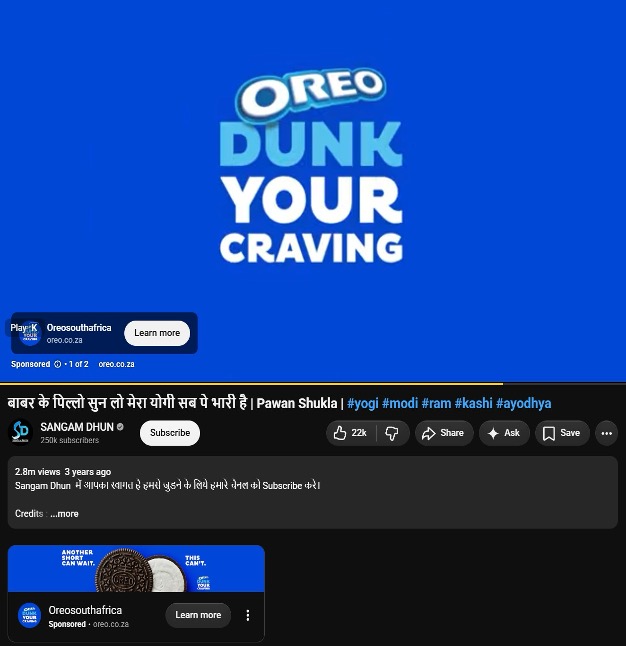
Advertisements from major Indian corporations, including Godrej, JK Cement, Urban Company, Flipkart, Myntra, ITC Hotels, IndiGo Airlines, Akasa Air, Reliance Jewels, Tanishq, ICICI Bank, and Kotak Life were displayed alongside hateful, abusive, and dehumanizing songs, often accompanied by violent visuals.
BigBasket by Tata Digital had an advertisement running on a video titled, “Babar vaalo chup baitho” (Shut up Babar’s people),169 with visuals of saffron-clad men waving swords to lyrics like, “Ghar mein ghuske maarenge, Babar banne ki socho naa” (We will enter your homes and strike, don’t even think of becoming Babar). This is a direct call for violence against Muslims.
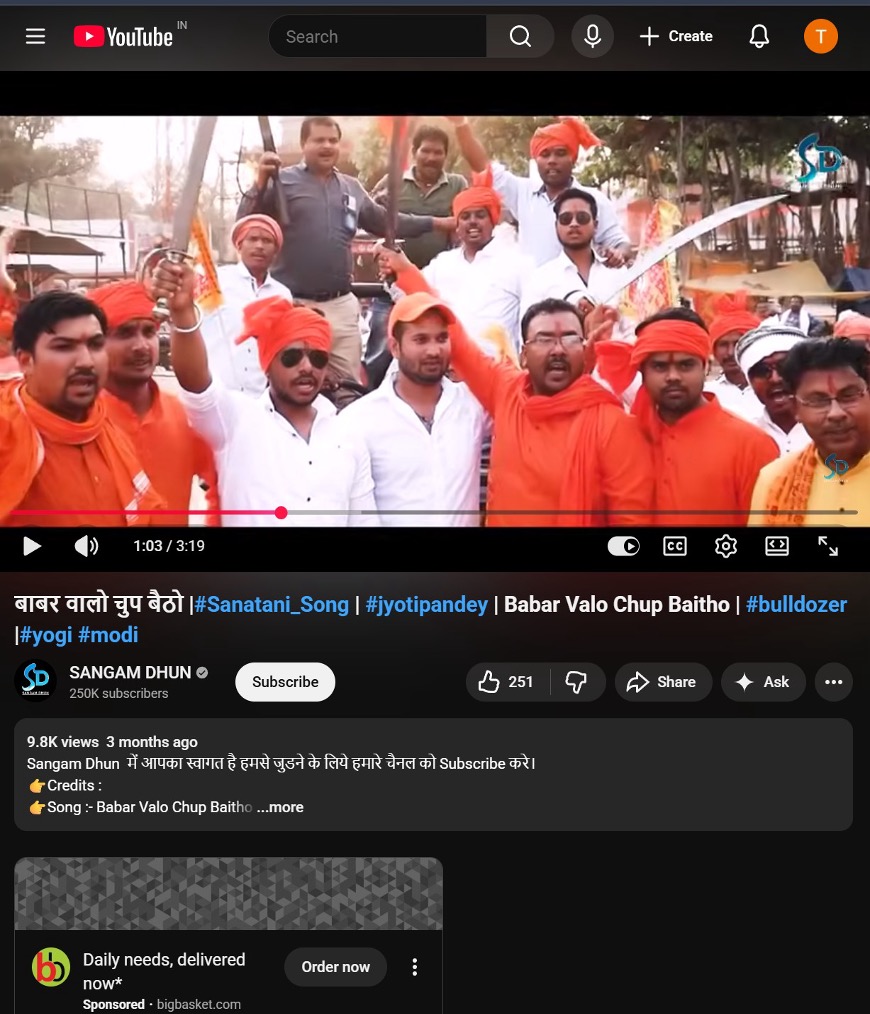
Flipkart’s ad appears in a song titled, “Suno Hinduon, batenge toh katenge” (Listen Hindus, if we become divided we will be killed).170The song warns of an impending demographic change if Hindus do not unite: “aabaadi ke santulan ka desh mein badal raha hai hisaab, aane waali peedhi ko sochoge kya tum doge jawaab” (“the country’s demographic balance is changing, just think about how you will be able to answer future generations”). This song capitalizes on unsubstantiated fears of demographic change and contributes to disinformation targeting Muslim minorities.
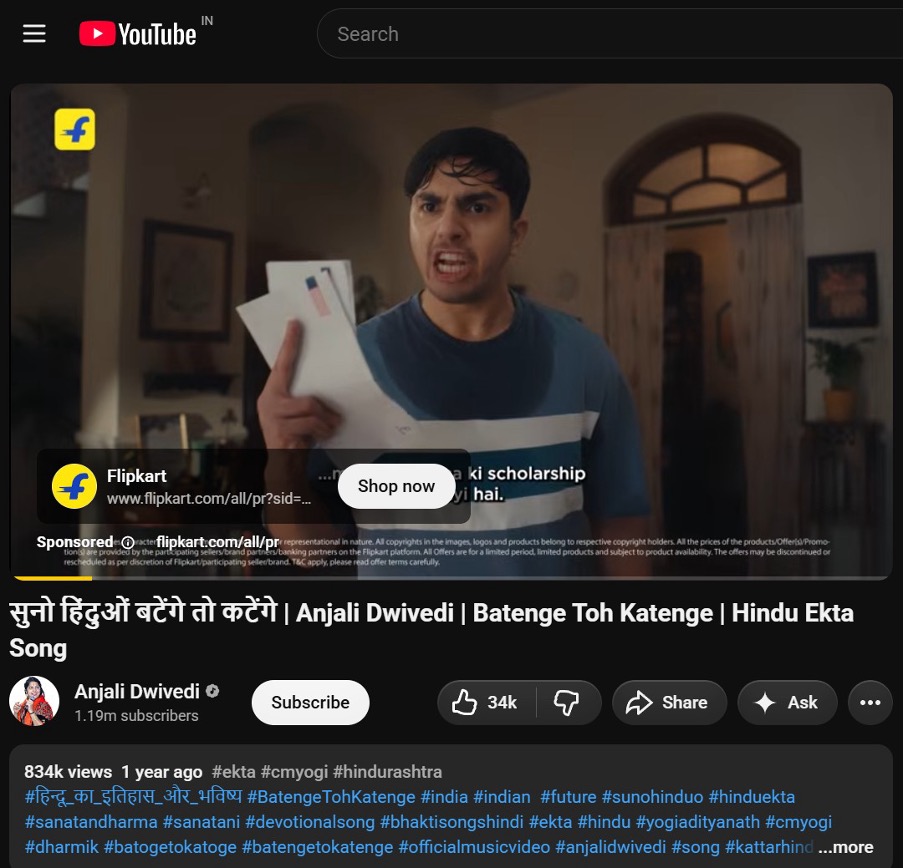
Urban Company’s advertisement appears in a song titled, “Mitane Love Jihad ko taiyaar ho jao” (“Become ready to erase Love Jihad”),171with the singer at one point asking the listeners to get ready to eliminate the perpetrators of “Love Jihad”, i.e., Muslim men in interfaith relationships who allegedly entrap and then abuse, or even kill, Hindu women. The singer urges listeners, “aise papiyon ko khatam karo”(“finish/kill such sinners”).
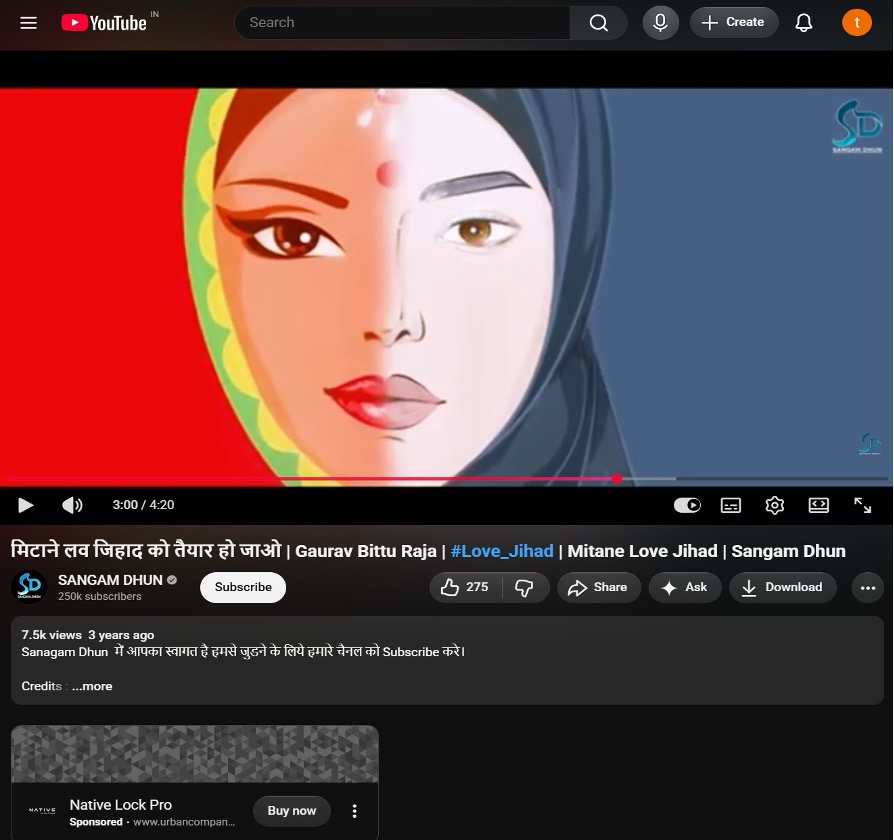
ITC Hotels’ advertisement appears in a song titled, “Bharat Hindu Rashtra banaoge tabhi 24 mein aaoge” (“You will return in 2024 only if you make India a Hindu Rashtra”).172 The song is directed at Prime Minister Narendra Modi, urging him to declare the country a “Hindu Rashtra” (Hindu ethnostate) in order to retain power in the 2024 general elections.
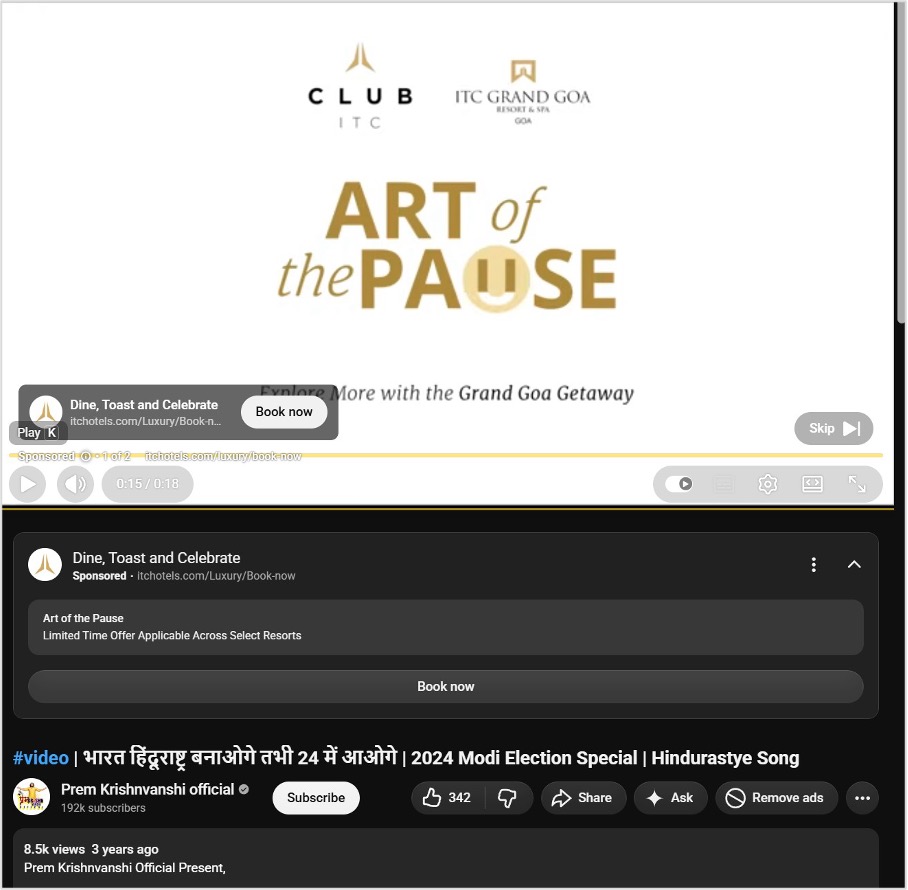
ICICI Bank’s advertisement appears in a song titled “Bulldozer wala baba ke aage koi tik naa payega” (“No one is capable of confronting/opposing Bulldozer Baba [referring to Chief Minister Yogi Adityanath]”).173
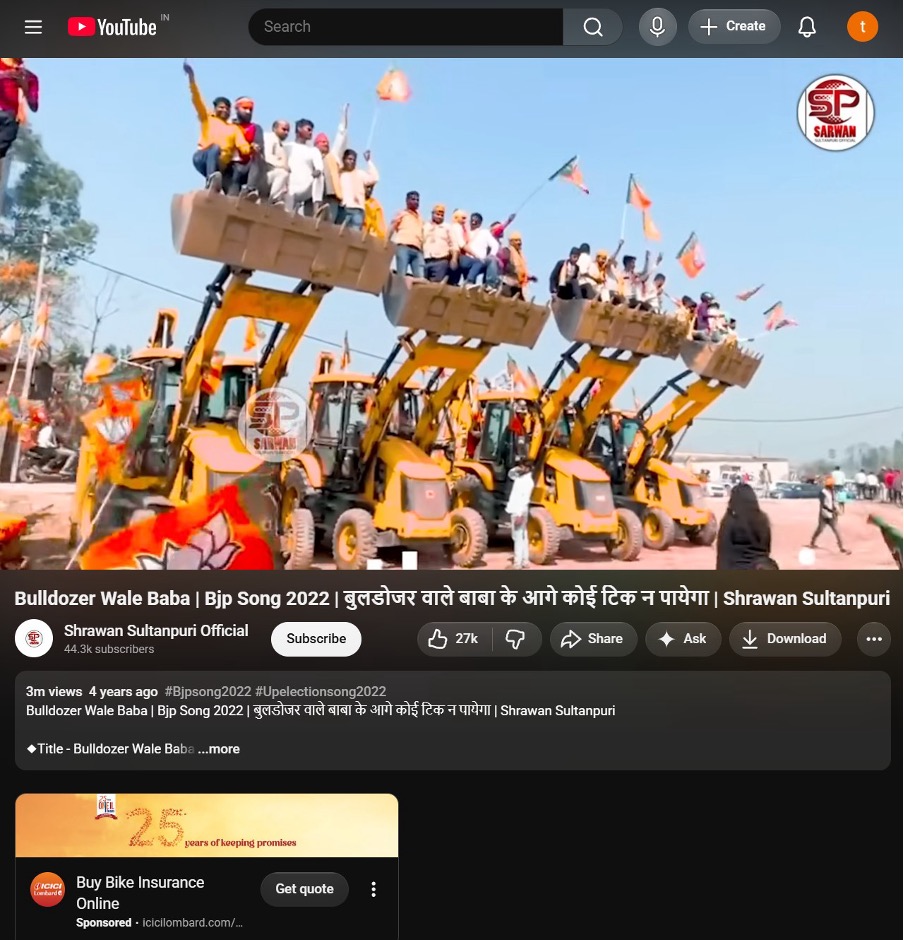
Tata Group’s popular jewelry brand, Tanishq’s advertisement appears on the song, “Khak naa kardu toh mai Ram kaa nhi” (“If I don’t burn [the enemy] to ashes, I do not belong to Lord Ram”)174 with lyrics: “Matribhoomi ki raksha khatir hum talwar uthate hai… Dushman naa kaampe humse aisi koi subha-shaam nahi” (“We raise our swords to protect our motherland… there isn’t a single morning or evening when the enemy does not tremble before us”).
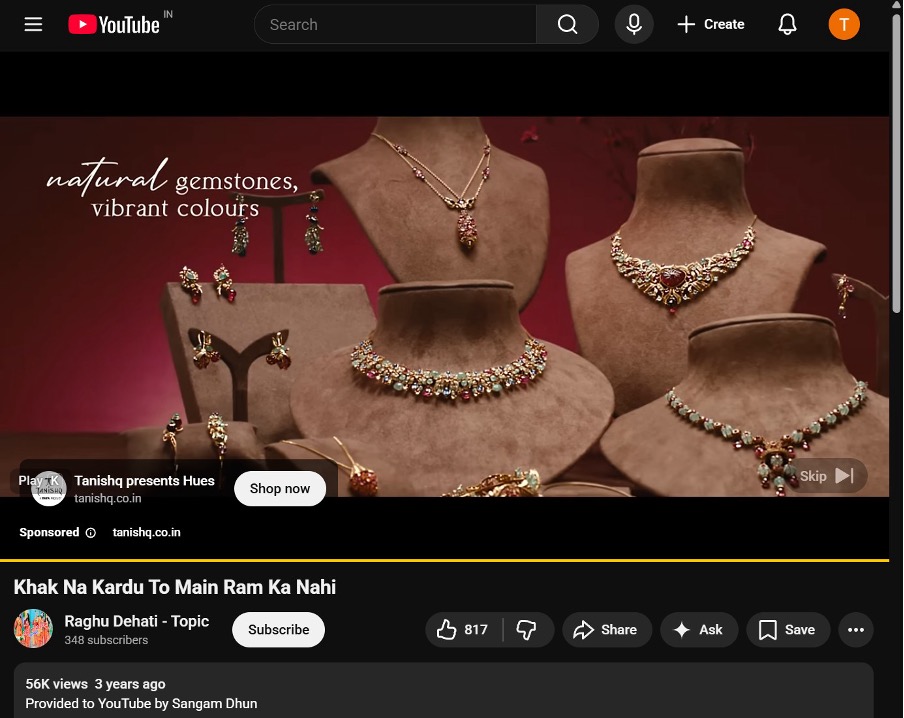
Dish TV’s advertisement appears in a video titled, “Topi waala sar jhukar Jai Shri Ram bolega-2” (“Those who wear skull caps will bow their heads and say Jai Shri Ram – 2 ”).175 The song’s lyrics celebrate the glory of the saffron flag in the sacred motherland where Muslim citizens are forced to chant “Jai Shri Ram” under physical threats and violence: “Bharat ki paavan dharti par bhagwa rang jhanda phairega, lathi ke bal par topi-wala Jai Shri Ram bolega” (“On the sacred land of India, the saffron flag will be hoisted; by the force of the stick, those wearing skull-caps [Muslims] will have to chant Jai Shri Ram”).
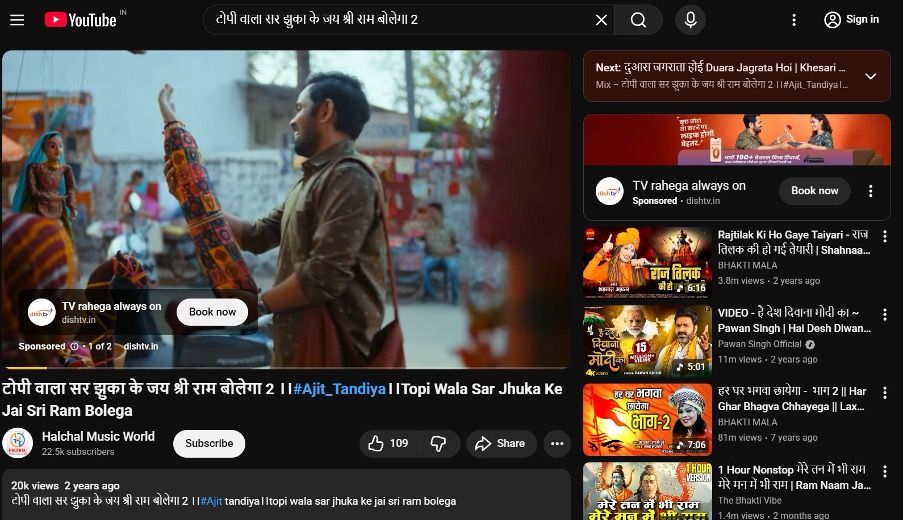
The clear incitement to violence from this song becomes apparent if one looks at the numerous incidents in the past decade where Muslim individuals, including children and the elderly, are subjected to inhumane violence by Hindu nationalist mobs, forcing them to chant “Jai Shri Ram.” 176
Ads from India’s central bank, the Reserve Bank of India (RBI), National Payments Corporation of India (NPCI), and the Central Bureau of Communication, Government of India, were also displayed next to hateful songs. For instance, an advertisement from the RBI appeared in-stream for a song titled, “Jo Gau Mata Ne Kaate Hum Unne Kaate Ge” (“We will cut/kill those who cut/kill Mother Cow”).177
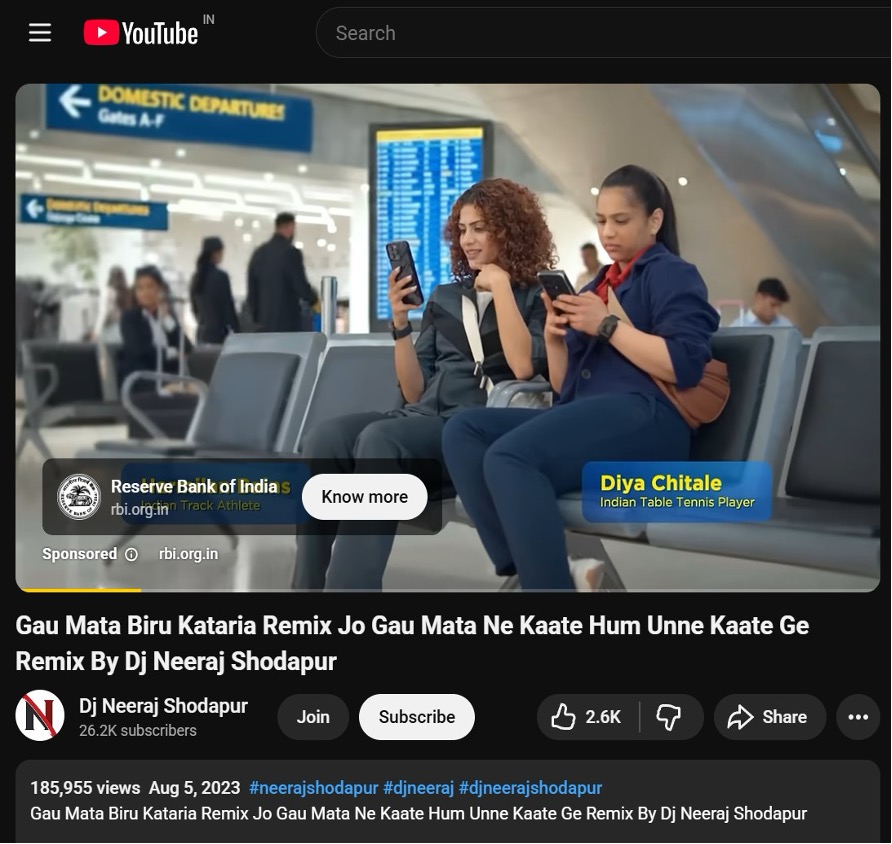
The threat from incitement to violence in this song is clearly imminent, given the lynchings of Muslims and Dalits by cow vigilante groups. Another RBI ad appeared on a song titled, “Kattarwadi Song: Hindu hokar bhi tumko shri ram kyu nhi bhaate” (“Hardliner song: Why do you not like Shri Ram despite being a Hindu”).178
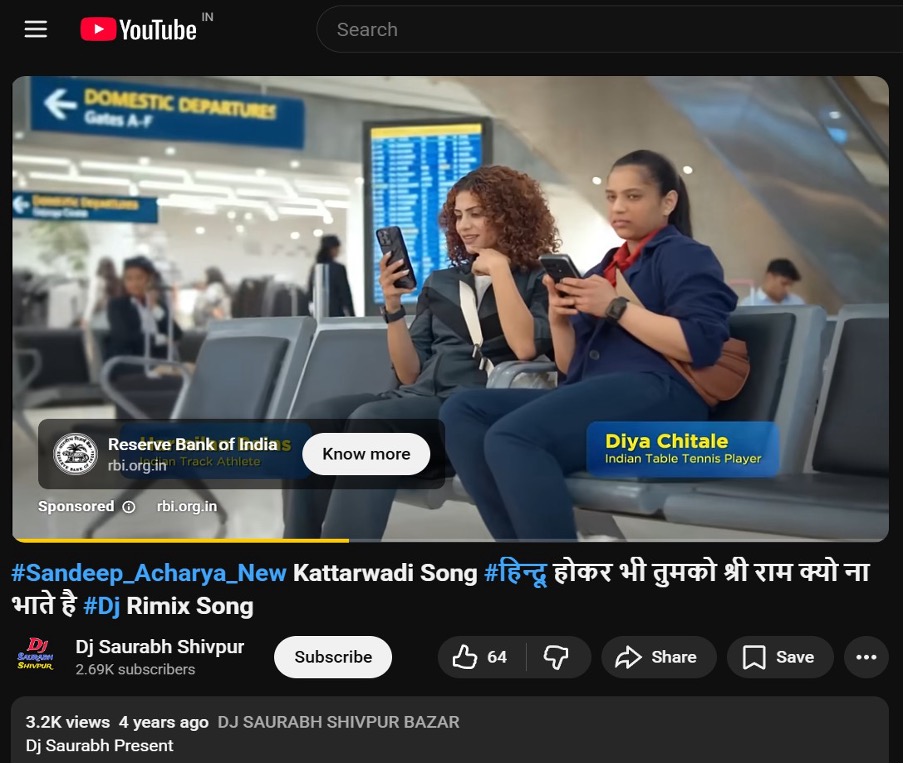
The singer implies that such Hindu families have a sinister or even a secret illegitimate intimate relationship with Muslim men: “toh pata karo kya ghar mein tumhare abdul chacha aate hai” (“find out whether an ‘Abdul chacha’ comes to your house”).
Advertisements for educational institutions and courses, including from Coursera, Lovely Professional University, Vidyamandir Classes, and Chandigarh University, were also displayed in hateful songs. Coursera’s ad appears in-stream a video titled, “Ram naam ke naaro se Babur ki Babari toot gayi” (“Cries in the name of Lord Ram destroyed Babur’s Babri [mosque]”)179 referring to the demolition of the 16th-century Babri Mosque in 1992 by a mob of Hindu nationalists.180 The ad appears next to images of the mosque’s destruction, accompanied by lyrics glorifying the mob that not only demolished the physical structure, but also the pride of Mughal Emperor Babur, and by extension, all Muslims, whom the Hindu nationalists derogatorily refer to as descendants of Babur.
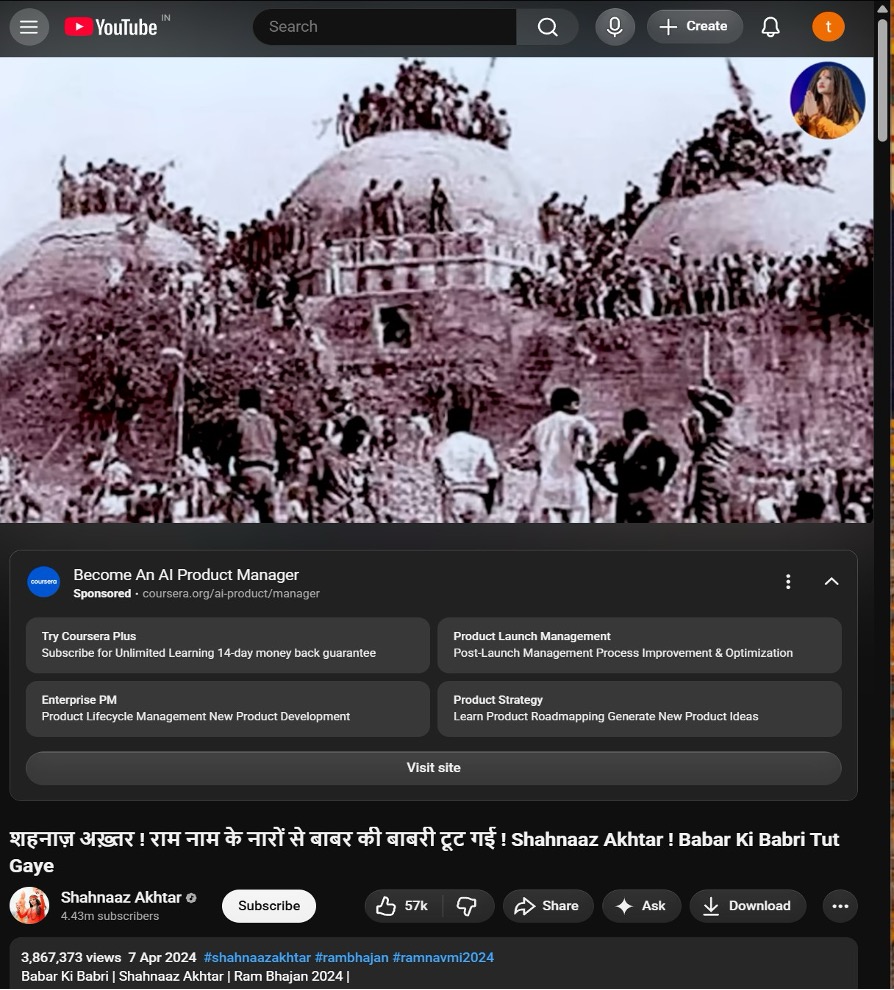
Similarly, Lovely Professional University’s advertisements appear on the songs, “Babar ke pillo sun lo mera Yogi sab par bhari” (Listen, you pups/descendants of Mughal Emperor Babur; my Yogi is stronger than all of you)181 and “Ayodhya hui hamari ab Kashi Mathura ki baari” (“Ayodhya is now ours, Kashi and Mathura are next”).182
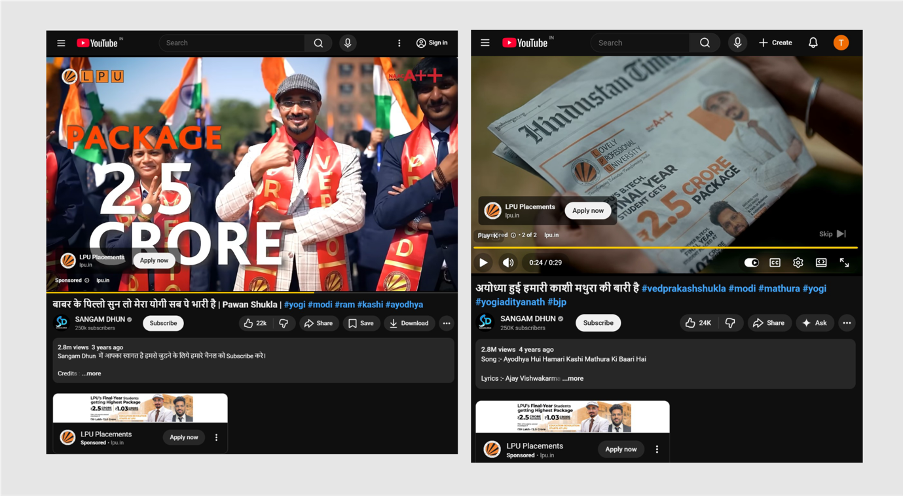
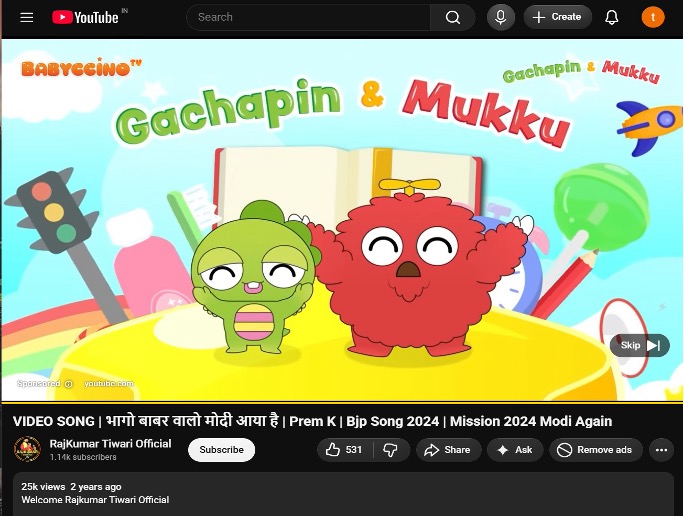
A YouTube advertisement for the children’s channel Babyccino TV appears in-stream on “Bhaago Babar Walo Modi Aaya Hai” (“Run Away, Babar’s People, Modi Has Come”),183 a song that targets Muslims while celebrating the construction of the Ram Mandir in Ayodhya on the site of the demolished Babri Masjid.
The examples above illustrate that YouTube profits from advertisement revenue on Hindu nationalist hate music that targets, dehumanizes, and incites violence against religious minorities in India. Creators that are part of the YouTube Partner Program (YPP) are eligible to a share in this advertisement revenue. However, even if a channel is not monetized and the creator is not part of the YPP, YouTube may still run ads on the videos and retain the entire revenue.184
For creators who are part of the YPP, advertising revenue becomes an important source of funding for the production of more hateful music. Since YouTube does not publicly disclose information about the channels that are part of its YPP, it is not possible to accurately identify all the creators who receive a share of advertising revenue from YouTube. However, the platform also provides creators in the YPP additional avenues for monetization. This includes the fan-funded “Super Thanks” feature for eligible videos of a channel.185 Through this feature, creators can directly receive revenue from viewers who can buy a one-time animation and a stand-out comment. Since this feature is directly visible on the platform, we were able to identify that 114 of the 210 videos, or around 54 percent, had this feature enabled, allowing Indian users to contribute sums ranging from 40 rupees ($0.42 USD) to 10,000 rupees ($104.83 USD).
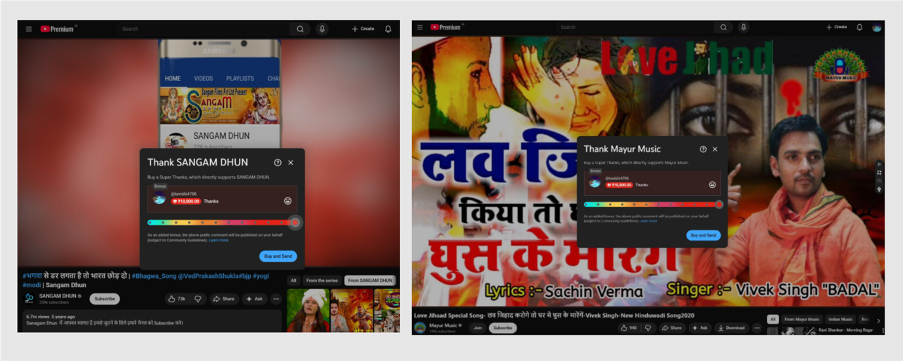
It is important to note that YouTube’s own policy states that compliance with its Community Guidelines is a prerequisite for enabling such monetization features. Nonetheless, as noted in previous sections, the songs in this study violate the platform’s hate speech policy.186
Furthermore, approximately 55 percent of the songs that explicitly incite or encourage violence also had the “Super Thanks” feature enabled, allowing creators to crowdfund music that incites violence against Muslims and other religious minorities. Viewers can contribute and “thank” creators for songs that incite hatred against the Muslim community. The three channels – Mayur Music, Sangam Dhun, and Prem Krishnavanshi Official – which are major contributors of hate music (hosting approximately 40% of the songs identified in the study), have the “Super Thanks” feature enabled, allowing them to seek direct fan funding on YouTube and also indicating that these channels are monetized and members of the YouTube Partner Program (YPP), most likely earning a proportion of the advertisement revenue from their videos.
Apart from Super Thanks, eligible channels can also allow viewers to join the channel through exclusive monthly memberships.
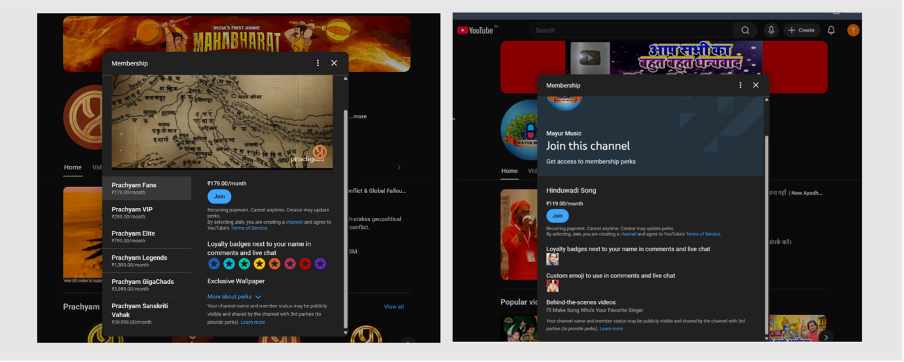
The five channels include Mayur Music,187 Sanju King Records,188 Dj Neeraj Shodapur,189 Prachyam,190 and Bhagwa Brand Factory,191which had this paid membership feature enabled, allowing viewers to contribute financially to the channel through different tiers of monthly subscriptions.
Monetization on Meta Platforms
Meta’s content monetization program allows eligible creators to monetize content and earn through in-stream ads, ads on Reels, and a performance bonus based on audience engagement, recently through a single program.192
We examined the monetization status of profiles of prominent H-Pop singers on Facebook. The singers were selected based on the aggregate number of views on their songs in our YouTube database and the aggregate number of Reels on Instagram using their music from the Meta Music Library. Of the 30 singers studied, accounts of 20 singers (66.66 percent) were found to be monetized. Since many accounts were not verified, it cannot be certain whether they were being operated by the singers themselves. Additional fan pages/accounts of singers were also found to be monetized (not included in this number).
Meta is the only social media platform to provide information on the monetization partnerships, and we used the WHAT TO FIX’s Meta monetization archive to verify the monetization status of the accounts.193
A Facebook account named Sandeep Acharya Ayodhya, which has uploaded several hateful songs, is monetized as per the archive. Sandeep Acharya’s YouTube accounts have been terminated multiple times for community guidelines violations, as documented in earlier sections.
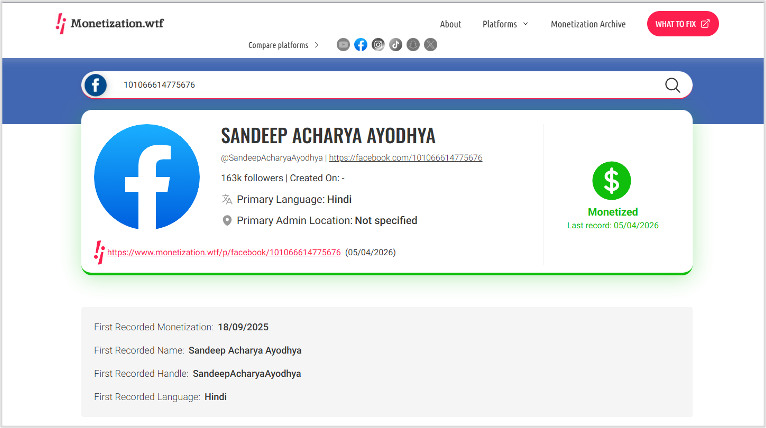
Similarly, the Facebook account Kanhaiya Mittal, with 3 million followers, is monetized according to Meta’s monetization partner archive. Previous studies of Hindutva hate music on YouTube have also noted the failure of content moderation in acting against hate music by this creator.194
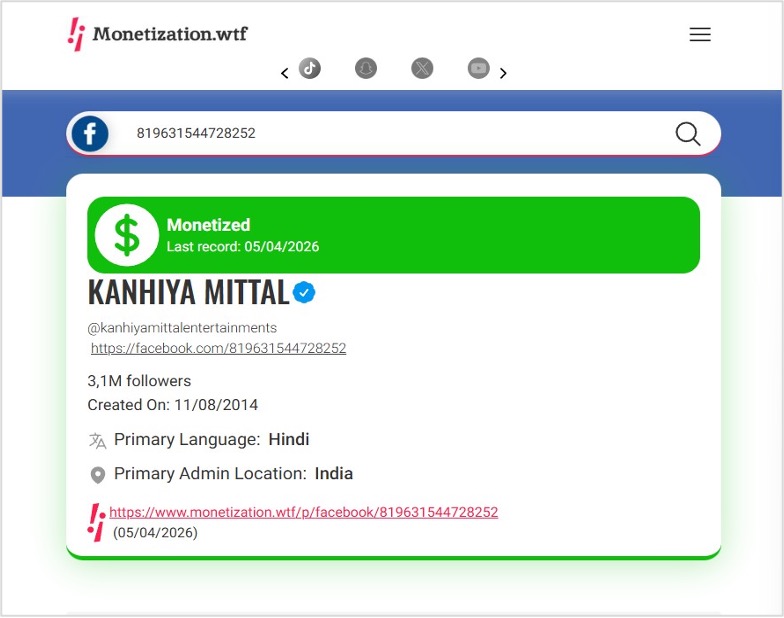
The Facebook profile of another popular H-pop singer, Prem Krishnavanshi,195 has 276,000 followers and is monetized as per the WTF Meta Monetization Archive. His official YouTube channel196 also appears to be monetized, given it has “Super Thanks” enabled for songs such as “370 Swaha, Mehbooba kare Aha Aha” (“370 is gone, Mehbooba goes ‘aha aha’) and “Khoon kaa badla khoon hi hoga” (“the revenge for blood will only be blood”).
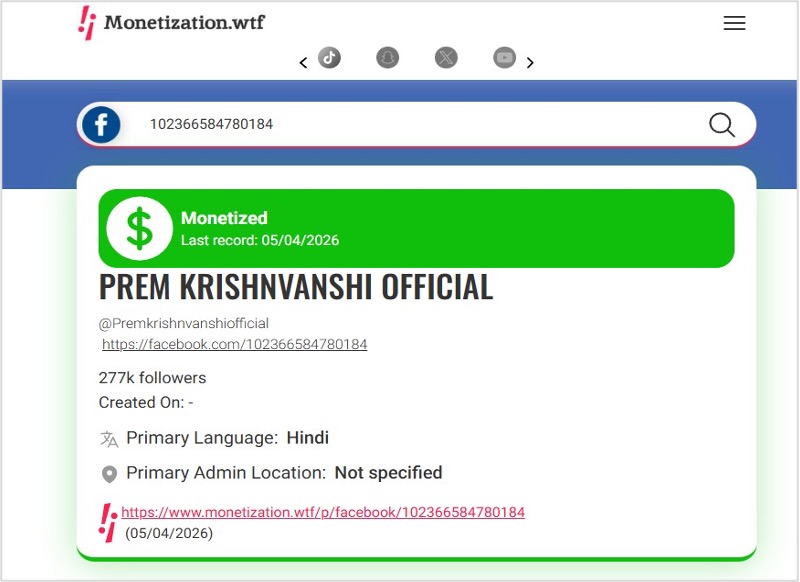
Other prominent monetized accounts include those of Kavi Singh, Ved Vyas, Shahnaaz Akhtar, and Rocky Mittal, who have shared hate songs on their Facebook account.
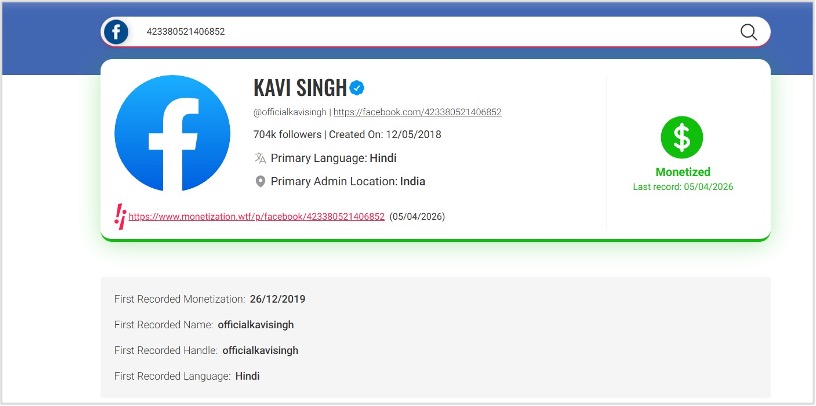
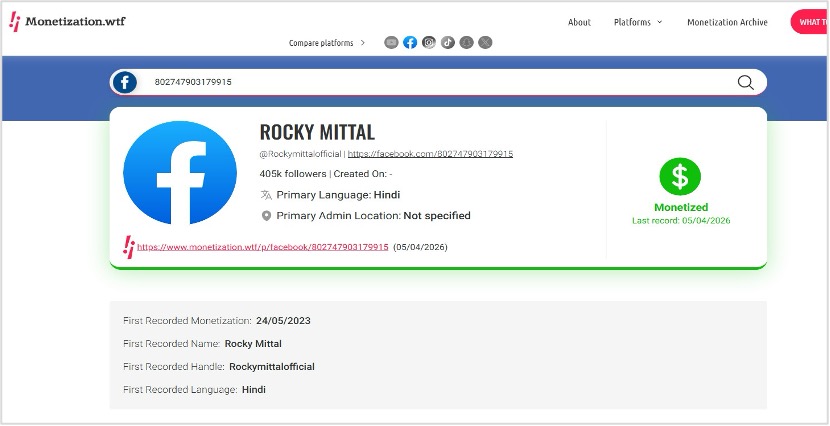
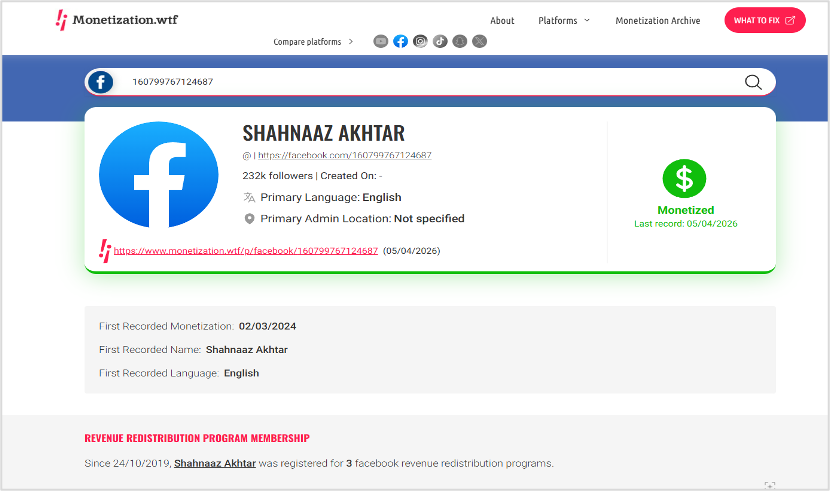
It is evident that major social media and streaming platforms have systematically failed to moderate hate-filled Hindutva pop music, even when such content was reported using the platform tools as discussed below. In doing so, they have continued to profit from user engagement with this harmful content while providing creators with opportunities to earn through advertising revenue, royalties, and fan funding.
YouTube continues to run advertisements on hateful music that dehumanizes religious minorities and actively calls for violence against them, despite violating its community guidelines and advertiser-friendly content guidelines. It also allows those enrolled in the YouTube Partner Program to retain a share of this advertisement revenue and earn through fan-funding in the form of premium subscriptions and “super thanks” features.
Meta, similarly, not only hosts hateful music in its Meta Music Library, making it available for use in Reels on Instagram, but also enables the sharing of revenue from such Reels with music rights holders. Moreover, the Facebook profiles of many popular Hindutva pop singers are monetized and earn a share of ad revenue.
Streaming platforms like Spotify and Apple Music also pay royalties to music rights holders from a pool of subscription revenue. While it is plausible that various Hindutva pop creators earn royalties through these platforms, the opacity of these systems makes it difficult to verify or quantify such earnings.
Advertisers, by contrast, represent a powerful stakeholder and a major source of revenue for both Meta and YouTube, yet they operate with limited transparency and are often unaware when their advertisements appear alongside content calling for violence against religious minorities. Advertising spend from numerous multinational and Indian corporations ultimately helps finance hateful music targeting communities that are increasingly vulnerable to mob lynchings, state persecution, and everyday discrimination in India.
Platform Reporting
The flourishing presence of Hindutva pop hate music across YouTube, Spotify, Apple Music, and Meta indicates a systemic failure of proactive content moderation. Despite explicit guidelines prohibiting this type of violative content, these platforms have allowed songs promoting hatred, dehumanization, and violence to accumulate hundreds of millions of views, generate millions of likes and shares, and reach vast audiences across India and potentially the global Indian diaspora, including in Europe, the U.K., the U.S., and Canada.
Evidence suggests that some of this failure is by design. Media reporting has documented that Meta declines to apply its hate speech policies against posts by the ruling Bharatiya Janata Party (BJP) leaders and affiliated Hindu nationalist organizations.197 Similar reporting has found that YouTube has ignored flagged hate speech on its platform.198 Rather than rely on prior reporting, however, we conducted a systematic test of the reporting mechanisms that each platform (YouTube, Meta Music Library, Spotify, and Apple Music) makes available to users wishing to flag violative content.
This exercise was designed to serve multiple purposes. The first was to assess the efficacy of these mechanisms, examining whether platforms’ reporting tools and moderation systems act on content in clear violation of their own policies. The second was to gauge their efficiency, including how straightforward or burdensome the reporting process is for ordinary users.
Of the 523 Hindutva pop songs identified in this study, 225 (43 percent) were reported to their respective platforms for violating hate speech policies. All reports were submitted between October and November 2025. By the end of April 2026, only 18 of the 225 reported songs had been removed, a takedown rate of just 8 percent. The remaining 92 percent stayed active despite having been formally flagged.
FIGURE 3. STATUS OF 225 HATE SONGS REPORTED ACROSS 4 PLATFORMS
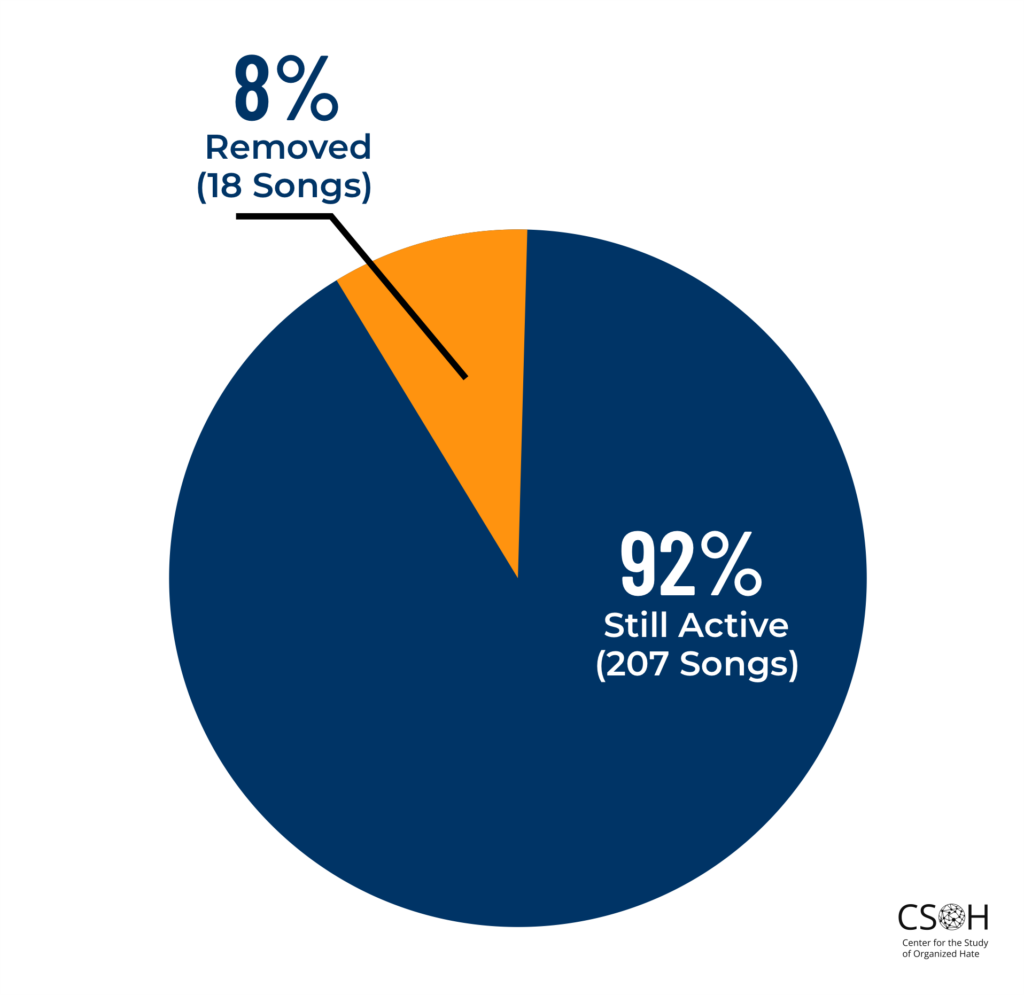
Of the 18 songs no longer available at the time of review, 13 were hosted on YouTube, 4 on Meta’s Music Library, and 1 on Apple Music. In at least 3 of the 10 YouTube cases, the songs had been “unlisted” by the uploaders themselves, which means that the songs “can be viewed and shared by anyone with a link”, according to YouTube Help.199 This suggests that YouTube’s own content moderation response was even more limited.
Reporting on YouTube
The largest portion of our dataset (210 of 523 songs) exists on YouTube, making the platform a primary focus of our reporting exercise. YouTube’s policies state that creators found to be repeatedly engaging in hate speech are subject to removal or penalty if they repeatedly target, insult, and abuse a group based on protected group status (e.g., religion) across multiple uploads, or if they create content that persistently incites hostility against a group with protected group status for personal financial gain.200
We reported 91 songs to YouTube, selected as a representative mix of songs that promote hatred, incite violence, or a combination of these, targeting religious minorities and Muslims in particular.
The Process
Of the four platforms, YouTube offers the most straightforward and accessible reporting mechanism for users wishing to flag violative content. A three-dot icon displayed beneath every video opens a window through which users can report violative content in a single click. YouTube also sends a confirmation email when a report is submitted, allowing users to track the status of their report over time. For users unfamiliar with the option, however, the function can be difficult to locate, and YouTube should display the reporting function more prominently to ensure it is accessible to all users.
The Result
The relative ease of the reporting process did not translate into meaningful enforcement action. Of the 91 songs reported in mid-October 2025, only 13 were no longer available on YouTube by May 2026. In other words, 78 songs promoting hatred, dehumanizing communities, and inciting violence against religious minorities remained active after being formally reported to the platform.
Among the 13 songs that were actioned, at least 3 had been removed by the uploaders themselves rather than by the platform. These 3 had been “unlisted” by the uploaders which, according to YouTube help, means that the songs could still be “viewed and shared by anyone with a link”201.
In two cases—both different versions of the song “Tel Laga Do Dabur Ka, Naam Mita Do Babur Ka” (“Apply Dabur’s Oil, Wipe Babur’s Name”)—the videos had been taken down with the following message displayed: “This video has been removed for violating YouTube’s Terms of Service.” Clicking on the “Learn more” link directs the user to the platform’s Terms and Conditions page202, rather than providing any further detail about the specific category of violation.
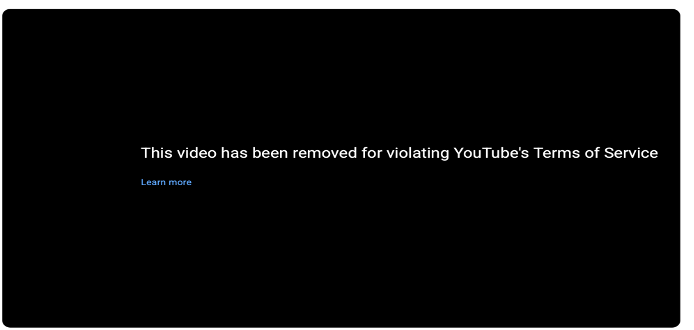
A significant incident during the reporting period was the termination of the YouTube channel of Sandeep Acharya, a prominent Hindutva pop figure known for songs promoting hatred and violence against Muslims. Although the platform terminated his channel, this action had a negligible practical effect: 24 of Acharya’s 26 songs in the dataset are hosted on other channels, with only 2 having been uploaded to his own. As a result, his music continues to circulate freely on YouTube despite the removal of his channel. As noted in section 3, however, Acharya created a new channel203 with content uploaded from August 2025 onward.
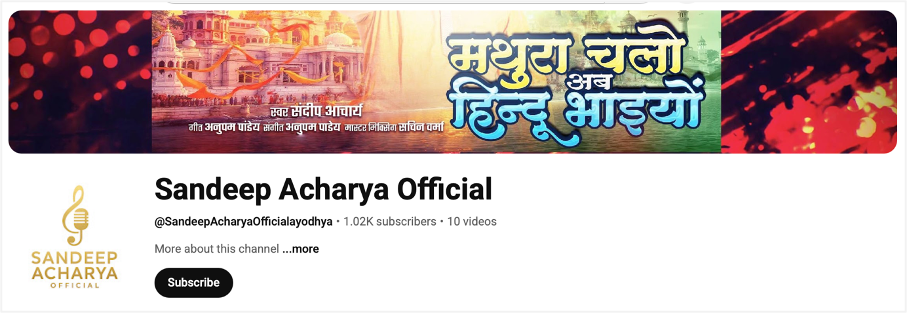
YouTube’s community guidelines impose escalating penalties on channels that repeatedly violate its policies, culminating in termination after three strikes. Yet the three channels most persistently responsible for hosting Hindutva hate music in our dataset—Sangam Dhun, Mayur Music, and Prem Krishnvanshi Official—continue to operate without any visible enforcement action. Whether any of these channels have previously received strikes or warnings from the platform remains unavailable to the public.
Reporting on Spotify
Although Spotify is the world’s largest audio streaming service, the platform does not have a streamlined process for users to report violative content. Of the 109 songs identified as violating Spotify’s hate content policies, we randomly selected and reported 59 – roughly half – through the platform’s online reporting mechanism.
The Process
Unlike YouTube, Spotify’s user interface offers no direct pathway for reporting violative content. Users must navigate multiple pages before arriving, through the platform’s FAQ section, at a brief note explaining how to report content. If simply locating this process is considered difficult, the act of actually reporting content is more-so.
Spotify requires users to complete an online form in order to flag content that violates its policies.204 Despite repeated attempts, the form consistently returned errors each time we tried to submit a report – the form would only offer one type of content to report which was something called “Canvas”. With no other option available to select, the website would throw up an error (in the picture below) when we tried to submit the information. We attempted to report songs across multiple devices, different browsers, and different locations, but the errors persisted throughout. In early October 2025, we subsequently contacted Spotify’s support team via live text chat to communicate the problem.
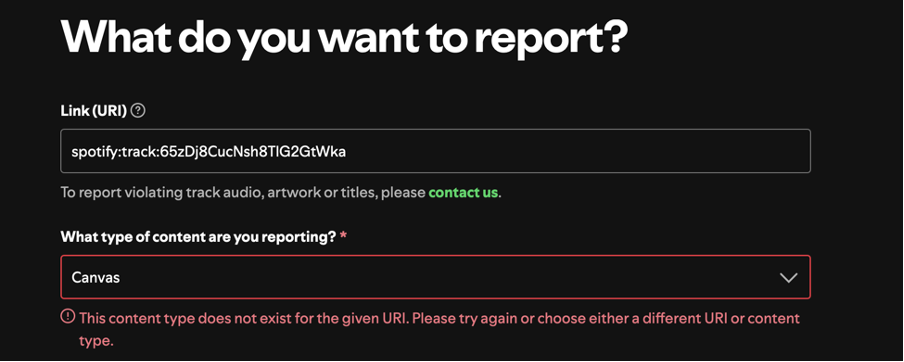
The process proved cumbersome: it took 33 minutes of chat communication to report a single song through a Spotify representative. The representative then offered to register all of the links we wished to report on our behalf and, over an hour later, confirmed via chat that our request had been logged.
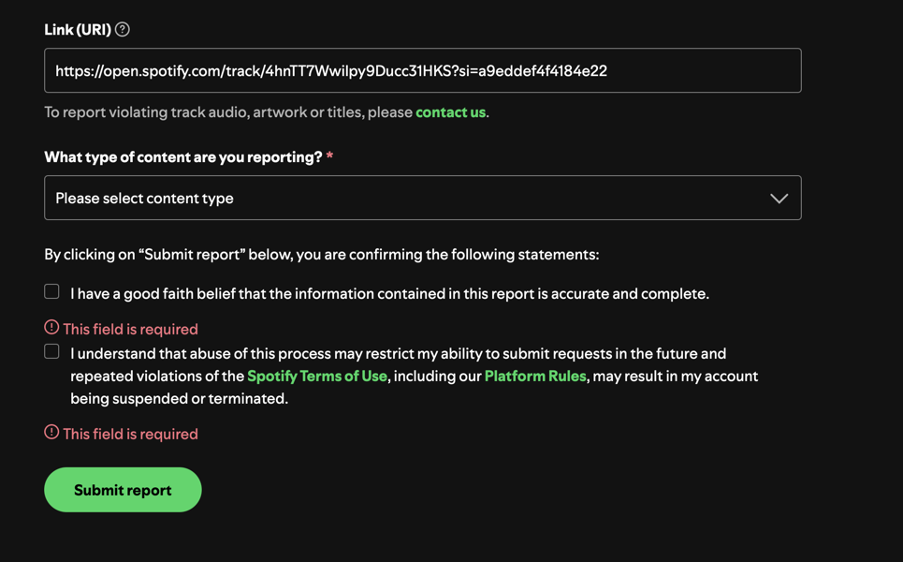
The Result
Despite registering our reports directly with Spotify representatives, the platform had taken no action against any of the 59 flagged songs by the end of May 2026. Beyond its largely inaccessible reporting mechanism and its failure to act on user reports, Spotify provides no straightforward means for users to check the status of a submitted report. Users who manage to navigate the process have no clarity over whether any action has been or will be taken.
Reporting on Apple Music
Apple Music is one of the largest and most widely available audio streaming services in the world, but, unlike the other three platforms, it maintains vague and limited regulations governing what content is permissible on its platform. It requires only that content be “legal” for the country or region in which it is accessed. Applying that standard, we identified 101 songs in conflict with varying Indian laws on hate speech, including songs that stoke hatred and incite violence against Muslims. Of these, 34 were flagged through Apple Music’s reporting mechanism.
The Process
Apple Music’s interface offers no straightforward option for users to flag violative content. Users are instead directed to the Apple Support page, where relevant guidance is not readily apparent. A search on the internet finally led us to a ‘Feedback’ form on Apple’s website, meant for users to report any feedback on the content on Apple Music.205 Consequently, we initiated a live chat with an Apple Music representative who confirmed that we needed to fill out the form to report any such content. The form is cumbersome,206 and the effort required to find and navigate it would likely deter most users from completing it. Individual reports were filed separately for each of the 34 songs, after which we were informed that we would receive email notifications if Apple Music took any action in response. No email updates have been received as of the publishing of this report.
The Result
Of the 34 songs reported in early November 2025, 33 remain active on the platform as of May 2026. One song is no longer available, though the reason for its removal is not clear and cannot be attributed with certainty to any action taken by Apple Music in response to our request.
Reporting on Meta
Meta’s Music Library is a critical vehicle for the dissemination and amplification of Hindutva pop music, with songs often used to create Instagram Reels. We found 103 songs that violate the platform’s community guidelines by promoting or glorifying hate speech and inciting real-world harm. These songs were collectively used to create over 5.9 million Reels. 46 songs specifically contained explicit calls to violence against Muslims and were used to create over 1.4 million Reels. As such, our reporting process focused on Reels given their reach, and did not include other Meta products.
The Process
Meta’s reporting mechanism on Instagram is the most straightforward of the four platforms, although reporting Reels containing violative songs is not always a clear or consistent process.
Instagram’s search function includes the categories for search results: For you, Profiles, Audio, Tags, and Places. A user must search a song in the search function, then select ‘Audio’ to find the official song listed. For popular songs, this displays a feed of Reels that have used the song in posts, and the user can click on the three-dot icon at the top of the page to report the song directly. However, this feature appears to be mostly available for popular songs and not for songs that are less well-known. Instagram does not disclose whether there is a threshold for the number of Reels using a song in order to qualify for the reporting mechanism. For searching lesser-known songs, options are limited to: Share, Set as profile song, Copy link, and QR code. A report feature is not always available. Nonetheless, this did not prove consistent with our testing, as even songs with one Reel had the report feature enabled.
The only official information provided by Meta to report a song is to “report a song while adding music to what you’re sharing on Instagram.”207 Yet, this reporting mechanism applies in the instance of a user who is adding music to a created post and wishes to report the song. Consequently, there is no option to report some songs via the search function, even if ‘Audio’ is selected, nor via Reels.
Alternatively, users can report a Reel by clicking on a three-dot icon on the side of the post and selecting the “report” function, then selecting the category of violation, and submitting a report. This is the method we selected for our reporting as it was the only consistent option available, despite the limitations of this approach.
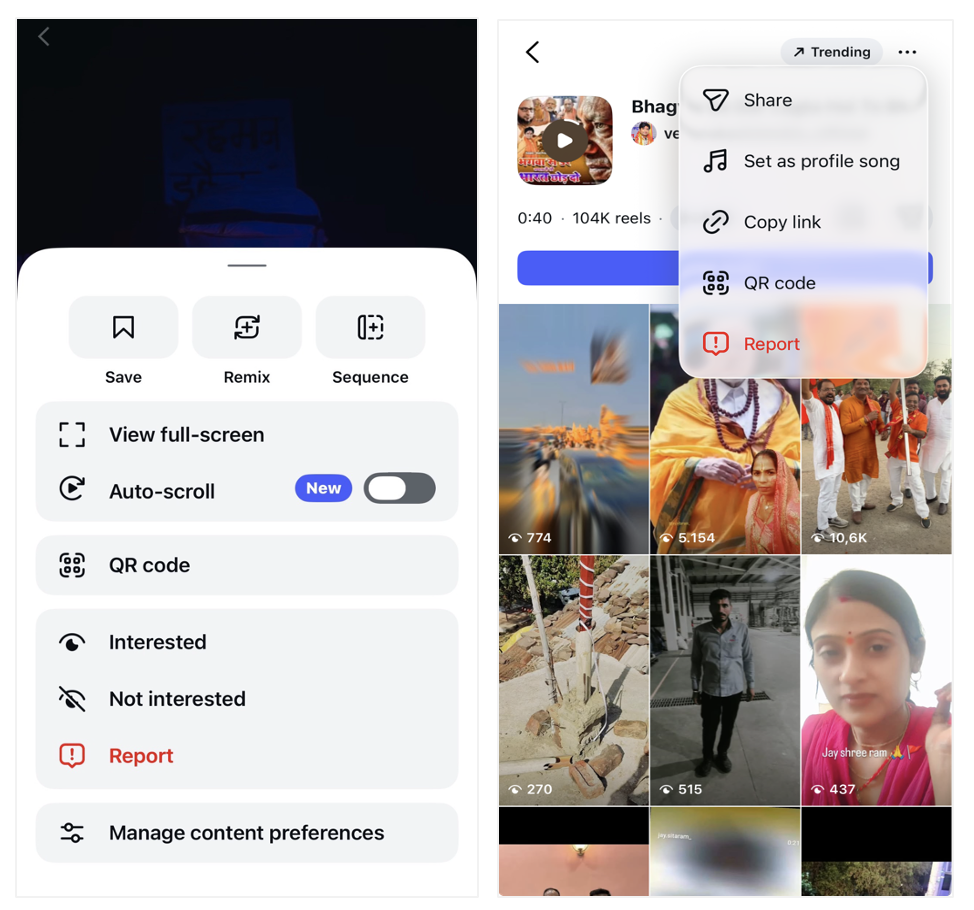
The Result
As with the other platforms, the relative ease of the reporting process on Meta did not translate into meaningful enforcement. In October 2025, we reported 41 Reels containing songs that violate Meta’s community guidelines. As of April 2026, 37 of these 41 Reels remained active on the platform.
It is unclear whether the four Reels that are no longer available had been removed as a result of Meta enforcement action, or had been taken down by the artists or uploaders. Unlike YouTube, which specifies when content has been removed by the platform for violating its Terms of Service, the pages for these four Reels display a generic message stating that the link is broken or the page has been removed, without indicating the reason for their unavailability or which entity removed them.
Although images or videos in Reels may not contain violative content, the use of audio that has a violative component signals a major blind spot in Meta’s content moderation system: the platform does not recognize the use of violative music in Reels despite being reported for review. The ability for a user to specify which component in a Reel is violative must be included in the reporting mechanism.
Conclusion
This report documents, for the first time, the scale and reach of Hindutva pop hate music across the world’s four largest digital platforms—Spotify and Apple Music as licensed catalogs, YouTube as a video host, and Meta’s Music Library as soundtrack audio for Instagram and Facebook. The 523 songs identified across these services represent a structured and thriving ecosystem of hate, one that the platforms have allowed to flourish largely unchecked despite their own stated prohibitions.
The findings are stark. On YouTube alone, 210 songs promoting hatred and violence against Muslims and other religious minorities have been viewed over 198 million times. On Meta, 103 violative songs were used to create more than 5.9 million Reels, each multiplying the original content’s reach through shares and algorithmic amplification. Spotify and Apple Music, while offering less visibility into engagement data, host a combined 210 songs that violate their respective content policies. Across all four platforms, these songs call for the extermination of Muslims, threaten to demolish mosques, deploy slurs, dehumanization, propagate dangerous conspiracy theories, and urge Hindus to take up arms for religious war.
The role of digital platforms in sustaining and incentivizing the production of such hate music cannot be overstated. Three YouTube channels alone account for nearly 40 percent of the Hindutva pop music on the platform, yet continue to operate and grow without any visible enforcement. Artists whose channels have been terminated simply create new ones and resume uploading songs.
YouTube not only fails to act on hate music but also profits from its dissemination. We documented advertisements from over 100 brands appearing on approximately 78 percent of the hate videos in the study. Furthermore, YouTube offers direct and indirect monetization opportunities to creators of these songs: 54 percent of the songs had the “Super Thanks” feature enabled, allowing creators to receive crowdfunding on the platform. Five channels hosting violative content also had premium subscriptions enabled for viewers to purchase monthly memberships. An aforementioned channel hosting violating content was even rewarded by the platform with a Creator Award, which it displays prominently as validation. While YouTube states that “each channel is carefully reviewed to make sure the criteria is met”208 to receive an award, the criteria include compliance with the platform’s Terms of Service, such as Community Guidelines, which the channel in question routinely violates.
Audio streaming services Spotify and Apple Music similarly enable hate music creators to earn royalties from the streaming of their songs. Meta offers royalties for songs featured in its Music Library that are subsequently used in Instagram Reels,209 while the Reel ecosystem simultaneously amplifies the reach of each song far beyond its original audience.
The result is that Big Tech platforms are not merely offering impunity to the creators of hate music who stoke hatred against religious minorities – they are among the most significant sources of financial patronage for these artists. Media reporting on this ecosystem has shown that royalties from all four platforms serve as a crucial means of financial sustenance for Hindutva pop artists, enabling them to invest further resources in their music.210
Beyond the financial dimension, these platforms function as powerful disseminators, multiplying each artist’s reach. Such virality carries its own additional rewards as online popularity transforms hate music artists into influencers, opening further monetization opportunities, and encouraging others to emulate their model.211 In this digital ecosystem, hate is not merely permitted, it is incentivized.
Our systematic testing of platform reporting mechanisms further revealed failures at every stage: from inaccessible, broken, and inconsistent reporting tools, to perfunctory responses, to near-total inaction on flagged content. Of the 225 songs formally reported across all four platforms, over 92 percent remained active months later.
The overall effect is a self-reinforcing ecosystem in which hateful rhetoric and violent threats against religious minorities are encouraged, rewarded, and largely free from scrutiny or consequence. In present-day India, where the state has consistently enabled political hate speech and emboldened hate actors,212 such an ecosystem ensures that digital platforms become mirrored spaces of hate targeting religious minorities. Where Hindutva pop hate music has flourished, religious minorities must endure constant dehumanization, threats of extermination, and incitement to brutal violence that saturate their digital environments. This has severe offline consequences as well, in which such music played by Hindu nationalists during religious processions creates an environment of fear and encourages the public spectacle of violence.213 Increasingly, platforms hosting Hindutva pop hate music become complicit in instances of offline violence, where users are initially exposed to content produced by artists that is subsequently normalized and used as entertainment at the expense of religious minorities.214 This music has already caused real-world violence against minority communities, and addressing this crisis demands urgent, coordinated accountability, from platforms, regulators, and civil society alike, before the violence that hate music incites continues to translate into further bloodshed and harm.
Recommendations
- Effective Enforcement of Platform Guidelines: With the exception of Apple Music, platforms YouTube, Spotify, and Meta have published guidelines prohibiting hateful content. Yet, based on our reporting to platforms, all have failed to meaningfully enforce their own policies. Hate speech that discriminates on the basis of religion, content that dehumanizes communities, and material that promotes or incites violence continues to proliferate. Platforms must invest meaningfully in consistent and proactive enforcement of guidelines.
- Identifying and Acting Against Repeat Offenders: Each platform hosts content from artists and channels that have committed multiple repeated violations of hate speech guidelines. On YouTube, for instance, the channel Sangam Dhun hosts 46 songs that incite hatred and threaten violence against religious minorities, yet the channel not only continued to operate throughout the period of this study, but gained nearly 13,000 new subscribers between mid-2025 and January 2026. This directly contradicts YouTube’s own stated policy of suspending or terminating accounts that repeatedly violate its community guidelines. All platforms must identify repeat offenders systematically and apply escalating consequences, including demonetization, consistently, in accordance with their own published rules.
- Identifying the Evolving Language of Hate: In order to evade platform scrutiny, online hate actors, including Hindutva pop artists, continuously adapt the language through which they refer to their targets. In the Indian context, religious minorities are described in coded terms, such as “snakes,” “topi waale” (skullcap wearers), “traitors,” and “anti-national”: language that is understood by intended audiences while remaining difficult for automated moderation systems to detect. Platforms must respond to this challenge by training automated content moderation tools in low-resource languages, while supplementing these tools with oversight from context-informed human moderators capable of identifying and flagging such coded language in order to keep pace with the continuously evolving vocabulary of hate. Additionally, platforms must engage with civil society and research organizations with subject matter expertise on how hate manifests in the Indian context, in order to keep pace with the evolving language and coded terms used to target religious minorities.
- Moderation with Intent: In the rare instances where platforms have taken action against hate music, the response has been partial and ultimately ineffective. YouTube deplatformed singer Sandeep Acharya’s channel multiple times, yet his hate songs remain hosted on other channels. Of the 26 Acharya songs that violate YouTube’s guidelines, 21 continue to be available on the platform. Effective moderation requires platforms to pursue content-level enforcement in combination with account-level action, ensuring that violating material is removed wherever it is hosted, rather than only from the primary account of the creator responsible.
- Strengthened Oversight and Enforcement in Meta Music Library and Reels: Meta must implement proactive detection and enforcement mechanisms within the Music Library and Reels ecosystem to identify and remove audio content that promotes hate speech, incites violence, or glorifies real-world harm. This includes auditing and removing high-risk audio tracks, limiting the reuse of flagged content across Reels, and preventing algorithmic amplification of such violative content. Meta must also ensure that once a piece of audio is identified as violating policy, all derivative uses, including Reels created using that audio, are reviewed and subject to moderation enforcement.
- Easier Reporting Mechanisms and Responsiveness: The accessibility of content reporting mechanisms varies significantly across the four platforms examined in this report. YouTube and Meta offer relatively simple reporting processes requiring only a few clicks, though both platforms would benefit from displaying the reporting function more prominently so that it is accessible to all users. Spotify and Apple Music, by contrast, offer no straightforward reporting pathway. In both cases, extensive searching and navigating was required before a reporting mechanism could be located. Apple Music’s process requires users to complete a lengthy form, while Spotify’s only reporting channel is a live chat with a support representative – a process so time-consuming that it took more than half an hour to report a single song. The latter two must invest in reporting mechanisms that are simple, visible, and accessible to ordinary users across local languages. The lack of response to submitted reports was an additional challenge. Of the four platforms, only YouTube sent a confirmation email acknowledging receipt of reports and provided a tracker through which users could monitor the status of their submissions. Spotify, Apple Music, and Meta provided no confirmation or follow-up, requiring a manual revisit to each reported song link to determine whether any action had been taken. This failure of acknowledgment reflects a fundamental disregard for users who flag harmful content, as well as a broader unwillingness on the part of platforms to be held accountable for the adequacy of their moderation efforts. All platforms must establish clear, transparent, and timely mechanisms for communicating with users who report violations, including acknowledgment of receipt, updates on the status of reports, explanation of any action taken or not taken in response, and the grievance redressal mechanisms available to challenge platform decisions.
- Periodic Transparency Reporting: Platforms must provide a system-level overview of content moderation in the form of periodic transparency reporting. Typically, major social media platforms have voluntarily provided such statistical aggregate information in transparency reports on enforcement of their community guidelines and terms of service,215 although more granularity on specific types of content actioned is needed.216 Streaming platforms like Apple Music and Spotify should also publish periodic transparency reports, which disclose aggregate information on actions taken (e.g., content takedown, account restrictions, visibility restrictions, demonetization) based on their own initiative/proactive moderation, user reports, reports by trusted flaggers (if any), and state orders for takedowns, broken down by the category of violative content and language of the content. Spotify has been publishing transparency reports for the European Union in compliance with the Digital Services Act (DSA) and Terrorist Content Online Regulation (TCO) since 2024.217 However, no such reporting is available for India. Similarly, while Apple does provide some form of transparency reporting, mostly focused on the App Store, specific reporting for Apple Music is largely absent. It is also important to note that while YouTube and Meta publish voluntary transparency reports and those mandated under the Information Technology (Intermediary Guidelines and Digital Media Ethics Code) Rules, 2021,218 this limited information disclosure, in itself, is not meaningful to hold platforms effectively accountable. Platforms must also disclose information on the efficacy of automated moderation tools in Indian languages and the diversity of trained human moderators across local languages.219 Platforms must go beyond aggregate numbers and provide more qualitative information on the internal processes they follow and the safeguards in place for identifying and acting on hateful content.
- Accountability for Recommendation Algorithms: The algorithmic amplification of hate music through opaque recommender systems of social media and music streaming platforms needs urgent scrutiny. Platforms must subject themselves to independent third-party algorithmic audits and collaborate with independent researchers to understand how platform design, specifically personalization and recommendation, might amplify hateful content. This is important as very little is known about the nature and impact of proprietary music recommendation algorithms.220 Similarly, even though limited independent studies exist on the amplification of hateful content by social media recommendation algorithms, few explore the Indian socio-political context and local languages. Furthermore, in the long-term, platforms must collaborate and consult with external experts, independent artists, and users, especially from historically marginalized communities in different languages, to develop alternative models that prioritize creativity and public interest over profit and engagement.
- Transparency in the Music Streaming Ecosystem: Unlike social media platforms such as YouTube, where users upload content directly, streaming platforms like Spotify and Apple Music rely on third-party music aggregators and distributors to serve as intermediaries for independent music creators. There exists very limited public information on the editorial and content moderation practices followed by these aggregators in screening and distributing user-generated music. Aggregators may also publish their own terms of service.221 However, there is no transparency on the internal processes followed, and the effectiveness and fairness of the enforcement of their terms of service. Streaming platforms provide little transparency into their internal processes and safeguards while curating content from aggregators. Furthermore, the lack of public information on monetization of hateful speech on streaming platforms is complicated by the confidential contracts between aggregators and streamers, as well as between music creators and aggregators.
- Transparency in Monetization on Social Media Platforms: Social Media platforms distribute billions of advertisement revenue dollars to millions of content creators in relative opacity.222 Even though platforms lay down eligibility conditions for partnership programs and content guidelines for advertisement suitability, the study documented widespread monetization of hateful and violent content in violation of platforms’ own policies. All Platforms must publicly disclose historical information on monetization partnerships, including details of the entity behind the account and the amount received by the entity over time.223 Meta is currently the only social media platform to provide a public list of monetized accounts, but financial information and details of legal entities behind the accounts are still absent.224 Furthermore, platforms provide no meaningful information on the internal processes followed and safeguards in place to govern monetization decisions. Such information, including the number of human reviewers involved in the oversight of automated monetization decisions, is especially in local languages and trained in local contexts should be periodically reported. Platforms must collaborate with independent researchers and civil society to understand the risks that their recommendation and monetization systems pose to the online information ecosystem and the safety of vulnerable and marginalized communities. Advertisers must also demand accountability from platforms in the enforcement of their community guidelines and transparency on ad placement.
Endnotes
1. Report 2025: Hate Speech Events In India (India Hate Lab, 2025), https://www.csohate.org/wp-content/uploads/2026/01/Hate-Speech-Events-in-India-2025-3.pdf.
2. “What Is Hate Speech?,” United Nations, United Nations, https://www.un.org/en/hate-speech/understanding-hate-speech/what-is-hate-speech.
3. Kunal Purohit, “How Hindutva Pop Music Is Giving Hate a Soundtrack,” Books, Frontline, November 20, 2023, https://frontline.thehindu.com/books/how-hindutva-pop-music-is-giving-hate-a-soundtrack/article67553452.ece.
4. James Windle and Clara Schenk, “The Origins of White Power Music: The Co-Opting of Punk and Oi! By a Parasitical Social Movement,” Deviant Behavior 46, no. 10 (2025): 1329–45, https://doi.org/10.1080/01639625.2024.2380738.
5. “A Case Study on White Supremacist Music,” Johns Hopkins Sheridan Libraries & University Museums, https://exhibits.library.jhu.edu/omeka-s/s/white-supremacist-music/page/welcome.
6. Windle and Schenk, “The Origins of White Power Music.”
7. Brian Whelan, “Ian Stuart Donaldson and a Legacy of Hate,” Channel 4 News, September 24, 2013, https://www.channel4.com/news/ian-stuart-donaldson-a-legacy-of-hate.
8. Ugo Corte and Bob Edwards, “White Power Music and the Mobilization of Racist Social Movements,” Music and Arts in Action 1, no. 1 (2008): 4–20, http://musicandartsinaction.net/index.php/maia/article/view/whitepowermusic.
9. “Hate Music,” Southern Poverty Law Center, https://www.splcenter.org/resources/extremist-files/hate-music/.
10. Robert H. Synder, “Disillusioned Words like Bullets Bark: Incitement to Genocide, Music, and the Trial of Simon Bikindi,” Ga. J. Int’l & Comp. L. 35 (2006): 645, https://digitalcommons.law.uga.edu/cgi/viewcontent.cgi?referer=&httpsredir=1&article=1175&context=gjicl.
11. Heather MacLachlan, “Music and Incitement to Violence: Anti-Muslim Hate Music in Burma/Myanmar,” Ethnomusicology 66, no. 3 (2022): 410–42, https://doi.org/10.5406/21567417.66.3.05.
12. Claude Chastagner, “Hate Music,” Transatlantica. Revue d’études Américaines. American Studies Journal, no. 2 (2012), 2, s.p. ⟨hal-03062595⟩,https://hal.science/hal-03062595/document.
13. Mayank Kumar, “From ‘Offensive Songs’ to Lathi-Charge & Killing, How Communal Violence Flared up in UP’s Bahraich,” The Print, October 25, 2024, https://theprint.in/india/from-offensive-songs-to-lathi-charge-killing-how-communal-violence-flared-up-in-ups-bahraich/2327438/.
14. Kunal Purohit, “41 Incidents In 9 Months: Urged On By BJP Leaders, Maharashtra Has Emerged As India’s Communal Tinderbox,” Article 14, October 25, 2023,https://article-14.com/post/41-incidents-in-9-months-urged-on-by-bjp-leaders-maharashtra-has-emerged-as-india-s-communal-tinderbox-65389139d2591.
15. Sheikh Saaliq, “In India, Hate-Filled Songs Are a Weapon to Target Muslims,” AP News, April 22, 2022, https://apnews.com/article/religion-india-violence-hindu-muslim-bf516bc2fbc0834c5822901f46c5d716.
16. “WHAT TO FIX Meta Monetization Archive,” Monetization.Wtf, https://www.monetization.wtf/about/license/.
17. Robert Booth, “Revisions of ‘Hateful Conduct’: What Users Can Now Say on Meta Platforms,” Technology, The Guardian, January 8, 2025,https://www.theguardian.com/technology/2025/jan/08/permitted-hateful-conduct-what-users-can-now-say-on-meta-platforms.
18. Nico Grant and Tripp Mickle, “YouTube Loosens Rules Guiding the Moderation of Videos,” Technology, The New York Times, June 9, 2025,https://www.nytimes.com/2025/06/09/technology/youtube-videos-content-moderation.html.
19. Kurt Wagner, “Meta to Reduce Role of Outside Content Moderators in Favor of AI,” Bloomberg, March 19, 2026, https://www.bloomberg.com/news/articles/2026-03-19/meta-to-reduce-role-of-outside-content-moderators-in-favor-of-ai.
20. Ananya Bhattacharya, “Global Fact-Checkers Were Disappointed, Not Surprised, Meta Ended Its Program,” Rest of World, January 10, 2025,https://restofworld.org/2025/meta-drops-fact-checking-partnerships-global-watchdogs-scramble/.
21. “YouTube Statistics 2026 [Users by Country + Demographics],” Global Media Insight, May 14, 2026, https://www.globalmediainsight.com/blog/youtube-users-statistics/.
22. “YouTube Statistics 2026 [Users by Country + Demographics].”
23. “Hate Speech Policy,” YouTube Help, https://support.google.com/youtube/answer/2801939?hl=en.
24. ChotuSingh Rawna,“Ram Mandir”, YouTube, November 21, 2023, https://youtu.be/syPDswxhaNs?si=XOxFwiqMOFEJIImx.
25. Ravi Malviya light, “Jo Bhi Aaya Saamne Usko Ram Kaa Jhanda Gaadenge”, YouTube, June 21, 2020, https://youtu.be/gQXBO_z605Q?si=qeYNZZYVt0zG0IZO.
26. Sangam Dhun,“Bhogol Hi Badal Jaayega”, YouTube, November 5, 2022, https://youtu.be/zUQiwcXR6TE?si=m_DcVc2phYvR-e6h.
27. Sangam Dhun, YouTube, https://www.youtube.com/@SANGAMDHUN.
28. Mayur Music, YouTube, https://www.youtube.com/@MayurMusicMM.
29. Prem Krishnvanshi Official, YouTube, https://www.youtube.com/@PremKrishnvanshiofficial.
30. Tom Newman, “Top 10 Music Streaming Platforms by Monthly Active Users in 2026,” RouteNote Blog, February 4, 2026, https://routenote.com/blog/music-streaming-monthly-active-users/; Felix Richter, “Infographic: Spotify Closes in on 700M Active Users,” Statista, February 7, 2025, https://www.statista.com/chart/15697/spotify-user-growth.
31. Ashley King, “Spotify Is Way Ahead of Apple Music in India, Latest Intel Shows — But Apple’s Bharti Airtel Deal Could Change That,” Digital Music News, September 3, 2024, https://www.digitalmusicnews.com/2024/09/03/spotify-apple-music-india-market-share-2024/.
32. “Spotify Removes ‘Hate Conduct’ Policy Following Backlash,” BBC News, June 2, 2018, https://www.bbc.com/news/newsbeat-44341720; “Spotify Policy Update,” Spotify, June 1, 2018, https://newsroom.spotify.com/2018-06-01/spotify-policy-update/.
34. “Safety and Privacy Center,” Spotify, https://www.spotify.com/us/safetyandprivacy/platform-rules.
35. Sandeep Acharya, “Ram Lala Ka Dham Hai”, 2022, streaming audio, Spotify, https://open.spotify.com/track/1EyeMFLrT1oL5HXM00sf4l?si=5cfc0f8e2311467f.
36. Kalki, “Hindu Chalisa”, 2022, streaming audio, Spotify, https://open.spotify.com/track/7vhaVFlG1xLJkDCzFjE0cO.
37. Khushboo Uttam, “Jago Hindu Jago”, 2018, streaming audio, Spotify, https://open.spotify.com/album/07Na0ghsqnan6DE8W97e0o?uid=64606cde1730944cdc57&uri=spotify%3Atrack%3A7rKb18Ky4qEwkDOaCuTWVl.
38. Gaurav Bittu Raja, “Band Hona Chahiye”, 2022, streaming audio, Spotify, https://open.spotify.com/track/4oYmcHGf559c7tBhJFZwbd?si=32d7331089af4be7&nd=1&dlsi=2b5aa19e410b4d7a.
39. Naveen Kumar, “How Many People Use Instagram in 2026 [Active Users Stats],” DemandSage, March 7, 2026, https://www.demandsage.com/instagram-statistics/.
40. “Hateful Conduct,” Meta Transparency Centre, https://transparency.meta.com/policies/community-standards/hateful-conduct/.
41. “Access to the Licensed Music Library on Instagram,” Instagram Help Centre, https://help.instagram.com/402084904469945/?cms_platform=www&helpref=platform_switcher.
42. DJ Prashant (@djprashanttt), “Bharat ka bacha bacha… 📢 Navratri day 4 💛”, September 30, 2022, Instagram reel, https://www.instagram.com/reel/CjGgRpoB3bk/?igsh=aWd1bmU3a2wwbjEz.
43. Raqib Hameed Naik et al., Streaming Violence: How Instagram Fuels Cow Vigilantism in India (Center for the Study of Organized Hate, 2024), https://www.csohate.org/wp-content/uploads/2024/11/How-Instagram-Fuels-Cow-Vigilantism-in-India.pdf.
44. Robert A. Lee, “Apple Music Statistics 2026: Growth Secrets Exposed,” SQ Magazine, January 15, 2026, https://sqmagazine.co.uk/apple-music-statistics/.
45. “Apple Music Style Guide 2.4,” Apple Support, https://help.apple.com/itc/musicstyleguide/en.lproj/static.html.
46. “Terms of Service,” Apple Music for Artists, https://artists.apple.com/read_terms.
47. Rapper Sohan Official and Rajesh Roy, “Love Jihad – Single”, 2023, streaming audio, Apple Music, https://music.apple.com/in/album/love-jihad-single/1691593284.
48. Special Correspondent, “‘Love Jihad’ Not Defined under Law, Says Centre,” India, The Hindu, February 5, 2020, https://www.thehindu.com/news/national/love-jihad-not-defined-under-law-says-centre/article30736760.ece.
49. Kunal Purohit, “In A Maharashtra Village, A Muslim Youth Who Led Ganpati Festivities Was Lynched By A Hindu Mob—Among Them His Friends,” Article 14, August 21, 2025, https://article-14.com/post/-in-a-maharashtra-village-a-muslim-youth-who-led-ganpati-festivities-was-lynched-by-a-hindu-mob-among-them-his-friends-68a6b06fb4f07.
50. Kunal Purohit, “Violent Reels to Morning Runs: Sambhaji Bhide’s Shadowy Hindutva Outfit Grows in Rural Maharashtra,” The Wire, September 22, 2025,https://thewire.in/communalism/violent-reels-to-morning-runs-sambhaji-bhides-shadowy-hindutva-outfit-grows-in-rural-maharashtra.
51. Kajal Singh, “Cheer Ke Rakh Denge”, 2020, streaming audio, Apple Music, https://music.apple.com/in/album/cheer-ke-rakh-denge-unko/1532703725?i=1532703893.
52. Sandeep Acharya, “Tel Laga Lo Dabar Ka (Bhakti) – Single”, 2018, streaming audio, Apple Music, https://music.apple.com/in/album/tel-laga-lo-dabar-ka-bhakti/1575324512?i=1575324513.
53. Suraj Sanwariya and Mukesh Sajan, “Naam Mitado Babar Kaa – Single”, 2023, streaming audio, Apple Music, https://music.apple.com/in/album/naam-mitado-babar-kaa/1679681652?i=1679681985.
54. Pawan Shukla, “Babar Ke Pillo Sun Lo Mera Yogi Sab Pe Bari Hai – Single”, 2023, streaming audio, Apple Music, https://music.apple.com/in/album/babar-ke-pillo-sun-lo-mera-yogi-sab-pe-bari-hai/1665060333?i=1665060616.
55. Avdhesh Kumar [@ImAvdheshkumar], “दुर्गा मूर्ति विसर्जन यात्रा में बजे इस गाने की वजह से बहराइच दंगों की चपेट में आ गया. उमेश कुमार सैनी ने पूरी पिक्चर क्लियर कर दी. इस एक गाने की वज़ह से पूरेक्षेत्र में मातम पसरा है. #BahraichVoilence #बहराइच_हिंसा @newslaundry @nlhindi #journalist https://t.co/cawbokkMzq,” Tweet, X, October 15, 2024,https://x.com/ImAvdheshkumar/status/1846298198383448172.
56. Rocky Mittal, “Samjho Love Jihad”, 2023, streaming audio, Apple Music, https://music.apple.com/us/song/samjho-love-jihad/1695003888.
57. Roy Razneesh, “Love Jihad”, 2024, streaming audio, Apple Music, https://music.apple.com/us/album/love-jihad-single/1724018549.
58. Lakshmi Narayan, “दुर्गा बन तू काली बन, कभी न बुर्के वाली बन…धीरेंद्र शास्त्री का नया बयान, जानिए उन्होंने ऐसा क्यों कहा,” News18 हिंदी, August 4, 2025,https://hindi.news18.com/news/dharm/durga-ban-tu-kali-ban-kabhi-na-burke-wali-ban-dhirendra-shastri-new-controversy-on-love-jihad-statement-ws-n-9475429.html.
59. ABP News Bureau, “Karnataka Govt Issues Order Amid Hijab Row, Says Uniform That Affects Harmony Must Be Banned,” ABP Live, February 5, 2022,https://news.abplive.com/karnataka/karnataka-govt-issues-fresh-order-amid-hijab-row-says-uniform-that-affects-harmony-must-be-banned-1511101.
60. “India: Chief Minister’s Removal of Woman’s Hijab Demands ‘Unequivocal Condemnation,’” Amnesty International, December 16, 2025,https://www.amnesty.org/en/latest/news/2025/12/india-chief-ministers-removal-of-womans-hijab-demands-unequivocal-condemnation/.
61. Bhakti Mala, “Mere Bharat Ka Baccha Baccha Jai Shri Ram Bolega”, YouTube, November 13, 2023, https://www.youtube.com/watch?v=vOpkyoLnj2w.
62. Halchal Music World, “Topi Wala Sar Jhuka Ke Jai Shri Ram Bolega”, YouTube, March 30, 2023, https://youtu.be/Zx1qi0VZxpc?si=3SGhvkjYP_Ho1wl8.
63. Prachyam, “Tel Laga Ke Dabur Ka, Naam Mita Do Babur Ka”, YouTube, May 27, 2020, https://www.youtube.com/watch?v=q_UF8_Sq138.
64. Biru Kataria, “Gau Mata”, YouTube, January 13, 2026, https://youtu.be/zn1X4VA7l0I?si=1Xgu53rfQLbdTLX4.
65. Haryanvi music studio 0, “Jai Gau Mata”, YouTube, October 10, 2023, https://www.youtube.com/watch?v=8AWuGVZ6968&list=RD8AWuGVZ6968&start_radio=1.
66. Mental Music Haryana, “Gau Mata”, YouTube, September 25, 2025, https://www.youtube.com/watch?v=pFbPAvCJd-I&list=RDpFbPAvCJd-I&start_radio=1.
67. Sangam Dhun,“Cheer Ke Rakh Denge”, YouTube, October 1, 2022, https://youtu.be/0jMF_MXMZTU?si=uLDNL21rVsOTtDqj.
68. Sangam Dhun, “Laaton Ke Bhoot Kabhi Baaton Se Na Mante Hai”, YouTube, November 5, 2024, https://youtu.be/YR_HmeXgPUI?si=j28f_0zGMmPS9xnL.
69. Sangam Dhun, “Jis Din Mere Yogi Delhi Mein Dahadenge”, YouTube, August 21, 2023, https://youtu.be/tCj_E3bYJy4?si=qtPgYNEpS32t79Hn.
70. Mayur Music, “Taj Mahal Nahin Tejo Mahalaya”, YouTube, September 13, 2020, https://youtu.be/PCii01YdtPY?si=uvxwqALCWEdEMkwZ.
71. Siraj Qureshi, “Taj Mahal a Tomb, Not a Shiva Temple: ASI,” India Today, February 20, 2018, https://www.indiatoday.in/india/story/taj-mahal-a-tomb-not-a-shiva-temple-asi-1173962-2018-02-20.
72. Sangam Dhun, “Gaddaro Ko Sabak Sikhana Hai”, YouTube, January 26, 2022, https://www.youtube.com/watch?v=cNn-GVvA-G0.
73. MBD Music World, “Awadh Dham Mein Math Hai Hamara”, YouTube, December 12, 2022, https://youtu.be/EjNwu88TkCU?si=iu87N3PRdn3cDJTs.
74. Kavi Singh, YouTube, https://www.youtube.com/@kavisinghofficial6501.
75. Kavi Singh, “Dhara 30”, YouTube, July 5, 2022, https://www.youtube.com/watch?v=fxgMh5zBjsk&list=RDfxgMh5zBjsk&start_radio=1.
76. Nisha Pandey Official, “Jaago Neend Se Hindu Veeron”, YouTube, August 28, 2024, https://youtu.be/G62gqSHDH84?si=97gp_ep2Lloo1h0K.
77. “Religious Minorities in India Suffer Escalating Attacks,” USCIRF, February 6, 2026, https://www.uscirf.gov/news-room/releases-statements/religious-minorities-india-suffer-escalating-attacks.
78. Kunal Purohit, “As Hate Spirals in India, Hindu Extremists Turn to Christian Targets,” Al Jazeera, January 14, 2026, https://www.aljazeera.com/features/2026/1/14/as-hate-spirals-in-india-hindu-extremists-turn-to-christian-targets.
79. Kunal Purohit, “As Hate Spirals in India, Hindu Extremists Turn to Christian Targets.”
80. Sangam Dhun, “Odh Ke Bhagwa Chola Ailan Karte Hai”, YouTube, October 9, 2022, https://youtu.be/EFGJFo71hLg?si=h5I-BmRR60FkjNzs.
81. Deep Shree Entertainment, “Yachna Nahi Ab Rann Hoga”, YouTube, May 1, 2024, https://youtu.be/Iz7HtZtK1xg?si=oAoCWtbYcso5MfYQ.
82. Prem Krishnvanshi official, “Krishna Lalla Hum Aayenge, Mandir Wahin Banayenge”, YouTube, September 12, 2020, https://www.youtube.com/watch?si=yA1O7ynDoaoxXUaw&v=qm7AXJtSYBE&feature=youtu.be.
83. “Mandiron ke Nishan”, YouTube, https://web.archive.org/web/20231013151733/https://www.youtube.com/watch?v=4tNgbBaFEzY.
84. Sandeep Acharya, “Mandiron ke Nishan”, 2023, streaming audio, Apple Music, https://music.apple.com/in/album/mandiron-ke-nishan/1704942597?i=1704942598.
85. Sangam Dhun, “Ayodhya Hui Hamari, Kashi Mathura Ki Baari Hai”, YouTube, January 11, 2022, https://youtu.be/h0sS3Pr8wfk?si=yMNgy3Q-wC_myreg.
86. Mayur Music, “Jahaan Jahaan Baitha Hai Khuda Waha Khudai Hogi”, YouTube, May 17, 2022, https://youtu.be/1hfBj6buSqE?si=-PCczn3-luIzIbQk.
87. ET Online, “Gyanvapi Case: What Is the History, Significance and Timeline of the Case?,” The Economic Times, January 31, 2024,https://economictimes.indiatimes.com/news/how-to/gyanvapi-mosque-case-what-is-the-history-significance-and-timeline-of-the-case/articleshow/107165807.cms?from=mdr.
88. “Haji Malang: The Sufi Shrine Caught up in a Religious Row in Mumbai,” BBC News, January 28, 2024, https://www.bbc.com/news/world-asia-india-68090708.
89. AN Music Official, “Malang Gadavar Samadhi Machindranathanchi”, YouTube, February 8, 2024, https://youtu.be/-5gRbojRR78?si=NLGDZ2tqrVGicXj-&t=92.
90. Bharatiya Nyaya Sanhita, 2023, sec. 196, https://devgan.in/bns/section/196/.
91. Bharatiya Nyaya Sanhita, 2023, sec. 299, https://devgan.in/bns/index.php?q=299&a=10.
92. Gaurav Bittu Raja, “Tod Tod Kar Mandir Saare Masjid Bahut Banaye Tum”, YouTube, December 16, 2024, https://www.youtube.com/watch?v=sNcSmb_5YtI.
93. Prem Krishnvanshi official, “Asteen Ke Saanp”, YouTube, June 11, 2022, https://www.youtube.com/watch?v=Ci6VPNjDI_o.
94. Sukumar Mahato, “20-Year-Old Bengali Migrant ‘Branded as Bangladeshi’ Lynched in Odisha,” The Times of India, December 26, 2025,https://timesofindia.indiatimes.com/city/kolkata/20-year-old-bengali-migrant-branded-as-bangladeshi-lynched-in-odisha/articleshow/126182316.cms.
95. “Bengal Migrant Allegedly Killed in AP after Being Labelled Bangladeshi; Another Worker Found Dead in Chennai,” Maktoob, January 24, 2026,https://www.maktoobmedia.com/post?id=112192&slug=bengal-migrant-allegedly-killed-in-ap-after-being-labelled-bangladeshi-another-worker-found-dead-in-chennai.
96. Jugni Series Cassettes, “Pakistan Chale Jao”, YouTube, September 19, 2017, https://youtu.be/dHvz5OWbU-4?si=4aEP3coXlJJGRfG1.
97. Rocky Mittal, “Yogi Denge Azaadi”, YouTube, June 30, 2023, https://youtu.be/ro1UYZLVc5U?si=MXySrLdp472zv0kz.
98. Jessica Rawnsley, “More than 20 Killed after Gunmen Open Fire on Tourists in Indian-Administered Kashmir,” BBC News, April 23, 2025,https://www.bbc.com/news/articles/cy9vyzzyjzlo.
99. Nikita Yadav, “How Kashmir Attack Victim’s Widow Went from Symbol of Tragedy to Trolling Target,” BBC News (Delhi), May 6, 2025,https://www.bbc.com/news/articles/cr5dgvmn6y5o.
100. Ministry of Information & Broadcasting, “Operation SINDOOR: India’s Strategic Clarity and Calculated Force,” PIB, May 14, 2025,https://www.pib.gov.in/www.pib.gov.in/Pressreleaseshare.aspx?PRID=2128748.
101. kavi singh official, “Pehle Dharm Pucha”, YouTube, April 23, 2025, https://www.youtube.com/watch?v=iTZIxrZYnuc.
102. Vats Bhakti Sagar, “Jaago Hindu Jaago”, YouTube, April 24, 2025, https://youtu.be/tpPD8hbWvsw?si=ga4zuAm3CNk59bik.
103. Shen Dutt Singh, “Aapas Mein But Jaaoge Tukdo Mein Kat Jaaoge”, 2025, streaming audio, Apple Music, https://music.apple.com/in/album/aapas-me-bat-jaogo-tukdo-me-kate-jaogo-single/1822829332.
104. Lavkush Singh, “Hindu Ko Bachalo, Hindutva Ko Bachalo”, 2025, streaming audio, Apple Music, https://music.apple.com/in/album/hindu-ko-bachalo-single/1811218464
105. Kunal Purohit, “Hate Speech, Violence, A Lynching & An Arrest: How The Pahalgam Terrorist Attack Was Used To Terrorise Indian Muslims,” Article 14, May 20, 2025,https://article-14.com/post/hate-speech-violence-a-lynching-an-arrest-how-the-pahalgam-terrorist-attack-was-used-to-terrorise-indian-muslims–682c05ca182a9.
106. Ritesh Pandey, “Maha Yudh Ho Jaane Do”, Instagram audio, https://www.instagram.com/reels/audio/1205811951175808?igsh=MWNqbTd3MGVnYXl4cw==.
107. kavi singh official, “Pehle Dharm Pucha”, YouTube, April 23, 2025, https://www.youtube.com/watch?v=iTZIxrZYnuc.
108. “What Is an Art Track?,” YouTube Help, https://support.google.com/youtube/answer/6007071?hl=en.
109. YouTube Help, “What Is an Art Track?”.
110. Rocky Mittal – Topic, “Samjho Love Jihad”, YouTube, June 30, 2023, https://www.youtube.com/watch?v=dM6OygNedM4.
111. Sangam Dhun, YouTube, https://www.youtube.com/@SANGAMDHUN.
112. Sangam Dhun, “Babur Ke Pillo Sun Lo Tum”, YouTube, January 10, 2023, http://youtube.com/watch?v=_BSV_739ca0.
113. Sangam Dhun, “Bhagwa Se Dar Lagta Hai Toh Bharat Chod Do”, YouTube, August 25, 2020, https://www.youtube.com/watch?v=E5f3HOLi14w.
114. Gaurav Bittu Raja, YouTube, https://www.youtube.com/@gauravbitturaja
115. Mayur Music, YouTube, https://www.youtube.com/@MayurMusicMM/videos
116. “YouTube Creator Awards,” YouTube Help, https://support.google.com/youtube/answer/7682560?hl=en#zippy=%2Celigibility-criteria%2Credeem-a-youtube-creator-award%2Cshipping-and-delivery.
117. Mayur Music, “Ram Lalla Ko Chodke Allah Allah Gaoge”, YouTube, October 23, 2021, https://www.youtube.com/watch?si=qywQ-VAFWqkU-wE1&v=afrEOWrYXUU&feature=youtu.be.
118. Mayur Music, “Love Jihad Special Song: Muslim Beti ko ab ghar laana hai”, YouTube, December 7, 2020, https://www.youtube.com/watch?v=y_dwzlLplh0.
119. Mayur Music, “Israel ke jaise Dharm Bachana Hoga”, YouTube, October 31, 2023, https://youtu.be/E1W6X8wbQwc?si=H97XfdsTOOSNEsD0.
120. Mayur Music, “Ayodhya Jeet Chuke Hai, Mathura Bhi Jeet Lenge, Fir Chalenge Ham Sab Kaashi”, YouTube, May 28, 2021, https://youtu.be/nGIOpNzL-B8?si=1qWYr8k60MuUejHH.
121. Prem Krishnvanshi Official, YouTube, https://www.youtube.com/@PremKrishnvanshiofficial.
122. Quratulain Rehbar, “‘Hindutva Pop’: The Singers Producing Anti-Muslim Music in India,” Al Jazeera, June 2, 2022,https://www.aljazeera.com/news/2022/6/2/hindutva-pop-the-singers-producing-anti-muslim-music-in-india.
123. Prem Krishnvanshi official, “Ye woh aasteen ke saanp hai jo bharat ne paale hai”, YouTube, June 11, 2022, https://www.youtube.com/watch?v=Ci6VPNjDI_o.
124. Prem Krishnvanshi official, “Ghazwa-e-Hind se pehle Bhagwa Hind kar dalenge”, YouTube, November 14, 2024, https://www.youtube.com/watch?v=SDK6LvaVPLg.
125. Prem Krishnvanshi official, “Shraddha ko Shradhanjali”, YouTube, November 16, 2022, https://www.youtube.com/watch?v=t7nRHKl5pQM.
126. Prem Krishnvanshi official, “Khoon Ka Badla Khoon Se Lenge”, YouTube, October 15, 2024, https://www.youtube.com/watch?v=xv2ljDK_ts4.
127. Pooja Chaudhuri, “YouTube Is Autogenerating Videos for Songs Advocating the Expulsion of Muslims from India,” Bellingcat, October 16, 2023,https://www.bellingcat.com/news/2023/10/16/youtube-is-autogenerating-videos-for-songs-advocating-the-expulsion-of-muslims-from-india/.
128. “Sandeep Acharya Official”, YouTube, https://www.youtube.com/@SandeepAcharyaOfficialayodhya/videos.
129. “India: Soundtrack of Hate,” DW, January 30, 2023, https://www.dw.com/en/india-soundtrack-of-hate/video-64544108.
130. “Bharat Mein Jo Deshdrohi Hai”, YouTube, https://web.archive.org/web/20251013162946/https://www.youtube.com/watch?v=4zC9tNhmz6E.
131. Dj Abhishek Jhansi, “Bharat me jo deshdrohi hai unki ma ka bh💣sda”, YouTube, August 15, 2024, https://www.youtube.com/watch?v=vaUWemsMkjg.
132. Traditional Music, “Ayodhya Mein Babur Sauchalaya Banwaunga”, YouTube, June 25, 2020, https://youtu.be/wuJHle8PsHM?si=1DehJKrUm9tD-1Cf .
133. Mayur Music, “Puncture Puntram Kabhi Na Mitram”, YouTube, November 4, 2020, https://www.youtube.com/watch?v=fC03FyK_Gz0.
134. Shannon Carroll, “Mark Zuckerberg Is Trying to Buy the Future,” Quartz, August 1, 2025, https://qz.com/mark-zuckerberg-meta-ai-spending-capex-advertising; Deborah Mary Sophia and Kenrick Cai, “Google Says Deep AI Investments Powering Ad Sales, Soothing Anxious Investors,” Business, Reuters, April 25, 2025,https://www.reuters.com/business/google-parent-alphabet-beats-quarterly-revenue-estimates-2025-04-24/.
135. See José Estrada-Jiménez et al., “Online Advertising: Analysis of Privacy Threats and Protection Approaches,” Computer Communications 100 (March 2017): 32–51, https://doi.org/10.1016/j.comcom.2016.12.016; Sarah Myers West, “Data Capitalism: Redefining the Logics of Surveillance and Privacy,” Business & Society 58, no. 1 (2019): 20–41, https://doi.org/10.1177/0007650317718185.
136. See Patrick Coffee, “Exclusive | Advertisers Push Big Tech to Adopt Standards for Transparency in Ad Sales,” C Suite, Wall Street Journal, October 8, 2025,https://www.wsj.com/articles/advertisers-push-big-tech-to-adopt-standards-for-transparency-in-ad-sales-8434f924. ; Damien Geradin and Dimitrios Katsifis, “‘Trust Me, I’m Fair’: Analysing Google’s Latest Practices in Ad Tech from the Perspective of EU Competition Law,” European Competition Journal 16, no. 1 (2020): 11–54,https://doi.org/10.1080/17441056.2019.1706413.
137. Olivia Solon, “Google’s Bad Week: YouTube Loses Millions as Advertising Row Reaches US,” Technology, The Guardian, March 25, 2017,https://www.theguardian.com/technology/2017/mar/25/google-youtube-advertising-extremist-content-att-verizon.
138. Kari Paul, “Facebook Faces Advertiser Revolt over Failure to Address Hate Speech,” Technology, The Guardian, June 22, 2020,https://www.theguardian.com/technology/2020/jun/22/facebook-hate-speech-advertisers-north-face.
139. “Statement on the Global Alliance for Responsible Media (GARM),” WFA, August 9, 2024, https://wfanet.org/leadership/garm.
140. Banned But Not Gone: How YouTube Bans Andrew Tate, Then Profits from His Misogyny Anyway (Center for Countering Digital Hate, 2025), https://counterhate.com/wp-content/uploads/2025/06/Banned-But-Not-Gone_Andrew-Tate-YouTube_Final.pdf.
141. See Gerry Shih and Pranshu Verma, “He Live-Streamed His Attacks on Indian Muslims. YouTube Gave Him an Award.,” The Washington Post, September 27, 2023,https://www.washingtonpost.com/world/2023/09/26/india-monu-manesar-viligante-social-media/ ; Gerry Shih, “Inside the Vast Digital Campaign by Hindu Nationalists to Inflame India,” The Washington Post, September 27, 2023, https://www.washingtonpost.com/world/2023/09/26/hindu-nationalist-social-media-hate-campaign/.
142. “Creator Economy: Income through YouTube,” How YouTube Works, https://www.youtube.com/intl/ALL_in/howyoutubeworks/creator-economy/; “YouTube Partner Earnings Overview,” YouTube Help, https://support.google.com/youtube/answer/72902?hl=en#zippy=%2Cwhats-my-revenue-share%2Chow-do-i-earn-revenue.
143. “How to Earn Money on Facebook and Instagram,” Meta for Business, https://en-gb.facebook.com/business/learn/lessons/how-make-money-facebook.
144. “Super Thanks Eligibility, Availability, and Policies,” YouTube Help, https://support.google.com/youtube/answer/10879035?sjid=4152478249506902906-NC#zippy=%2Celigibility.
145. “Get Started with Channel Memberships on YouTube,” YouTube Help, https://support.google.com/youtube/answer/7636690?hl=en#eligibility_requirements&zippy=%2Celigibility.
146. “YouTube Shopping Affiliate Program Overview & Eligibility,” YouTube Help, https://support.google.com/youtube/answer/13376398?hl=en&co=GENIE.Platform%3DAndroid.
147. See “How Royalties Work on Spotify,” Spotify for Artists, https://artists.spotify.com/royalties-guide; “Apple Music Insights: Royalties,” Apple Music for Artists, June 2, 2021, https://artists.apple.com/support/1124-apple-music-insights-royalty-rate.
148. See Eamonn Forde, “Spotify Is Trumpeting Big Paydays for Artists – but Only a Tiny Fraction of Them Are Actually Thriving,” Music, The Guardian, March 12, 2025,https://www.theguardian.com/music/2025/mar/12/spotify-is-trumpeting-big-paydays-for-artists-but-only-a-tiny-fraction-of-them-are-actually-thriving-loud-and-clear-report.
149. “Music Revenue Sharing: A New Way For Creators to Earn Money Through Facebook Videos,” Meta Newsroom, July 25, 2022, https://about.fb.com/news/2022/07/music-revenue-sharing-for-video-creators-on-facebook/.
150. See Kunal Purohit, H-Pop: The Secretive World of Hindutva Pop Stars (Harper Collins, 2023); Kai Schultz, “India’s Soundtrack of Hate, With a Pop Sheen,” World, The New York Times, November 10, 2019, https://www.nytimes.com/2019/11/10/world/asia/india-hindutva-pop-narendra-modi.html.
151. “Advertiser-Friendly Content Guidelines,” YouTube Help, https://support.google.com/youtube/answer/6162278?hl=en.
152. Nirahua Official, “Bulldozer Baba Chaanp Rahe Hai”, YouTube, April 7, 2023, https://youtu.be/5hDku3LMuZs?si=UKJmnwKTyWHKlSCM.
153. Omar Rashid, “‘Bulldozer Justice Is Unacceptable’: SC Directs Action Against Yogi’s Officials For Illegal Demolition,” The Wire, November 10, 2024,https://thewire.in/law/bulldozer-justice-is-unacceptable-sc-directs-action-against-yogis-officials-for-illegal-demolition; Afreen Fatima, “Bulldozers Have Razed My Home, and Broken the Back of India’s Muslims. Does the World Care?,” Ideas, TIME, July 5, 2022, https://time.com/6193648/modi-india-bulldozer-justice-muslims/; If You Speak up, Your House Will Be Demolished: Bulldozer Injustice in India (Amnesty International, 2024), https://www.amnesty.org/en/documents/asa20/7613/2024/en/.
154. TF DJ Dhamaka, “Pakistan Hila Denge”, YouTube, September 2, 2016, https://www.youtube.com/watch?v=JvfZ21ocZnU.
155. vlogger varun, “#lovejihad| Unknown Boy Varun – (Official Video) | Shraddha Aftab Story”, YouTube, December 6, 2022, https://www.youtube.com/watch?v=fG7sgIQkvGQ.
156. Geeta Pandey, “Shraddha Walkar and Aftab Poonawala: India Gripped by Gruesome ‘Fridge Murder,’” BBC News, November 25, 2022, https://www.bbc.com/news/world-asia-india-63739683.
157. Gurmehar Kaur and Shabnam Surita, “Misogyny, Bigotry and Everything Else That Went Wrong with Shraddha Walkar Case Coverage,” Newslaundry, November 19, 2022,https://www.newslaundry.com/2022/11/19/misogyny-bigotry-and-everything-else-that-went-wrong-with-shraddha-walkar-case-coverage.
158. Sangam Dhun, “Ayodhya hui Hamari, Kashi Mathura ki baari hai”, YouTube, January 11, 2022, https://www.youtube.com/watch?v=h0sS3Pr8wfk.
159. J.P. Yadav, “Babri-Era Kashi-Mathura Trailer Takes Sinister Shape in VHP Film, Vows to ‘liberate’ Temples,” The Telegraph Online, May 19, 2026,https://www.telegraphindia.com/india/babri-era-kashi-mathura-trailer-takes-sinister-shape-in-vishwa-hindu-parishad-film-vows-to-liberate-temples/cid/2073643; Shreevatsa Nevatia, “Gyanvapi Masjid Case: Disquiet in Banaras amid Impending Legal Battle,” India, Frontline, June 29, 2023, https://frontline.thehindu.com/the-nation/gyanvapi-masjid-case-disquiet-in-banaras-amid-impending-legal-battle/article67001957.ece.
160. Shivshambhu Film, “Baba ke Bulldozer”, YouTube, December 8, 2021, https://www.youtube.com/watch?v=-0JLBY72U7c.
161. “Love Jihad Special Song: Muslim Beti ko ab ghar laana hai”, Mayur Music.
162. “Jahaan Jahaan Baitha Hai Khuda Waha Khudai Hogi”, Mayur Music.
163. Diksha Munjal and Sumeda, “Explained | Gyanvapi Mosque-Kashi Vishwanath Temple: Case History and Present Controversy,” India, The Hindu, May 16, 2022,https://www.thehindu.com/news/national/gyanvapi-mosque-kashi-vishwanath-temple-history-case-explained/article65411250.ece.
164. Radheshyam Pandey Lallu Ji Official, “Bhagwa lehrayenge”, YouTube, April 2, 2022, https://www.youtube.com/watch?v=9lHRxqZeuBk.
165. Upendra Rana, “Naringhanand Jagave”, YouTube, May 20, 2021, https://www.youtube.com/watch?v=0tcBEhM8IPU .
166. Vineet Khare, “Yati Narsinghanand Saraswati: Who Is the Arrested Hindu Priest?,” BBC News, January 20, 2022, https://www.bbc.com/news/world-asia-india-59952851; News Agencies, “Hindu Monk in India Charged over Call for ‘Genocide’ of Muslims,” Al Jazeera, January 18, 2022, https://www.aljazeera.com/news/2022/1/18/india-hindu-monk-yati-narsinghanand-genocide-muslims-haridwar.
167. Mayur Music, “Ayodhya jeet chuke, Mathura jeet hi lenge, phir chalenge hum sab Kashi”, YouTube, May 28, 2021, https://www.youtube.com/watch?v=nGIOpNzL-B8.
168. “Babur Ke Pillo Sun Lo Tum”, Sangam Dhun.
169. Sangam Dhun,”Babar vaalo chup baitho”, YouTube, January 18, 2026, https://www.youtube.com/watch?v=aqgspz350D4.
170. Anjali Dwivedi, “Suno Hinduon, batenge toh katenge”, YouTube, November 8, 2024, https://www.youtube.com/watch?v=hEFvZK1QjsM.
171. Sangam Dhun, “Mitane Love Jihad ko taiyaar ho jao”, YouTube, January 27, 2023, https://www.youtube.com/watch?v=yJHzgifOqug.
172. Prem Krishnvanshi official, “Bharat Hindu Rashtra banaoge tabhi 24 mein aaoge”, April 8, 2023, https://www.youtube.com/watch?v=dsr2aCzddms.
173. Shrawan Sultanpuri Official,“Bulldozer wala baba ke aage koi tik naa payega”, YouTube, March 11, 2022, https://www.youtube.com/watch?v=6QyB40vPNuc.
174. Raghu Dehati – Topic, “Khak naa kardu toh mai Ram kaa nhi”, YouTube, May 17, 2022, https://www.youtube.com/watch?v=j2oklepR4bE.
175. Halchal Music World, “Topi waala sar jhukar Jai Shri Ram bolega-2”, YouTube, January 28, 2024, https://www.youtube.com/watch?v=D-6sLfsM38Y.
176. See “Jai Shri Ram: The Hindu Chant That Became a Murder Cry,” BBC News, July 9, 2019, https://www.bbc.com/news/world-asia-india-48882053; Namita Bajpai, “13-Year-Old Muslim Boy Stabbed by Minor for Refusing to Chant ‘Jai Shri Ram’ in UP’s Kanpur,” The New Indian Express, April 18, 2025,https://www.newindianexpress.com/india/2025/Apr/18/13-year-old-muslim-boy-stabbed-by-minor-for-refusing-to-chant-jai-shri-ram-in-ups-kanpur; The Hindu Bureau, “Muslim Man Alleges Assault for Refusing to Chant Jai Shri Ram Slogan, FIR Doesn’t Mention Communal Angle,” Bengaluru, The Hindu, June 24, 2025,https://www.thehindu.com/news/cities/bangalore/muslim-man-alleges-assault-for-refusing-to-chant-jai-shri-ram-slogan-fir-doesnt-mention-communal-angle/article69731757.ece; Amil Bhatnagar, Elderly Man Says ‘Beaten, Forced to Chant Jai Shri Ram’ in Ghaziabad, (Ghaziabad), June 16, 2021, https://indianexpress.com/article/cities/delhi/elderly-man-attacked-in-ghaziabad-forced-to-chant-jai-shri-ram-7358603/.
177. Dj Neeraj Shodapur, “Gau Mata Biru Kataria Remix Jo Gau Mata Ne Kaate Hum Unne Kaate Ge”, YouTube, August 5, 2023, https://www.youtube.com/watch?v=-dnheaLPTb8.
178. Dj Saurabh Shivpur, “Kattarwadi Song: Hindu hokar bhi tumko shri ram kyu nhi bhaate”, YouTube, August 9, 2021, https://www.youtube.com/watch?v=yHCbazD4Lkw.
179. Shahnaaz Akhtar, “Ram naam ke naaro se Babur ki Babari toot gayi”, YouTube, April 7, 2024, https://www.youtube.com/watch?v=8dnZXcWPabc.
180. Paola Bacchetta, “Sacred Space in Conflict in India: The Babri Masjid Affair,” Growth and Change 31, no. 2 (2000): 255–84, https://doi.org/10.1111/0017-4815.00128.
181. “Babur Ke Pillo Sun Lo Tum”, Sangam Dhun.
182. “Ayodhya hui Hamari, Kashi Mathura ki baari hai”,Sangam Dhun.
183. RajKumar Tiwari Official, “Bhaago Babar Walo Modi Aaya Hai”, YouTube, February 29, 2024, https://www.youtube.com/watch?v=4BzRtHIvb5E.
184. See The YouTube Team, “Updates to YouTube’s Terms of Service,” YouTube Official Blog, November 18, 2020, https://blog.youtube/news-and-events/updates-to-youtubes-terms-of-service/; “I’m Not a YouTube Partner, so Why Am I Seeing Ads on My Videos?,” YouTube Help, https://support.google.com/youtube/answer/2475463?hl=en; “YouTube Adds Ads but Won’t Pay All Content-Makers,” BBC News, November 20, 2020, https://www.bbc.com/news/technology-55016142.
185. “Super Thanks Eligibility, Availability, and Policies,” YouTube Help, https://support.google.com/youtube/answer/10879035?hl=en&ref_topic=9154079&sjid=16354256490050480244-NC#zippy=%2Celigibility.
186. YouTube Help, “Hate Speech Policy.”
187. Mayur Music, “Puncture Putram Kabhi Naa Mitram”, YouTube, November 4, 2020, https://youtu.be/fC03FyK_Gz0?si=zQB_LDcmr4wPMaFK.
188. Sanju King Records, “Kattar Hindu Hai Hum! Babar Ki chhati par bhagwa hi lehraya”, YouTube, January 15, 2024, https://www.youtube.com/watch?v=fT79L6Z105o.
189. Dj Neeraj Shodapur, “Gau Mata Biru Kataria Remix Jo Gau Mata Ne Kaate Hum Unne Kaate Ge”, YouTube, August 5, 2023, https://www.youtube.com/watch?v=-dnheaLPTb8.
190. Prachyam, “Tel Laga lo Dabur Ka Naam Mita Do Babur Ka”, YouTube, May 27, 2020, https://youtu.be/q_UF8_Sq138?si=jBPMD35ShSDkw0Z0.
191. Bhagwa Brand Factory, “Yogi ne ailaan kiya hai”, YouTube, March 15, 2024, https://www.youtube.com/watch?v=8JmkUehdAco.
192. “Monetize More Content with Facebook’s New Streamlined Program,” Meta Newsroom, October 2, 2024, https://about.fb.com/news/2024/10/monetize-content-facebooks-new-streamlined-program/.
193. “WHAT TO FIX Meta Monetization Archive,” Monetization.Wtf, https://www.monetization.wtf/about/license/.
194. Pooja Chaudhuri and Yong Xiong, “YouTube Hosts Hindutva Pop Videos That Violate Its Hate Policies, Auto-Generates More,” Columbia Journalism Review, March 8, 2023, https://www.cjr.org/tow_center/youtube-allows-hindutva-pop-videos-that-violate-its-hate-policies-auto-generates-more.php.
195. Hanan Zaffar and Danish Pandit, “Hindutva Pop: The Soundtrack to India’s Anti-Muslim Movement,” World, TIME, December 20, 2022,https://time.com/6242156/hindutva-pop-music-anti-muslim-violence-india/; Quratulain Rehbar, “‘Hindutva Pop’: The Singers Producing Anti-Muslim Music in India,” Al Jazeera (New Delhi, India), June 2, 2022, https://www.aljazeera.com/news/2022/6/2/hindutva-pop-the-singers-producing-anti-muslim-music-in-india.
196. Prem Krishnvanshi official, YouTube, https://www.youtube.com/@PremKrishnvanshiofficial.
197. “Facebook Ignored Hate Speech by India’s BJP Politicians: Report,” Al Jazeera, August 15, 2020, https://www.aljazeera.com/news/2020/8/15/facebook-ignored-hate-speech-by-indias-bjp-politicians-report.
198. Vittoria Elliott, “Hate Speech Proliferates on YouTube in India, Research Finds,” Tags, Wired, February 1, 2024, https://www.wired.com/story/youtube-hate-speech-india-elections/.
199. “Change Video Privacy Settings – Android,” YouTube Help, https://support.google.com/youtube/answer/157177?hl=en&co=GENIE.Platform%3DAndroid.
200. YouTube Help, “Hate Speech Policy.”
201. YouTube Help, “Change Video Privacy Settings – Android.”
202. “Terms of Service,” YouTube, https://www.youtube.com/t/terms.
203. Sandeep Acharya Official, YouTube, https://www.youtube.com/@SandeepAcharyaOfficialayodhya.
204. “Report Content on Spotify,” Spotify, https://support.spotify.com/in-en/content-policy-reporting/.
205. “Feedback – Apple Music,” Apple, https://www.apple.com/feedback/apple-music/.
206. Apple, “Feedback – Apple Music.”
207. “Report a Song While Adding Music to What You’re Sharing on Instagram,” Instagram Help Center, https://www.facebook.com/help/instagram/655993606576860/?cms_platform=ipad-app&helpref=platform_switcher&_rdr.
208. “YouTube Creator Awards,” YouTube Help, https://support.google.com/youtube/answer/7682560?hl=en#zippy=%2Celigibility-criteria%2Credeem-a-youtube-creator-award%2Cshipping-and-delivery.
209. “Announcements: Music Revenue Sharing Is Globally Available: Giving Facebook Creators a New Way to Earn Money,” Meta for Creators, October 5, 2022,https://www.facebook.com/creators/music-revenue-sharing.
210. Purohit, H-Pop: The Secretive World of Hindutva Pop Stars; Chaudhuri and Xiong, “YouTube Hosts Hindutva Pop Videos That Violate Its Hate Policies, Auto-Generates More,” https://www.cjr.org/tow_center/youtube-allows-hindutva-pop-videos-that-violate-its-hate-policies-auto-generates-more.php.
211. Kunal Purohit, “How Meta, YouTube, Twitter & Instagram Ignored Their Own Hate-Speech Standards To Give Hindutva Its Latest Star,” Article 14, April 14, 2023,https://article-14.com/post/how-meta-youtube-twitter-instagram-ignored-their-own-hate-speech-standards-to-give-hindutva-its-latest-star-6438b8594afe3.
212. Report 2025: Hate Speech Events In India.
213. Gaurav Vivek Bhatnagar, “New Report Finds ‘Distinct’, ‘Eerie’ Patterns in Hanuman Jayanti, Ram Navami Rallies in April 2022,” The Wire, March 25, 2023,https://thewire.in/communalism/new-report-finds-distinct-eerie-patterns-in-hanuman-jayanti-ram-navami-rallies-in-april-2022.
214. Apoorvanand, “Hindu Society Looks Away, Letting Its Festivals Descend Into Obscenity and Hate,” The Wire, April 6, 2026, https://thewire.in/communalism/hindu-society-looks-away-letting-its-festivals-descend-into-obscenity-and-hate.
215. See “YouTube Community Guidelines Enforcement,” Google Transparency Report, https://transparencyreport.google.com/youtube-policy/removals?hl=en; “Community Standards Enforcement,” Transparency Center, https://transparency.meta.com/reports/community-standards-enforcement/.
216. Aleksandra Urman and Mykola Makhortykh, “How Transparent Are Transparency Reports? Comparative Analysis of Transparency Reporting across Online Platforms,” Telecommunications Policy 47, no. 3 (2023): 102477, https://doi.org/10.1016/j.telpol.2022.102477; Daphne Keller and Paddy Leerssen, “Facts and Where to Find Them: Empirical Research on Internet Platforms and Content Moderation,” Social Media and Democracy: The State of the Field and Prospects for Reform 220 (2020): 224.
217. “Regulatory and Transparency Reports,” Safety and Privacy Center, https://www.spotify.com/us/safetyandprivacy/transparency.
218. The Information Technology (Intermediary Guidelines and Digital Media Ethics Code) Rules, 2021, rule 4(1)(d), https://www.meity.gov.in/static/uploads/2026/02/550681ab908f8afb135b0ad42816a1c9.pdf.
219. Tavishi and Shobhit S., Platform Transparency under the EU’s Digital Services Act: Opportunities and Challenges for the Global South (Centre for Communication Governance, 2025), https://ccgdelhi.org/research-reports/platform-transparency-under-the-eus-digital-services-act-opportunities-and-challenges-for-the-global-south.
220. See Dinnissen, Karlijn, and Christine Bauer. “How control and transparency for users could improve artist fairness in music recommender systems.” In Proceedings of the 24th International Society for Music Information Retrieval Conference. ISMIR press, 2023; Dinnissen, Karlijn, and Christine Bauer. “Fairness in music recommender systems: A stakeholder-centered mini review.” Frontiers in big Data 5 (2022): 913608.
221. For instance, the popular aggregator DistroKid prohibits content that “may be deemed to constitute hate speech” in its Terms of Service. See “DistroKid Terms of Service,” DistroKid, https://distrokid.com/terms/.
222. Victoire Rio, From Content To Payout: The Rise and Implications of Social Media Ad Revenue Sharing (WHAT TO FIX, 2024),https://drive.google.com/file/d/1P2BomKmA8yKt0sBBTxuitiluCvITsX7e/view.
223. “Recommended Transparency,” WHAT TO FIX : Monetization Principles, https://principles.monetization.wtf/transparency/.
224. Social Media Monetization 2025 (WHAT TO FIX, 2025), https://drive.google.com/file/d/16albh0VSb2tj2_HabwyIbZ0xz-8JB4fY/view.