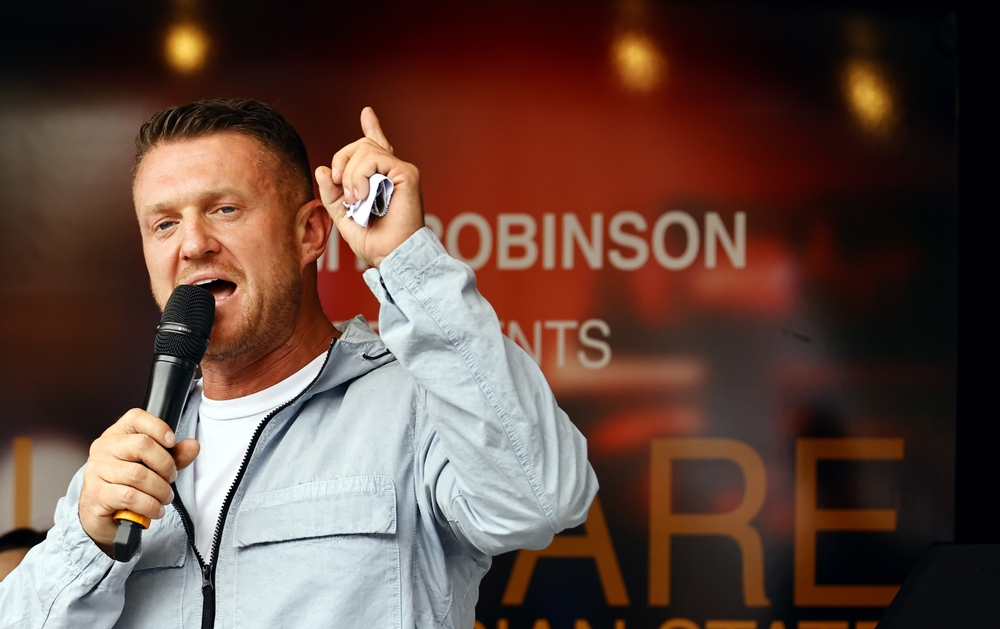
Earlier this year, Tommy Robinson (real name Stephen Yaxley-Lennon) undertook an extensive tour of the United States, appearing on podcasts, alternative media platforms, university events, and interviews with conservative activists, commentators, and politicians. The tour—in late February and early March—coincided with Robinson’s growing international profile and a broader convergence between British and American far-right movements.
His appearances have included meetings with US Department of State officials, members of Congress and politicians (e.g. Rep. Randy Fine, Texas AG Ken Paxton), conservative media figures, and activists associated with the MAGA movement (such as Alex Jones, Jack Posobiec, and Isabel Brown), while his own YouTube channel has documented a near-continuous series of interviews and political discussions across Washington D.C., Texas, Florida, and other locations.
This led to lucrative donations from various benefactors, including a first-time $200,000 donation from Tennessee-based Republican donor Andy Miller and a further $100,000 from businessman Robert Shillman, who had previously funded a fellowship that helped pay for Robinson’s employment at Rebel Media in 2017. It was the first time Robinson was allowed into the country after a previous ban imposed in 2013 for traveling on a friend’s passport and a delayed visa application in 2018.
The significance of the tour lies not simply in the legitimization and funding that Robinson received in the United States, but also in the master narratives and frames he has sought to export and reinforce during his time in the US. Across dozens of interviews and speeches, relatively consistent themes emerged around the defense of free speech, warnings about immigration and multiculturalism, criticism of Islam, distrust of political and media institutions, and the presentation of Britain as a cautionary tale for Americans. These themes place Robinson at the heart of a transnational far-right ecosystem that spans both sides of the Atlantic. Such themes also echo last year’s US National Security Strategy and Secretary of Defense Pete Hegseth’s more recent D-Day commemoration comments, which bemoan a form of ‘cultural erasure’ and ‘invasion’ happening in Europe.
Britain as a Warning
The most persistent theme throughout Robinson’s appearances was the portrayal of contemporary Britain as a failed model that the United States must avoid replicating. In interviews and speeches, he frequently framed the UK as suffering from excessive immigration, weakened national identity, and restrictions on free expression. His message to American audiences was often explicit: “Don’t become the UK.”
This framing serves two purposes. First, it positions Robinson as someone offering testimony from a society allegedly further along a trajectory of cultural decline. Second, it encourages American conservatives to view domestic political disputes through an international lens. Britain becomes less a nation-state than a political allegory—a future that Robinson argues Americans should prevent and avoid.
This rhetorical strategy mirrors a broader tendency within contemporary far-right politics to use foreign examples as warnings. Robinson invokes Britain as evidence of the dangers of unchecked immigration, multiculturalism, and political censorship—a fantasy that has been echoed and repeated during Trump’s second presidency.
Free Speech as a Master Narrative
A second major theme during Robinson’s latest US tour was concerns about freedom of expression. Robinson consistently presents himself as a victim of political persecution and institutional suppression. During his American tour, he repeatedly described legal battles, deplatforming, banking restrictions, and media criticism as evidence that Western governments are becoming hostile to dissenting voices.
The concept of ‘free speech’ functions here according to what political theorists describe as a “master narrative” – a framework capable of connecting many otherwise distinct grievances. Immigration concerns, criticism of Islam, opposition to hate speech legislation, and hostility toward mainstream media are all incorporated into a broader story about censorship and institutional control.
Importantly, Robinson’s framing often shifts the discussion away from the content of his claims and toward the right to make those claims—a discursive and rhetorical technique often used by far-right figures. Such claims of epistemic injustice are common among far-right figures, a powerful mobilizer that has been used in the past to furnish their free speech claims whilst also broadening their mainstream appeal.
Islam and Civilizational Conflict
A third recurring theme within Robinson’s latest US tour was his discussion of Islam. In interviews and videos, Robinson frequently presented Islam not simply as a religion but as a political or civilizational challenge to Western societies. Conversations with politicians and activists repeatedly focused on the threats of Sharia law, Islamism, and demographic change.
Such language often draws upon a civilizational framework in which Western values and Islamic influence are portrayed as fundamentally incompatible. Robinson and his supporters have long argued that he is criticizing political Islam and multiculturalism rather than Muslims as individuals. However, academic observers have contended that his rhetoric frequently blurs these distinctions and contributes to broader anti-Muslim sentiment. Indeed, these days, Robinson openly calls for mass deportations and explicitly names Muslims, not just Islam, as a threat.
Civilizational arguments have likewise become a key master frame of the modern far-right, linking fringe conspiracy theories to mainstream concerns about national sovereignty, public safety, and cultural endangerment. Islam becomes a symbol within this larger narrative about perceived civilizational decline – a contention that has aided conspiracy theories connected to key right-wing lone-actor terrorists internationally.
Internationalization of the British Far Right
Robinson’s tour further illustrates the increasingly transatlantic character of contemporary far-right extremism. Many of the figures appearing alongside him are American conservatives, media personalities, or activists who share concerns about immigration, national identity, and institutional distrust. The resulting network resembles less a collection of separate national movements than a shared political ecosystem, with conferences, speaking events, and national demonstrations serving as part of the cross-fertilization of narratives and frames, online and offline.
This transnational dimension—as demonstrated in the international program of speakers at Robinson’s Unite the Kingdom rallies—is particularly significant because far-right politics has often been understood as inherently nationalist. Yet Robinson’s American appearances reveal a paradox: nationalist actors increasingly collaborate across borders. Common themes, such as opposition to globalism, defense of national culture, and skepticism toward international institutions, create ideological connections that transcend national boundaries.
In this sense, Robinson’s U.S. tour functioned as a process of alliance-building among activists, media figures, donors, and politicians who view themselves as participating in a common struggle against what they perceive as ‘liberal elite consensus’ that wants to cover up the disastrous consequences of immigration and multiculturalism.
Anti-Establishment Politics and Institutional Distrust
Another prominent feature of Robinson’s discourse is distrust of institutions. Mainstream media, government agencies, academic institutions, and political parties were frequently portrayed as ‘dishonest’, ‘self-serving’, or ‘ideologically captured’. Throughout the tour, Robinson presented himself as an outsider, exposing truths that establishment actors allegedly conceal, building upon previous tactics used by the far-right.
This anti-establishment posture aligns with a broader populist distinction between “ordinary people” and “corrupt elites.” The appeal of such rhetoric lies partly in its simplicity. Complex social problems are explained through institutional failure or deliberate concealment rather than through structural or economic analysis.
Whether one agrees with Robinson’s conclusions or not, the effectiveness of this narrative should not be underestimated. It resonates with audiences who already possess low levels of trust in traditional media and political institutions.
Ironically, in the U.S. (and even parts of the UK), the political and media establishment has been captured by the radical right. Robinson’s tour was possible because his ban was lifted by a friendly administration, and a visit in which he was invited to the State Department and met with Republican politicians, a notion that would have been unthinkable five years ago.
Overall, Robinson’s recent American tour reveals more than the activities of a single activist. It highlights the emergence of a transatlantic political discourse and movement centered on free speech, immigration, national identity, and distrust of established institutions. Britain is presented as a warning, America as a battleground, and Western civilization as something perceived to be under threat.
Supporters interpret Robinson’s message as a necessary challenge to political orthodoxies surrounding immigration, multiculturalism, and free expression. Many see the same message as a vehicle for anti-Muslim sentiment, conspiracy thinking, and exclusionary nationalism. The debate surrounding Robinson therefore reflects larger conflicts shaping contemporary Western politics, as well as the normalization and mainstreaming of far-right politics more generally.
What is clear is that his American tour has strengthened connections between British and American far-right networks and demonstrated how political narratives now travel across borders with unprecedented speed. Whether these narratives continue to gain influence is perhaps by-the-by, but the real-world effects of these value claims are hard to ignore—with the racist pogroms and riots of Belfast acting as a cautionary tale.
(Dr William Allchorn is an Associate Professor of Criminology at Richmond, the American International University in London, and Senior Research Fellow at the International Policing and Public Protection Research Institute, Anglia Ruskin University. He is an expert on far-right extremist social movements in the UK, Western Europe, and globally.)