At the United Nations tribunal for Rwanda, a witness was asked how a radio station had turned ordinary listeners into killers. “What RTLM [Radio Télévision Libre des Mille Collines] did,” he said, “was almost to pour petrol, to spread petrol throughout the country little by little, so that one day it would be able to set fire to the whole country.”
That image became foundational to Susan Benesch’s Dangerous Speech Project. It has shaped how a generation of researchers thinks about the road from words to (mass) violence.
What was in the petrol turned out to be specific. In the years before the 1994 genocide, ordinary Hutu speech filled up with two words — inyenzi (cockroach) and inzoka (snake) — casually applied to Tutsi neighbors. By 1994, the same words were guiding killers to their victims. Each repetition, in a market, in a classroom, on the radio, added a thin layer of permission to a growing social reservoir: a license to treat the person so labeled the way one treats vermin.
Killing a neighbor, as the philosopher Lynne Tirrell has shown in her study of Rwanda’s genocidal speech, came to require almost nothing in the way of justification, because the surrounding community had already, implicitly, granted it.
The petrol was on the ground in San Diego long before the match was struck.
A Curriculum of Violence
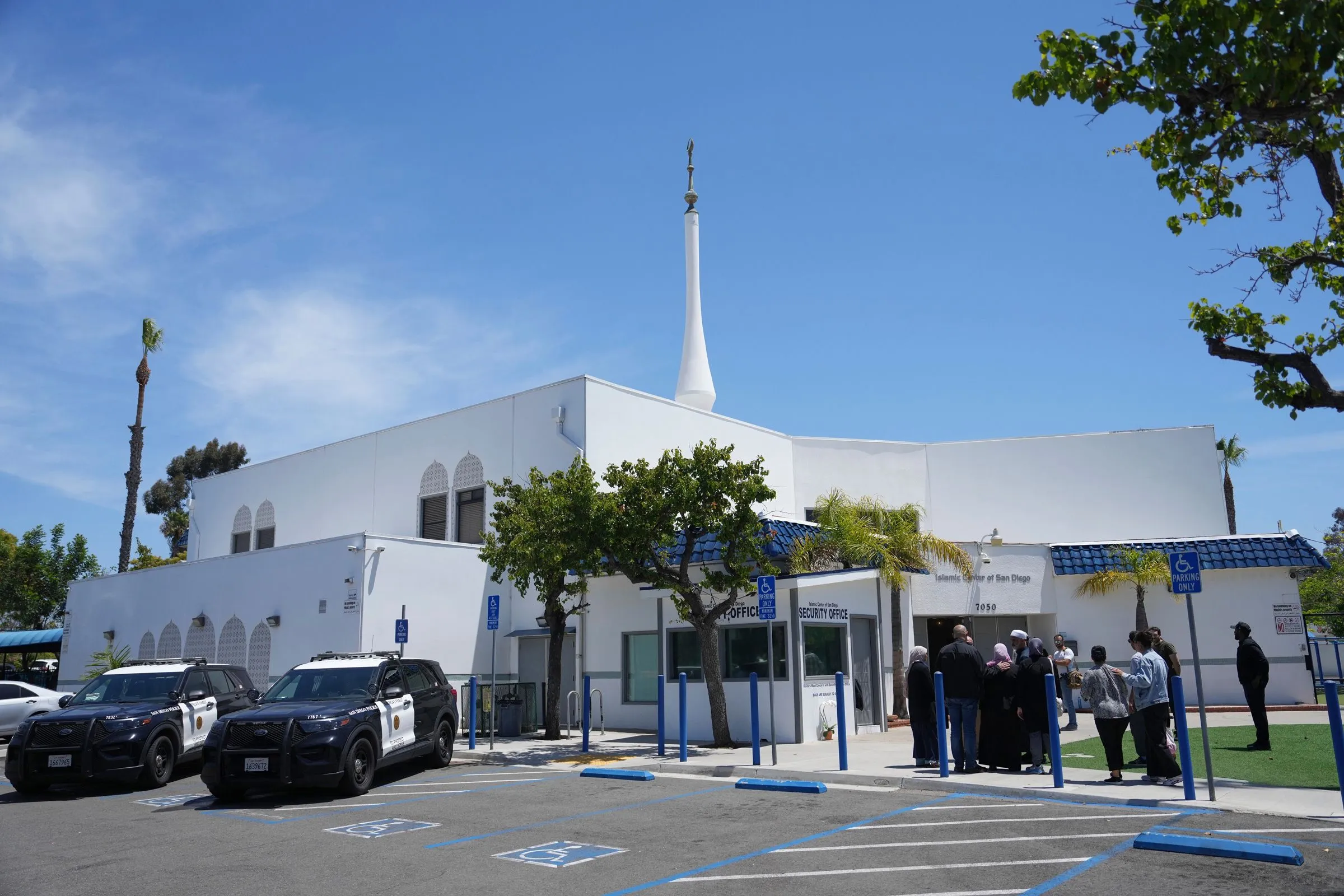
On Monday, 18 May, Caleb Vazquez, 18, and Cain Clark, 17, killed three men outside the Islamic Center of San Diego on Monday, May 18. The attack is being investigated as a hate crime. It follows a now-familiar pattern: two teenagers, radicalized online through anonymous messaging networks, leaving behind a 75-page manifesto titled The New Crusade: Sons of Tarrant, livestreaming the attack, wearing neo-Nazi insignia, including the Sonnenrad and the Atomwaffen Division logo.
Reports suggest that the manifesto is centered on white-supremacist accelerationism: the ideology calling for mass-casualty racist violence to hasten the collapse of liberal democracy and clear ground for a white ethno-state. The manifesto praised a lineage of mass killers such as Brenton Tarrant, the Christchurch mosque shooter, the 2018 Tree of Life synagogue killer, the 2019 Poway Chabad shooter, and the 2022 Buffalo supermarket attacker, as “heroes and inspirations.” In accelerationist circles, Tarrant has been canonized in quasi-religious iconography as “Saint Tarrant”, the figure understood to have kick-started the current wave.
This is what researchers call a curriculum of violence. Each attack is engineered to inspire the next. Manifestos lift passages from earlier manifestos. Weapons are inscribed with references to prior killers and to centuries-old battles between Christianity and Islam. The killers livestream so the footage can be clipped, memed, and folded into the “saint culture” that recruits the next teenager. Ideology in this ecosystem is not a worldview that occasionally erupts into action. It is a transmission system whose purpose is to produce violent action.
Different Targets, Same Playbook
The manifesto’s accelerationist core is wrapped in several other ideologies, each carried by its own vocabulary. Jewish people are described as “the universal enemy.” Muslims are “invaders” who “must be isolated and exterminated.” Black people are “subhumans.” LGBTQ+ people “deserve to be hung or forced into a labor camp.” Women are called “foids,” a contraction of “female” and “humanoid,” and described as “the most evil creature[s] in this world, second only to Jews.” Elliot Rodger, the 2014 Isla Vista killer, is revered as “Saint Elliot.”
The temptation after an attack like this is to triage the hatreds and debate which one mattered most. The harder question is what these vocabularies have in common, and how each of them does the work inyenzi did: moving from words to crime.
A growing body of scholarship argues that harmful speech does not merely express prejudice. It assigns social roles and reshapes social norms.
Even without formal authority, a speaker can enact oppressive norms. When the words align with broader rules of oppression already at work in society, the philosopher Mary Kate McGowan has argued, the act of speaking covertly imports those social norms into the immediate conversational context and applies them to the target there and then. The damage is done by the time the words leave the speaker’s mouth. This is why hate speech is rarely undone by counterargument — a point that scholars such as Katharine Gelber and Molly Murphy develop at length in their recent survey of the harms of hate speech. What looks like an opinion functions as an act of subordination.
Role-Assignment Mechanism
Look closely at a single slur (or exclusionary speech more generally). To call a Muslim worshipper an “invader” is to force them, in front of any listening audience, into the role of someone whose presence is illegitimate, whose claims on the community can be dismissed, and against whom defensive action is permitted. The speaker, in the same breath, takes the dominant role: the one with the standing to make the assignment stick. This is the role-assignment account developed by the philosophers Mihaela Popa-Wyatt and Jeremy Wyatt, and it explains something that pure psychology cannot: why a single word, repeated, can change the social standing of the person it names.
To call a woman a “foid” is to position her as something less than human, against whom further actions become thinkable and silencing her. Done once, in a Discord channel, this is petty cruelty. Done a million times, across platforms that reward and escalate dehumanizing speech, it becomes petrol.
That connection still does not register in most American institutions. Reports from The Washington Post and the Center for the Study of Organized Hate (CSOH) have documented that sitting U.S. senators saying “Islamists are the enemy;” sitting House members writing that “Muslims don’t belong in American society;” one congressman declaring that “we need more Islamophobia, not less.” Senator Tommy Tuberville has used the line “the enemy is inside the gates” in reference to the New York City mayor, Zohran Mamdani.
These statements fall short of legal incitement. They are not the same as a manifesto. But they are dangerous speech in Benesch’s sense, and they perform exactly the role-assignment that “invader” performs in a Discord channel, with the added weight of elected authority behind every repetition. The teenagers who killed Amin Abdullah, Mansour Kaziha, and Nadir Awad did not invent the framing in which Muslim worshippers are an existential threat to the American body politic. They inherited it.
Of the ideologies tangled in the manifesto, the incel strand has been most quickly waved away. This is a mistake. Properly understood, misogyny is a structural feature of this attack, not background noise.
Properly understood, misogyny is the enforcement arm of patriarchy: directed, as the philosopher Kate Manne argues in her book Down Girl, at women who refuse, reject, leave, lead, or otherwise step out of line, rather than at all women as a class. The incel taxonomy of “Stacys,” “Beckys,” and “foids” is exactly this logic of sorting: who deserves to be put back down and how hard. That vocabulary runs in a straight line to Alek Minassian, who killed ten people in Toronto in 2018 in Rodger’s name, and from there to the parking lot of the Islamic Center of San Diego.
For many young men, misogyny is the gateway grammar through which the rest of the ideology becomes legible. The ideological architecture is the same throughout — collective grievance, dehumanizing taxonomy, glorification of past killers — applied to different categories of victims. Misogyny is the schooling, not the prelude.
Britain has seen its own sharp rise in religious and racial hate crime: a 19 percent jump in anti-Muslim offences in the year to March 2025, fueled by far-right violence after the Southport murders; antisemitic offences at the highest level since records began; a synagogue attack in Manchester on Yom Kippur 2025 that killed two Jewish men; mosques targeted in suspected arson. The same vocabulary circulates in the same online forums. The same accelerationist saints sit at the top of the same recruitment pyramid. Hate crime data, in both countries, lags behind the rhetorical environment it tracks by years.
Treating the San Diego attack as a hate crime is necessary but not sufficient. The hate-crime framing tells us what happened in the parking lot. It does not address the reservoir of dehumanizing language that filled up beneath these teenagers for years before they got there. It does not address the platforms that hosted The New Crusade. It does not address the casualness with which Islamophobic, antisemitic, and misogynistic dehumanization is now spoken in public life, by senators, by influencers with millions of followers, and by teenagers taking the ideology onto the streets. They are all pouring petrol on the same floor, creating an environment in which violence sits not only in the words, but in what the words make permissible.
Three families in San Diego have buried their dead. Amin Abdullah, the security guard whose lockdown call saved more than a hundred children. Mansour Kaziha, the mosque’s handyman of nearly forty years. Nadir Awad, who ran toward the gunfire from across the street. They deserve a response equal to what was actually done to them — one that treats the words and the ideology that preceded the violence as part of the violence.
(Mihaela Popa-Wyatt is Senior Lecturer in Philosophy at the University of Manchester. Her work spans philosophy of language, social and political philosophy, with a focus on how speech causes social harm and how those harms can be mitigated without sacrificing free expression. Her current policy work develops a polluter-pays regulatory framework for platform amplification.)