WASHINGTON, D.C. (June 15, 2026) — The world’s largest digital platforms and music streaming services are hosting, amplifying, and financially rewarding a growing genre of Indian music that dehumanizes and incites violence against Muslims and Christians, according to a new report published today by the Center for the Study of Organized Hate (CSOH).
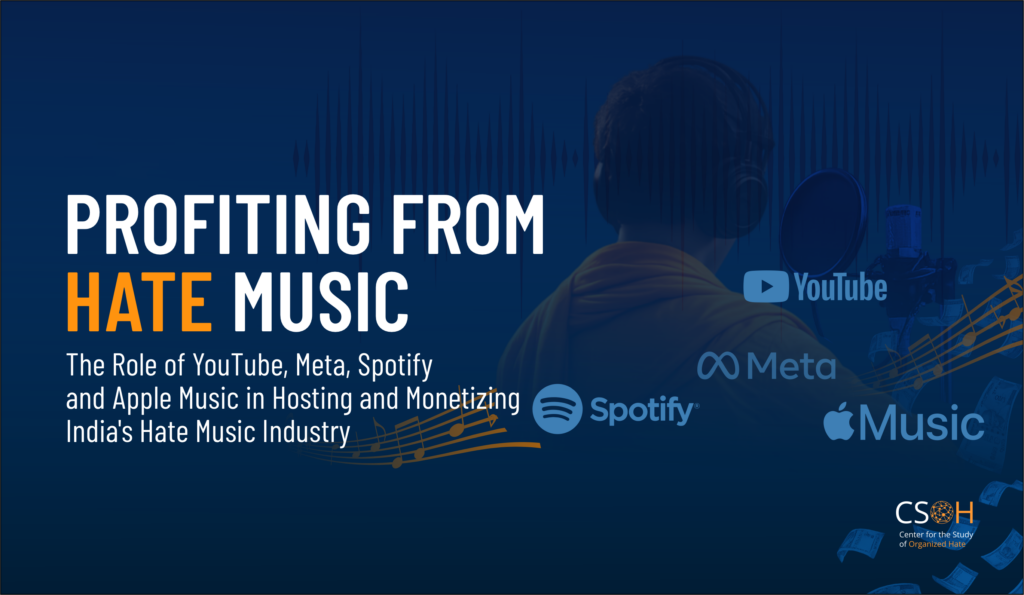
Profiting from Hate Music: The Role of YouTube, Meta, Spotify and Apple Music in Hosting and Monetizing India’s Hate Music Industry is the first comprehensive mapping of the country’s hate music industry and of the role major technology companies play in sustaining and funding it.
Drawing on a database compiled between January 2025 and January 2026, the report identifies 523 Hindutva pop (H-Pop) hate songs that violate the platforms’ own content policies. On YouTube alone, these songs have been viewed more than 198 million times; on Meta, they have been used in more than 5.9 million Instagram Reels. One in two of the songs explicitly incites violence against religious minorities.
In India, H-Pop hate songs played during religious processions and rallies have already been linked to deadly communal violence.
The report found that platforms have built multiple overlapping ways to profit from hate music, both profiting from it directly and paying the artists who produce it. On YouTube, we documented advertisements from 103 brands and services, including OpenAI, Google, Amazon Prime, Adobe, Canva, Dell, Motorola and Levi’s running on hate music videos, appearing on 83 percent of those that explicitly call for violence. On Meta, 20 of 30 prominent Hindutva pop singers studied had monetized Facebook accounts.
“Hate music is one of the oldest and most dangerous instruments of mass violence, and we have seen where it leads, from Rwanda to Myanmar,” said Raqib Naik, Executive Director of CSOH.
“What makes India’s Hindutva pop so alarming is its reach. These companies and platforms, most of them based in the United States, have handed these artists a global stage, an audience of hundreds of millions, and the tools and revenue streams to keep producing more,” Naik added.
“Hindutva pop music has emerged as one of the most potent methods of radicalizing Indians and stoking hate and violence against religious minorities in India, by combining catchy beats with vitriolic lyrics,” said Kunal Purohit, independent journalist and co-author of the report. “Through this report, we have been able to demonstrate what was long suspected: while American social media platforms have been censoring content even remotely critical of the ruling Modi government, they have simultaneously amplified, patronized, and funded content that calls for violence against Muslims and Christians in India,” he added.
Purohit is also the author of the book ‘H-Pop: The Secretive World of Hindutva Pop Stars’, published by HarperCollins in November 2023.
“These platforms have built a business model where hatred pays both for the artists who produce it and for the companies that host it. Monetization is one of the engines of this growing industry,” said Tavishi, South Asia Researcher at CSOH and a co-author of the report.
The report closes with a set of recommendations directed at YouTube, Meta, Spotify, and Apple Music, outlining concrete steps the platforms can take to enforce their own policies and curb the spread and monetization of hate music. It also calls on advertisers and regulators to play a role in holding the platforms accountable.
The full report is available for download here.
For media inquiries or to request interviews with the report authors, please contact: [email protected]