How content farms monetize Islamophobia and anti-migrant hate for export to the UK, Europe, and North America
The growing role of AI-generated content, deepfakes, and platform monetization in amplifying far-right rhetoric, Islamophobia, and anti-migrant narratives, produced across South Asia and exported to the UK, Europe, North America, and beyond, poses a new threat.
Recent investigations have exposed how online hate is increasingly being produced not only by ideologically motivated actors, but also by commercially driven networks seeking to profit from outrage, polarisation, and platform engagement. A study by the Institute for Strategic Dialogue (ISD) identified a Sri Lanka-based network of more than 100 Facebook pages and groups spreading anti-migrant and anti-government content to UK audiences. The network reached a combined audience of around 1.6 million users, with some posts receiving millions of views containing AI-generated content, false claims, and hateful narratives targeting migrants.
This phenomenon is not limited to Sri Lanka. Recent reporting by the Bureau of Investigative Journalism (TBIJ) found that a content creator in Pakistan was earning money from AI-generated Islamophobic content aimed at UK audiences. The investigation highlighted how AI tools, platform monetization systems, and low barriers to entry now enable individuals to create and circulate inflammatory content at scale, even when they may have little understanding of the political or social context of the material they post.
This panel will examine how low levels of digital literacy, existing demand for anti-Muslim and anti-migrant narratives, and limited economic opportunities for youth create conditions in which far-right networks, content farms, and individual creators can be incentivized to produce and circulate harmful content. The event will also consider how platforms such as YouTube, Facebook, Instagram, TikTok, and X enable the monetization of hateful, inflammatory, or AI-generated harmful content, especially originating from South Asia. The session will also discuss how platform policies and designs that facilitate the monetization and amplification of disinformation targeting migrant and vulnerable communities in the EU and the UK pose systemic risks under the Digital Services Act (DSA) and the Online Safety Act (OSA).
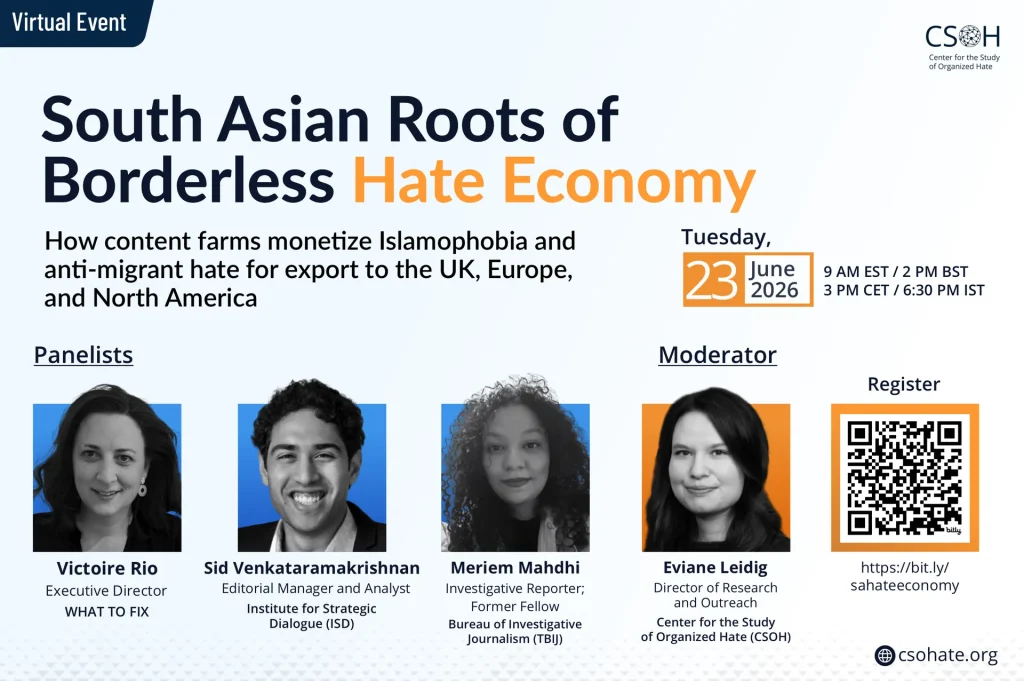
Panelists
Victoire Rio
Victoire Rio is the founder and executive director of WHAT TO FIX, a tech policy and accountability nonprofit, and a leading expert on social media monetization and its impact on information integrity. Prior to founding WHAT TO FIX to address systemic risks associated with social media, Victoire spent 8 years leading tech accountability efforts in Myanmar, where she co-founded and led the Myanmar Tech Accountability Network.
Sid Venkataramakrishnan
Sid Venkataramakrishnan is an analyst and editorial manager at the Institute for Strategic Dialogue (ISD); his role includes both overseeing the quality across both public and confidential outputs, and analysing a range of topics including anti-South Asian hate, misinformation related to the financial system and anti-migrant discourse.
Meriem Mahdhi
Meriem Mahdhi is a Tunisian investigative reporter specialising in tech, disinformation and online abuse. She was an Aziz fellow at The Bureau of Investigative Journalism, where she contributed to reporting that uncovered the network of Sri Lanka-based Facebook pages spreading anti-migrant and anti-government content to UK audiences. She has worked in the private sector as a digital analyst and OSINT investigator looking into state-led influence operations.
Moderator
Eviane Leidig
Dr. Eviane Leidig is Director of Research and Outreach at the Center for the Study of Organized Hate (CSOH). She leads CSOH’s research projects and coalition building efforts to combat hate, extremism, and digital harms. Eviane is an expert on online radicalization, extremism, threats to democracy, and platform governance and regulation.