Governments across Southeast Asia increasingly recognize the need to strengthen protections for children online as the nature of digital harm continues to evolve. The risks children face form an interconnected spectrum including harm to mental health and wellbeing, driven in part by addictive, attention-grabbing design, along with eating disorder content, cyberbullying, sexual exploitation and abuse, exposure to harmful or age-inappropriate material, the ‘manosphere’ and gendered radicalization, violent extremism, and a newer set of harms tied to AI, from companion chatbots to AI-generated abuse material.
Regulators have started to act. Indonesia enforced Government Regulation No. 17 of 2025 on Electronic System Governance for Child Protection (PP TUNAS) in March 2026. Malaysia’s Child Protection Code (CPC) and Risk Mitigation Code (RMC), issued under the Online Safety Act 2025, took effect in June 2026.
Together, these measures signal a move away from reactive content moderation and toward regulating how children access platforms in the first place. That move raises a central question. Do these rules actually reduce children’s exposure to the full range of harms, or do they mainly control who gets in while leaving the design of what happens inside largely unchanged?
Recent cases make the question harder to set aside. In Indonesia, minors radicalized through online extremist communities have been drawn into real-world violence, including two school bombings, one in November 2025 and the most recent in July 2026, carried out by teenagers who learned bomb-making online. In the Philippines, two students aged 14 and 15 carried out a fatal school shooting in June 2026 that has been linked to the online nihilistic violent extremist communities.
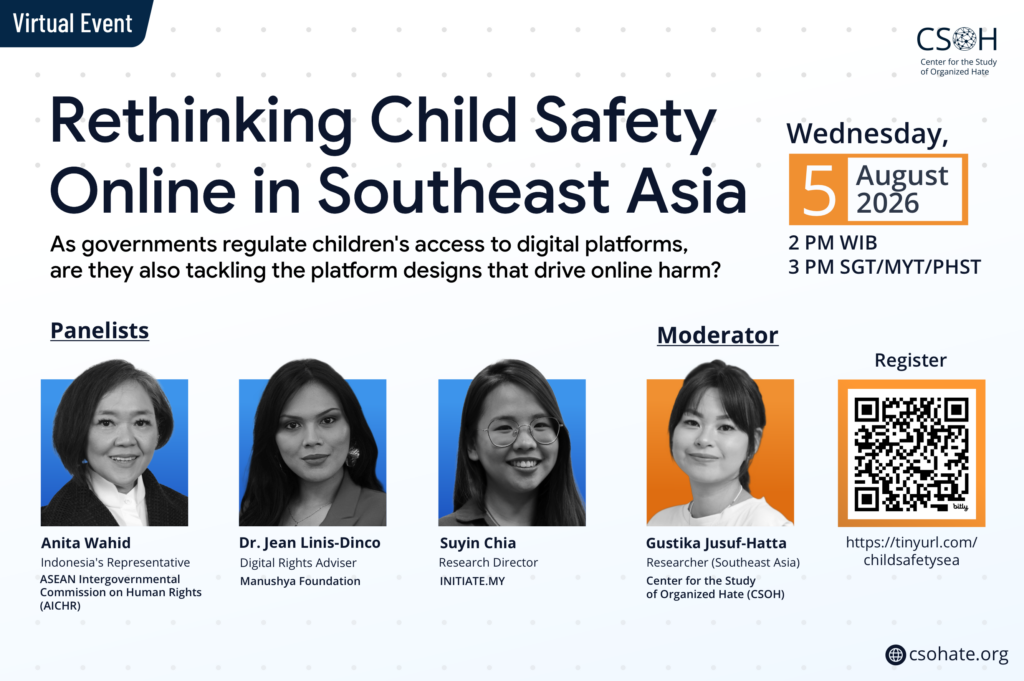
This event brings together experts from across the region to examine whether Southeast Asia’s emerging child safety regulations address the underlying mechanisms shaping children’s online experiences or mainly regulate access. Governments are increasingly regulating who can access digital platforms, but the harder question is whether they are doing enough to regulate how those platforms and their products expose children to harm.
Panelists
Anita Wahid
Anita Ashvini Wahid is Indonesia’s Representative to the ASEAN Intergovernmental Commission on Human Rights (AICHR) for the 2025–2027 term. She is currently a PhD candidate at the Australian National University, where her research focuses on the weaponization of disinformation during Indonesia’s 2024 elections. Anita holds a BA in International Relations from the University of Indonesia and an MA in Development Management from Ruhr-Universität Bochum, Germany. Prior to her doctoral research, she worked extensively on democracy and human rights issues, including anti-corruption, religious tolerance, and digital democracy. She continues to serve on the advisory and supervisory boards of several NGOs and is a member of TikTok’s Safety and Security Advisory Council representing Indonesia.
Jean Linis-Dinco
Dr. Jean Linis-Dinco is Digital Rights Adviser at Manushya Foundation and an activist-researcher working at the intersection of technology and human rights. She completed her PhD in Cybersecurity at the University of New South Wales (UNSW), where her dissertation focused on the analysis of propaganda and hate speech targeting Rohingya communities. Her work centres on digital rights, online harms, and the impact of technology on vulnerable communities.
Suyin Chia
Suyin Chia is Research Director at INITIATE.MY, where she leads research on online hate speech, far-right extremism, and the societal impacts of technology and AI, with a focus on Malaysia and Southeast Asia. Her work examines how digital platforms and algorithmic systems shape political discourse, deepen social fragmentation and radicalisation, and erode public trust in democratic institutions. Alongside her research, Suyin leads humanitarian innovative finance initiatives at the International Federation of Red Cross and Red Crescent Societies (IFRC), leveraging private sector partnerships and capital markets to support humanitarian response and anticipatory action. She also serves as Director of the Humanitarian Finance Forum, convening cross-sector collaborations to finance resilience at scale. Suyin holds a Master’s degree in Terrorism, Security and Society from King’s College London.
Moderator
Gustika Jusuf-Hatta
Gustika Jusuf-Hatta is a Researcher at the Center for the Study of Organized Hate (CSOH), where she focuses on digital harms and extremism across Southeast Asia. Her research examines online hate, disinformation, and the ways digital platforms shape conflict, security, and human rights in the region. She has worked extensively on issues including security sector governance, digital safety, and the spread of anti-Rohingya narratives across online platforms, combining policy analysis with human rights advocacy.