Hate speech and polarization feed off each other, and together they pose one of the most pressing challenges facing democracies today. The harder question is what to do about it.
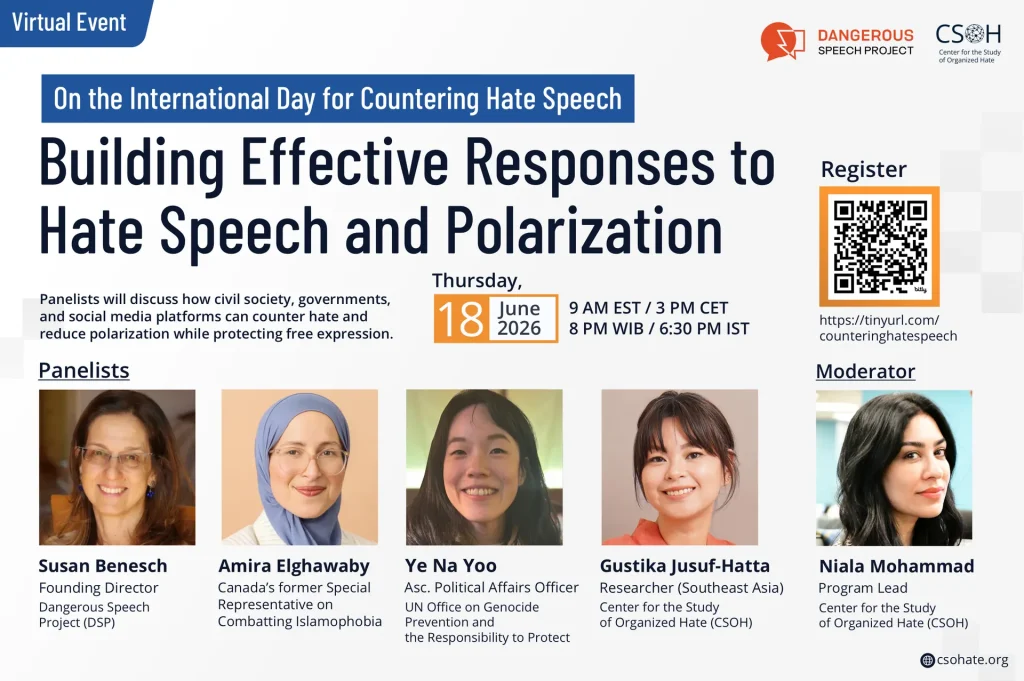
For the International Day for Countering Hate Speech, the Center for the Study of Organized Hate (CSOH) is hosting a virtual panel focused squarely on responses. Bringing together experts from different regions, the conversation will examine the strategies, policies, and grassroots efforts that have made a real difference.
Drawing on their work across varied political and cultural settings, panelists will discuss how civil society, governments, and social media platforms can counter hate and reduce polarization while protecting free expression.
Panelists
Amira Elghawaby
Amira Elghawaby, journalist and human rights advocate, served as Canada’s first ever Special Representative on Combating Islamophobia between 2023 to 2026. During her historic tenure, Ms. Elghawaby provided strategic advice to the Government of Canada on legislation, policies, and programs impacting Canadian Muslim communities. She also worked closely with federal departments to address issues related to online hate, anti- racism, discrimination and community safety.
Additionally, Ms. Elghawaby worked to raise public awareness on the challenges Islamophobia poses to Canada’s shared values, championing human rights, freedom of religion and inclusion on national and global platforms, including at the United Nations. In spring 2025, her Office published The Canadian Guide to Understanding and Combating Islamophobia, the first of its kind to be launched by a national government.
Prior to Ms. Elghawaby’s role, she was a contributing columnist at the Toronto Star and held roles in strategic communications and human rights at various national organizations, including at the Canadian Race Relations Foundation, at the National Council of Canadian Muslims, and in Canada’s labour movement.
Ms. Elghawaby is a founding board member of the Canadian Anti-Hate Network and has served two terms as a Commissioner on the Public Policy Forum’s Canadian Commission on Democratic Expression.
Ms. Elghawaby was awarded the King Charles Coronation Medal as well as the Jack Layton Progress Prize for her leadership.
Ye Na Yoo
Ye Na Yoo is Asc. Political Affairs Officer at UN Office on Genocide Prevention and the Responsibility to Protect. Her work focuses on early warning and risk assessment, as well as the responsibility to protect, and countering and addressing hate speech.
Susan Benesch
Susan Benesch founded and directs the Dangerous Speech Project, an independent research team that focuses on rhetoric that can inspire violence – and on ways to prevent this without infringing on freedom of expression. To that end, she studies methods to diminish harmful speech online or the harm itself.
She also critiques and advises technology companies to improve content moderation and user behavior. Trained as an international human rights lawyer at Yale, Susan has worked as a refugee lawyer and advocate, publishes widely, and has taught and lectured at universities in many countries.
She is an adjunct professor at American University and a Faculty Associate of the Berkman Klein Center for Internet & Society at Harvard University.
Gustika Jusuf-Hatta
Gustika Jusuf-Hatta is a Researcher at the Center for the Study of Organized Hate (CSOH), focusing on digital extremism and online harms across Southeast Asia. Before joining CSOH, Gustika built expertise across policy and civil society institutions.
At the ASEAN Secretariat, she served as a Security Cooperation Officer working on regional security cooperation, including ICTs security, counter-terrorism, and transnational crime. Prior to that, Gustika served as a Researcher at Imparsial (the Indonesian Human Rights Monitor), where she conducted research on security sector reform and governance (SSR/G) and militarisation.
She also led and supported human rights monitoring and advocacy efforts, and delivered digital safety trainings for civil society actors. As a Research Consultant for the Asia Justice Coalition, she analysed how anti-Rohingya narratives spread across digital platforms and shape policy discourse in Indonesia and Malaysia in relation to the pursuit of international justice.
Moderator
Niala Mohammad
Niala Mohammad serves as Program Lead (North America) on Islamophobia and anti-migrant hate at the Center for the Study of Organized Hate (CSOH). She previously served as Senior Policy Analyst for South Asia at the U.S. Commission on International Religious Freedom (USCIRF) and as Director of Policy and Strategy at the Muslim Public Affairs Council (MPAC).
Prior to her policy work, Niala spent more than 14 years as a multimedia broadcast journalist with Voice of America, where she covered South Asia and produced in-depth reporting on politics, human rights, and regional affairs.