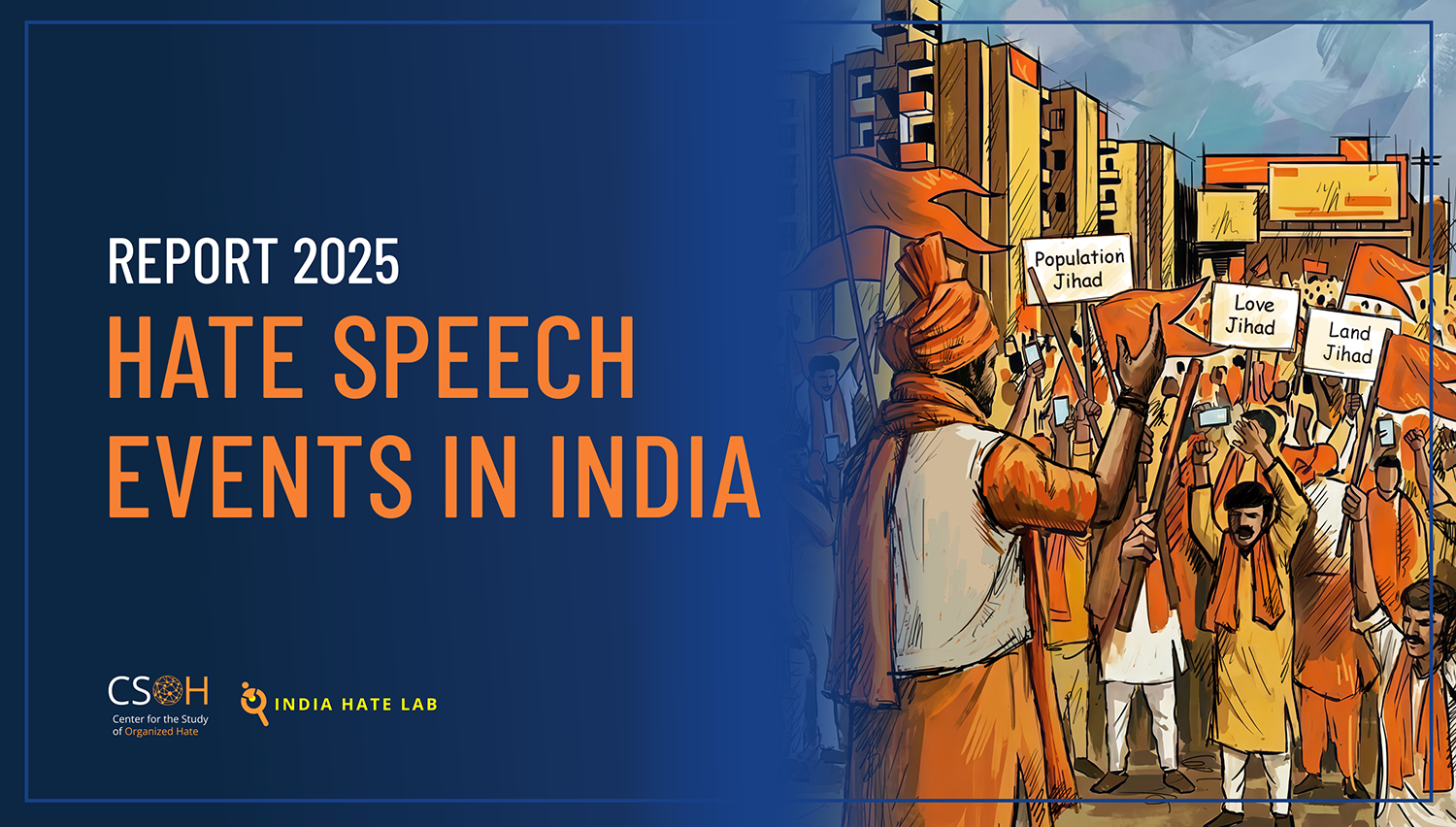
Washington, D.C. (January 13, 2026) – The India Hate Lab (IHL), a project of the Center for the Study of Organized Hate (CSOH), has released its 2025 annual report documenting 1,318 in-person hate speech events targeting religious minorities, primarily Muslims and Christians, across 21 states, one Union Territory, and the National Capital Territory (NCT) of Delhi in 2025. This represents a 13% increase from 2024, and 97% increase from 2023, when 668 such incidents were recorded.
The hate speech events were classified under the United Nations definition of hate speech and encompassed conspiracy theories, calls for violence and arms, appeals for social or economic boycotts, demands to seize or destroy places of worship, dehumanizing language, and speeches targeting Rohingya refugees living in India.
A total of 1,289 speeches, or 98 percent, targeted Muslims, either explicitly in 1,156 cases or alongside Christians in 133 cases, marking a nearly 12 percent increase from 2024. Hate speech targeting Christians was recorded in 162 incidents, accounting for 12 percent of all events, either explicitly in 29 cases or alongside Muslims in 133 cases. This reflects a 41 percent increase from the 115 anti-Christian hate speech incidents documented in 2024.
Approximately 88 percent (1,164) of all hate speech incidents occurred in BJP-ruled states, BJP-led National Democratic Alliance coalition states, and BJP-administered Union Territories. This marks a 25 percent increase from the 931 incidents recorded across these jurisdictions in 2024, underscoring the overwhelming concentration of anti-minority hate speech in regions under BJP control.
Across the 23 states and Union Territories analyzed, the BJP held power, either independently or as part of a coalition, in 16 jurisdictions for most of the year. Uttar Pradesh (266), Maharashtra (193), Madhya Pradesh (172), Uttarakhand (155), and Delhi (76) recorded the highest number of hate speech events, together accounting for 65 percent of all incidents nationwide.
By contrast, the seven states governed by opposition parties or coalitions recorded 154 hate speech events in 2025, a 34 percent decrease from the 234 incidents documented in these states in 2024.
The Vishwa Hindu Parishad (VHP) and Bajrang Dal emerged as the most frequent organizers, linked to 289 hate speech events (22 percent), followed by the Antarrashtriya Hindu Parishad (AHP) with 138 events. In total, more than 160 organizations and informal groups were identified as organizers or co-organizers of hate speech events in 2025.
Uttarakhand Chief Minister Pushkar Singh Dhami emerged as the most prolific hate speech actor with 71 speeches, followed by Antarrashtriya Hindu Parishad chief Pravin Togadia (46) and BJP leader Ashwini Upadhyay (35). Hindu monks and religious leaders were involved in 145 hate speech incidents, a 27 percent increase from 2024, continuing to provide religious legitimacy to anti-minority rhetoric.
Nearly half of all hate speeches documented in 2025 (656 incidents) invoked conspiracy theories such as “love jihad,” “land jihad,” and “population jihad,” representing a 13 percent increase from the previous year. At the same time, 308 speeches included explicit calls for violence, with 136 directly calling for arms, reflecting a 19 percent rise in violent rhetoric.
Maharashtra recorded the highest number of dangerous speeches, with 78 incidents, nearly 40 percent of which contained calls for violence, the highest proportion recorded for any state. The year also saw 120 speeches urging boycotts of minority communities, primarily Muslims, and 276 speeches calling for the removal or destruction of mosques, shrines, and churches. The Gyanvapi Mosque and Shahi Idgah Mosque in Uttar Pradesh were the most frequently targeted, signaling potential on-ground mobilization.
Dehumanizing language appeared in 141 speeches, with minorities described using terms such as “termites,” “parasites,” “insects,” “pigs,” “mad dogs,” “snakelings,” “green snakes,” and “bloodthirsty zombies.”
Videos from 1,278 of the 1,318 hate speech events were first shared or live-streamed on social media platforms. Facebook accounted for 942 first uploads, followed by YouTube (246), Instagram (67), and X (23), highlighting the central role of social media in amplifying hate speech.
“The data show that while domestic and international events continued to trigger episodic spikes in hate speech, the more striking trend was the persistence of an elevated baseline throughout the year,” said Dr. Eviane Leidig, Director of Research at the Center for the Study of Organized Hate. “Unlike previous years, where hate speech tapered off outside election cycles, 2025 saw sustained mobilization even during non-election periods, pointing to a strategic shift rather than reactive mobilization alone.”
“The BJP’s election-period strategy of overt communal polarization failed to deliver the decisive mandate it anticipated in 2024, leading to a shift in approach rather than an abandonment of that strategy,” said Raqib Hameed Naik, Executive Director of the CSOH. “Our data show a move toward sustained, decentralized, ground-level mobilization by Hindu nationalist groups within the RSS-led ecosystem, using rallies, religious events, and local processions to keep anti-Muslim fear and hostility active in everyday political life. This points to a long-term strategy aimed at shaping the political landscape ahead of upcoming state elections and the 2029 general elections.”
For press inquiries, interviews, or further information, please contact: [email protected]