Following the shooting of two National Guardsmen in Washington, D.C., on November 26, the Center for the Study of Organized Hate (CSOH) observed a sharp surge in online hate and threats targeting Afghans. Between November 26 and December 3, we recorded 8,785 posts across X (formerly Twitter), Facebook, and Instagram containing explicit anti-Afghan hate. Many of these posts were pushed by accounts with millions of followers and were reshared by tens of thousands of users.
The temporal distribution of this data shows a clear pattern of opportunistic mobilization. The volume of hate reached a peak on November 27, less than 24 hours after the incident.
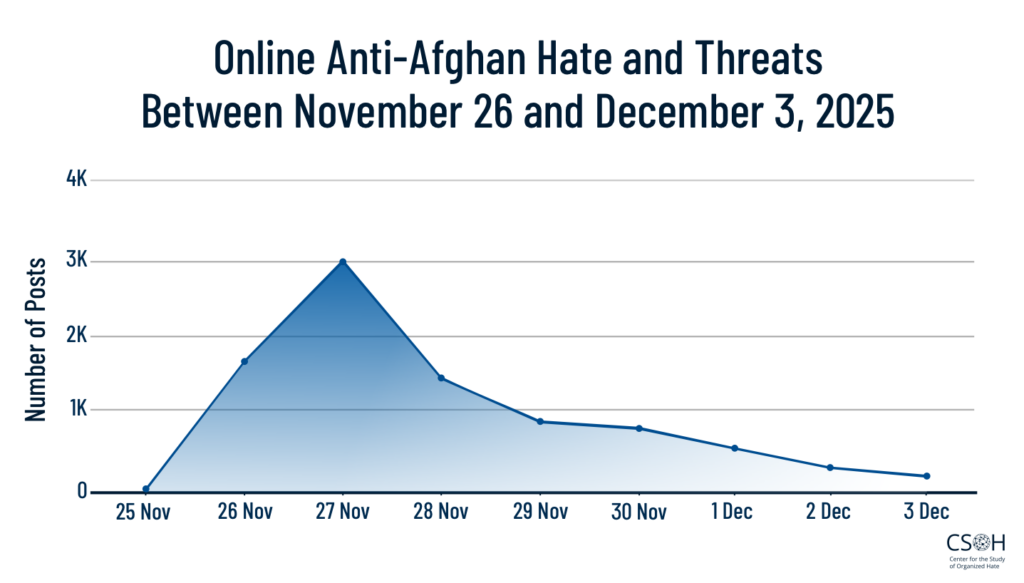
This immediate spike underscores a calculated strategy by extremist actors to exploit the shooting, projecting the actions of a single individual onto the entire Afghan population while simultaneously widening their aperture of xenophobic attacks to the broader Muslim and immigrant communities.
Across platforms, the dominant narrative reframed all Afghans as “terrorists,” “invaders,” and “illegals.” The majority of the analyzed posts advocated for mass deportations and the denaturalization of Afghans, operating at the dangerous intersection of nativist anti-Afghan sentiment and broader Islamophobia.
While the absolute volume of posts has receded from the acute peak observed on November 27, the data indicates a lasting impact. We continue to observe a sustained, elevated baseline of hateful rhetoric, suggesting that this event has successfully normalized a higher intensity of hate against Afghans in the U.S. digital sphere. We are closely monitoring this online hate and threats with our partners at the Afghan American Foundation (AAF) to assess potential risks of offline harm.
If you have witnessed or experienced anti-Afghan hate (online or offline), we encourage you to file a report with our partners at the Stop AAPI Hate Reporting Center. Reports can include harassment, discrimination, threats, property damage, racial profiling, and physical violence.